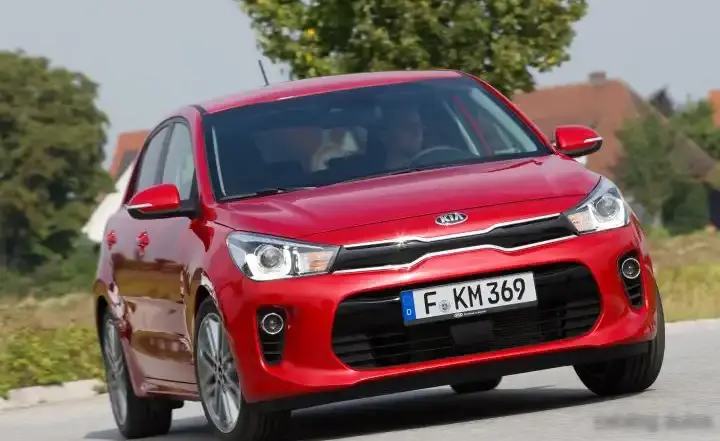
The Kia Rio IV Hatchback (YB) 1.4 MPI, producing 100 horsepower, was a key variant in Kia’s fourth-generation Rio lineup, manufactured from February 2017 to June 2019. Positioned as an entry-level to mid-range offering, this model aimed to provide affordable and efficient transportation within the highly competitive subcompact hatchback segment. It served as a crucial stepping stone for Kia in expanding its presence in the European and global markets, offering a practical and well-equipped vehicle at a competitive price point. The YB Rio represented a significant step forward in terms of design, build quality, and technology compared to its predecessors.
Technical Specifications
| Brand | Kia |
| Model | Rio |
| Generation | Rio IV Hatchback (YB) |
| Type (Engine) | 1.4 MPI (100 Hp) |
| Start of production | February, 2017 |
| End of production | June, 2019 |
| Powertrain Architecture | Internal Combustion engine |
| Body type | Hatchback |
| Seats | 5 |
| Doors | 5 |
| Fuel consumption (combined) | 5 l/100 km (47 US mpg, 56.5 UK mpg, 20 km/l) |
| CO2 emissions | 114 g/km |
| Fuel Type | Petrol (Gasoline) |
| Acceleration 0 – 100 km/h | 12.2 sec |
| Acceleration 0 – 62 mph | 12.2 sec |
| Acceleration 0 – 60 mph | 11.6 sec |
| Maximum speed | 176 km/h (109.36 mph) |
| Emission standard | Euro 6 b |
| Weight-to-power ratio | 11.3 kg/Hp, 88.5 Hp/tonne |
| Weight-to-torque ratio | 8.5 kg/Nm, 117.7 Nm/tonne |
| Power | 100 Hp @ 6000 rpm |
| Power per litre | 73.1 Hp/l |
| Torque | 133 Nm @ 4000 rpm (98.1 lb.-ft. @ 4000 rpm) |
| Engine layout | Front, Transverse |
| Engine Model/Code | Kappa / G4LC |
| Engine displacement | 1368 cm3 (83.48 cu. in.) |
| Number of cylinders | 4 |
| Engine configuration | Inline |
| Cylinder Bore | 72 mm (2.83 in.) |
| Piston Stroke | 84 mm (3.31 in.) |
| Compression ratio | 10.5:1 |
| Number of valves per cylinder | 4 |
| Fuel injection system | Multi-port manifold injection |
| Engine aspiration | Naturally aspirated engine |
| Engine oil capacity | 3.5 l (3.7 US qt | 3.08 UK qt) |
| Coolant | 5.1 l (5.39 US qt | 4.49 UK qt) |
| Kerb Weight | 1130 kg (2491.22 lbs.) |
| Max. weight | 1580 kg (3483.3 lbs.) |
| Max load | 450 kg (992.08 lbs.) |
| Trunk (boot) space – minimum | 325 l (11.48 cu. ft.) |
| Trunk (boot) space – maximum | 980 l (34.61 cu. ft.) |
| Fuel tank capacity | 45 l (11.89 US gal | 9.9 UK gal) |
| Permitted trailer load with brakes (12%) | 1000 kg (2204.62 lbs.) |
| Permitted trailer load without brakes | 450 kg (992.08 lbs.) |
| Length | 4065 mm (160.04 in.) |
| Width | 1725 mm (67.91 in.) |
| Height | 1450 mm (57.09 in.) |
| Wheelbase | 2580 mm (101.57 in.) |
| Front track | 1518 mm (59.76 in.) |
| Rear (Back) track | 1524 mm (60 in.) |
| Front overhang | 830 mm (32.68 in.) |
| Rear overhang | 655 mm (25.79 in.) |
| Ride height (ground clearance) | 135 mm (5.31 in.) |
| Minimum turning circle (turning diameter) | 10.2 m (33.46 ft.) |
| Drivetrain Architecture | The Internal combustion engine (ICE) drives the front wheels of the vehicle. |
| Drive wheel | Front wheel drive |
| Number of gears and type of gearbox | 6 gears, manual transmission |
| Front suspension | Independent, type McPherson with coil spring and anti-roll bar |
| Rear suspension | Semi-independent, coil spring, Elastic beam |
| Front brakes | Ventilated discs |
| Rear brakes | Drum |
| Assisting systems | ABS (Anti-lock braking system) |
| Steering type | Steering rack and pinion |
| Power steering | Electric Steering |
| Tires size | 185/65 R15; 195/55 R16; 205/45 R17 |
| Wheel rims size | 15; 16; 17 |
INTRODUCTION
The Kia Rio IV, launched in 2017, represented a significant overhaul for Kia’s popular subcompact. The 1.4 MPI (Multi-Point Injection) variant, producing 100 horsepower, was a mainstay of the range, particularly in markets where fuel efficiency and affordability were paramount. Built on the YB platform, this Rio generation offered improved interior space, a more refined driving experience, and a more mature aesthetic compared to previous models. The 1.4 MPI served as the entry point to the Rio lineup, appealing to buyers seeking a practical and economical city car.
Powertrain & Engine Architecture
At the heart of the Rio 1.4 MPI lies Kia’s Kappa series 1.4-liter inline-four cylinder engine, designated G4LC. This engine utilizes a multi-point fuel injection system, delivering fuel directly to the intake ports. The engine features dual overhead camshafts (DOHC) and four valves per cylinder, contributing to its relatively efficient operation. The 100 horsepower output is achieved at 6000 rpm, with a torque figure of 133 Nm (98.1 lb.-ft.) peaking at 4000 rpm. The engine’s design prioritizes fuel economy and smooth operation over outright performance. The 1.4 MPI was typically paired with a six-speed manual transmission, although a four-speed automatic transmission was also available, albeit less common. The automatic transmission, while offering convenience, impacted fuel economy and acceleration compared to the manual version.
Driving Characteristics
The Rio 1.4 MPI with the manual transmission offered adequate performance for urban driving and short highway trips. Acceleration from 0-60 mph took around 11.6 seconds, and top speed was limited to 176 km/h (109.36 mph). The engine felt somewhat strained when pushed hard, particularly when fully loaded or climbing hills. The automatic transmission further dulled performance, with noticeably slower acceleration. The steering was light and easy, making it ideal for maneuvering in tight city streets. The suspension, tuned for comfort, provided a reasonably smooth ride, although it could feel somewhat unsettled on rougher road surfaces. Compared to higher-output Rio variants, such as those equipped with a 1.0-liter turbocharged engine, the 1.4 MPI felt less responsive and lacked the same level of punch.
Equipment & Trim Levels
The 1.4 MPI Rio typically came equipped with a reasonable level of standard features. Base models included air conditioning, power windows, central locking, and a basic audio system. Higher trim levels added features such as alloy wheels, a touchscreen infotainment system with Apple CarPlay and Android Auto compatibility, a rearview camera, and cruise control. Interior upholstery was typically cloth, with a simple and functional dashboard layout. Optional extras included a sunroof, heated seats, and upgraded audio systems. The overall interior design prioritized practicality and durability over luxury.
Chassis & Braking
The Rio IV utilized a front-wheel-drive layout with an independent McPherson strut suspension at the front and a semi-independent torsion beam suspension at the rear. This setup provided a good balance between ride comfort and handling. Braking duties were handled by ventilated discs at the front and drum brakes at the rear. ABS (Anti-lock Braking System) was standard across the range. The chassis was designed to be lightweight, contributing to the car’s fuel efficiency. The relatively narrow tires (typically 185/65 R15 or 195/55 R16) prioritized fuel economy over grip.
Market Reception & Comparison
The Kia Rio 1.4 MPI was generally well-received by critics as a practical and affordable subcompact hatchback. It was praised for its value for money, comfortable ride, and generous warranty. However, it was also criticized for its relatively uninspiring performance and basic interior. Compared to rivals such as the Hyundai i20, Volkswagen Polo, and Ford Fiesta, the Rio 1.4 MPI offered a competitive price point but lacked the same level of refinement and driving engagement. Fuel economy was a strong point, with the 1.4 MPI achieving around 5 l/100 km (47 US mpg) in combined driving conditions. Reliability was generally good, although some owners reported minor issues with the automatic transmission.
Legacy
The Kia Rio IV 1.4 MPI has proven to be a reliable and durable vehicle, making it a popular choice in the used car market. The Kappa engine, while not particularly powerful, is known for its longevity and relatively low maintenance costs. The availability of affordable spare parts and a strong dealer network further contribute to its appeal. While newer Rio models offer more advanced technology and improved performance, the YB generation 1.4 MPI remains a viable option for buyers seeking a budget-friendly and dependable subcompact hatchback.