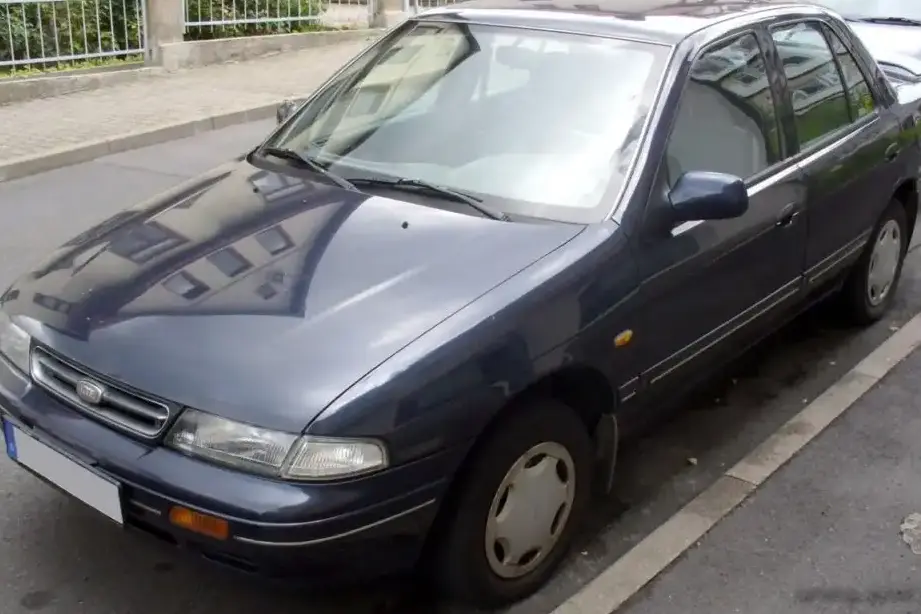
The Kia Sephia (FA) 1.5 i 16V, produced between 1995 and 1998, represented a significant step forward for the South Korean automaker as it attempted to establish a foothold in the global compact car market. Positioned as an affordable and practical sedan, the Sephia aimed to compete with established Japanese and European rivals. This particular variant, equipped with the 1.5-liter inline-four engine producing 110 horsepower, served as a core offering within the Sephia lineup, balancing fuel efficiency with adequate performance for everyday driving. The FA generation Sephia was a re-engineered and updated version of the original Sephia, offering improved refinement and features.
Technical Specifications
| Brand | Kia |
| Model | Sephia |
| Generation | Sephia (FA) |
| Type (Engine) | 1.5 i 16V (110 Hp) |
| Start of production | 1995 |
| End of production | 1998 |
| Powertrain Architecture | Internal Combustion engine |
| Body type | Sedan |
| Seats | 5 |
| Doors | 4 |
| Fuel Type | Petrol (Gasoline) |
| Maximum speed | 180 km/h (111.85 mph) |
| Weight-to-power ratio | 9.4 kg/Hp, 106.8 Hp/tonne |
| Weight-to-torque ratio | 8.1 kg/Nm, 123.3 Nm/tonne |
| Power | 110 Hp @ 6500 rpm |
| Power per litre | 73.4 Hp/l |
| Torque | 127 Nm @ 5500 rpm (93.67 lb.-ft. @ 5500 rpm) |
| Engine layout | Front, Transverse |
| Engine displacement | 1498 cm3 (91.41 cu. in.) |
| Number of cylinders | 4 |
| Engine configuration | Inline |
| Cylinder Bore | 78 mm (3.07 in.) |
| Piston Stroke | 78.4 mm (3.09 in.) |
| Compression ratio | 9.4:1 |
| Number of valves per cylinder | 4 |
| Fuel injection system | Multi-port manifold injection |
| Engine aspiration | Naturally aspirated engine |
| Valvetrain | DOHC |
| Kerb Weight | 1030 kg (2270.76 lbs.) |
| Fuel tank capacity | 50 l (13.21 US gal | 11 UK gal) |
| Length | 4335 mm (170.67 in.) |
| Width | 1690 mm (66.54 in.) |
| Height | 1390 mm (54.72 in.) |
| Wheelbase | 2500 mm (98.43 in.) |
| Front track | 1440 mm (56.69 in.) |
| Rear (Back) track | 1435 mm (56.5 in.) |
| Drivetrain Architecture | The Internal combustion engine (ICE) drives the front wheels of the vehicle. |
| Drive wheel | Front wheel drive |
| Number of gears and type of gearbox | 5 gears, manual transmission |
| Front suspension | Wishbone |
| Rear suspension | Spring Strut |
| Front brakes | Ventilated discs |
| Rear brakes | Disc |
| Assisting systems | ABS (Anti-lock braking system) |
| Steering type | Steering rack and pinion |
| Power steering | Hydraulic Steering |
| Tires size | 185/60 R14 H |
Introduction
The Kia Sephia (FA) 1.5 i 16V, launched in 1995, was a crucial model for Kia as the company sought to expand its presence beyond its domestic market. The FA series represented a significant upgrade over the initial Sephia, incorporating improvements in build quality, interior design, and mechanical refinement. This 1.5-liter variant was designed to appeal to buyers seeking an economical and reliable compact sedan. It was a key player in Kia’s strategy to offer value-for-money vehicles, directly challenging established competitors like the Honda Civic, Toyota Corolla, and Nissan Sentra in various international markets.
Powertrain & Engine Architecture
At the heart of the Sephia 1.5 i 16V lies a 1.5-liter inline-four cylinder engine. This engine, often identified by its internal code, utilized a multi-port fuel injection system to deliver fuel to the cylinders. The engine featured a double overhead camshaft (DOHC) valvetrain, operating 16 valves (four per cylinder) to optimize airflow and enhance volumetric efficiency. The 9.4:1 compression ratio was a compromise between performance and fuel economy. The engine’s output of 110 horsepower at 6500 rpm and 127 Nm (93.67 lb-ft) of torque at 5500 rpm was considered adequate for the vehicle’s weight class. The engine was transversely mounted, driving the front wheels. The standard transmission for this variant was a five-speed manual gearbox, providing a relatively direct connection between the engine and the wheels.
Driving Characteristics
The Sephia 1.5 i 16V with the manual transmission offered a reasonably engaging driving experience, though it wasn’t designed for outright performance. Acceleration was adequate for merging onto highways and navigating city streets, but it wasn’t particularly quick. The five-speed manual transmission allowed drivers to keep the engine in its optimal power band, maximizing efficiency and responsiveness. Compared to potential higher-output versions (which weren’t widely available in many markets), this variant prioritized fuel economy and ease of driving over sporty performance. The gear ratios were tuned for everyday usability, rather than aggressive acceleration. The relatively light weight of the Sephia helped to offset the modest engine output, resulting in a car that felt nimble and easy to maneuver.
Equipment & Trim Levels
The Sephia 1.5 i 16V typically came equipped with a basic but functional set of features. Standard equipment generally included power steering, a basic audio system, and cloth upholstery. Air conditioning was often an optional extra, as were power windows and door locks. Interior trim levels were relatively simple, reflecting the car’s affordable positioning. The dashboard layout was straightforward and functional, prioritizing ease of use over aesthetic flair. Safety features were limited by the standards of the time, typically including only a driver’s airbag and ABS (Anti-lock Braking System) on some models.
Chassis & Braking
The Sephia (FA) utilized a front-wheel-drive layout with an independent wishbone suspension at the front and a spring strut suspension at the rear. This suspension setup provided a comfortable ride quality, absorbing bumps and irregularities in the road surface effectively. The front brakes were ventilated discs, offering good stopping power, while the rear brakes were solid discs. The inclusion of ABS on some models enhanced braking safety, particularly in slippery conditions. The steering system employed a rack and pinion setup with hydraulic power assistance, providing precise and responsive steering feel.
Market Reception & Comparison
The Kia Sephia 1.5 i 16V was generally well-received as an affordable and reliable compact sedan. Critics praised its value for money and its relatively spacious interior. However, it was often criticized for its somewhat bland styling and its lack of refinement compared to more established competitors. Compared to other trims in the Sephia lineup, the 1.5-liter variant offered the best fuel economy and the lowest purchase price, making it an attractive option for budget-conscious buyers. Its reliability was generally considered good, although it didn’t quite match the reputation of Japanese rivals. Fuel economy figures typically ranged around 30-35 mpg in combined driving conditions.
Legacy
The Kia Sephia (FA) 1.5 i 16V played a significant role in establishing Kia as a viable competitor in the global automotive market. While not a groundbreaking vehicle, it offered a compelling combination of affordability, reliability, and practicality. Today, the Sephia is remembered as a solid, if unremarkable, compact car. The 1.5-liter engine proved to be reasonably durable, and well-maintained examples can still be found on the road. In the used car market, the Sephia 1.5 i 16V remains an affordable option for those seeking a basic and reliable transportation solution. Its simplicity and relatively low maintenance costs make it an appealing choice for first-time car owners or those on a tight budget.