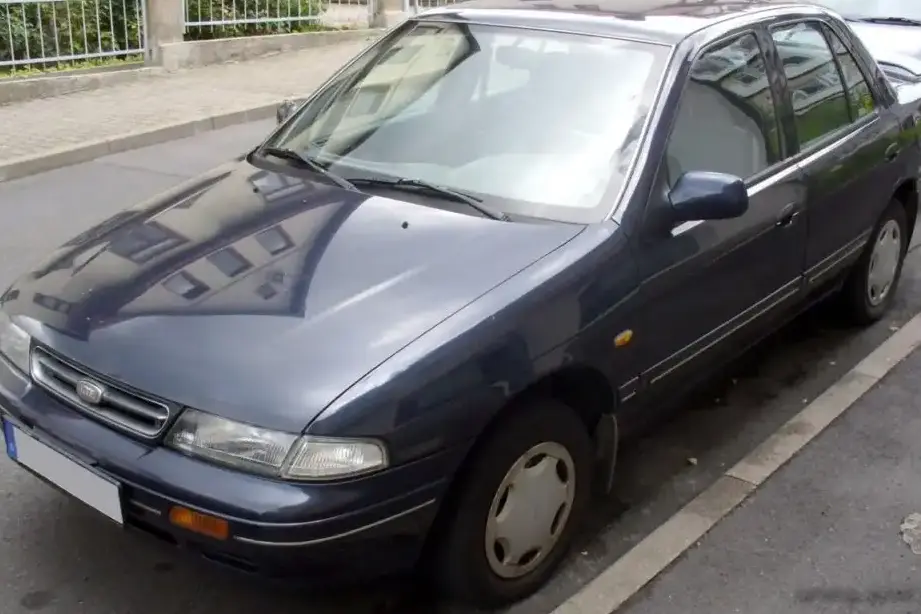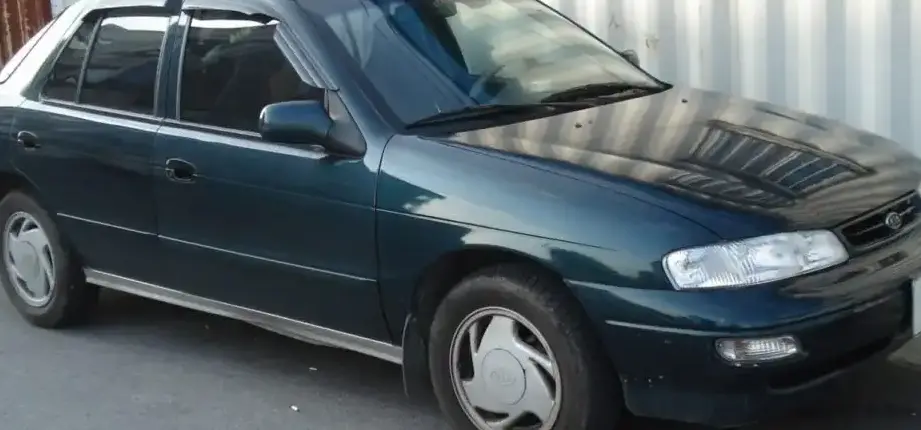
The Kia Sephia Hatchback (FA) 1.6 EGI, producing 80 horsepower, was a key model in Kia’s early expansion into international markets. Produced from 1993 to 1998, this variant occupied the entry-level position within the Sephia range, offering affordable transportation with a focus on fuel efficiency. It was a significant vehicle for Kia, representing a step up in design and engineering compared to their earlier offerings, and aimed to compete with established compact hatchbacks from Japanese and European manufacturers. The FA generation Sephia, built on Kia’s own platform, was a departure from previous reliance on licensed designs.
Technical Specifications
| Brand | Kia |
| Model | Sephia |
| Generation | Sephia Hatchback (FA) |
| Type (Engine) | 1.6 EGI (80 Hp) |
| Start of production | 1993 |
| End of production | 1998 |
| Powertrain Architecture | Internal Combustion engine |
| Body type | Hatchback |
| Seats | 5 |
| Doors | 5 |
| Fuel consumption (urban) | 9.6 l/100 km (24.5 US mpg) |
| Fuel consumption (extra urban) | 5.2 l/100 km (45.2 US mpg) |
| Fuel Type | Petrol (Gasoline) |
| Maximum speed | 180 km/h (111.85 mph) |
| Weight-to-power ratio | 12.8 kg/Hp |
| Weight-to-torque ratio | 8.5 kg/Nm |
| Power | 80 Hp @ 6200 rpm |
| Power per litre | 50.1 Hp/l |
| Torque | 120 Nm @ 3500 rpm (88.51 lb.-ft. @ 3500 rpm) |
| Engine layout | Front, Transverse |
| Engine Model/Code | B6E |
| Engine displacement | 1598 cm3 (97.52 cu. in.) |
| Number of cylinders | 4 |
| Cylinder Bore | 78 mm (3.07 in.) |
| Piston Stroke | 83.6 mm (3.29 in.) |
| Compression ratio | 9.3:1 |
| Number of valves per cylinder | 2 |
| Fuel injection system | Multi-port manifold injection |
| Engine aspiration | Naturally aspirated engine |
| Valvetrain | SOHC |
| Engine oil capacity | 3.2 l (3.38 US qt | 2.82 UK qt) |
| Coolant capacity | 6 l (6.34 US qt | 5.28 UK qt) |
| Kerb Weight | 1020-1100 kg (2248.72 – 2425.08 lbs.) |
| Max. weight | 1477 kg (3256.23 lbs.) |
| Max load | 377-457 kg (831.14 – 1007.51 lbs.) |
| Trunk (boot) space (minimum) | 354 l (12.5 cu. ft.) |
| Fuel tank capacity | 50 l (13.21 US gal | 11 UK gal) |
| Length | 4280 mm (168.5 in.) |
| Width | 1692 mm (66.61 in.) |
| Height | 1390 mm (54.72 in.) |
| Wheelbase | 2500 mm (98.43 in.) |
| Front track | 1440 mm (56.69 in.) |
| Rear track | 1435 mm (56.5 in.) |
| Front overhang | 827 mm (32.56 in.) |
| Rear overhang | 953 mm (37.52 in.) |
| Minimum turning circle | 10.6 m (34.78 ft.) |
| Drivetrain Architecture | Front wheel drive |
| Number of gears | 5 |
| Gearbox type | Manual transmission |
| Front suspension | Independent type McPherson |
| Rear suspension | Trailing arm |
| Front brakes | Ventilated discs |
| Rear brakes | Drum |
| Steering type | Steering rack and pinion |
| Power steering | Hydraulic |
| Tires size | 175/70 R13 |
| Wheel rims size | 5J x 13 |
Introduction
The Kia Sephia Hatchback (FA) 1.6 EGI, powered by the B6E engine, represented a significant step forward for Kia in the early to mid-1990s. Introduced in 1993 and continuing through 1998, this model was designed to appeal to budget-conscious buyers seeking a practical and reliable compact car. Positioned as the base model within the Sephia lineup, it offered a more affordable entry point compared to higher-trim levels with larger engines. The FA Sephia was primarily marketed in Asia, South America, and parts of Europe, serving as a crucial volume seller for Kia as they established their brand presence internationally.
Powertrain & Engine Architecture
At the heart of the Sephia 1.6 EGI was the B6E engine, a 1.6-liter inline-four cylinder gasoline engine. This engine utilized a single overhead camshaft (SOHC) valvetrain with two valves per cylinder. Fuel delivery was managed by a multi-port fuel injection (MPI) system, offering improved efficiency and smoother operation compared to earlier carburetor-based designs. The B6E engine produced 80 horsepower at 6200 rpm and 120 Nm (88.51 lb-ft) of torque at 3500 rpm. The engine’s relatively simple design prioritized reliability and ease of maintenance. The Sephia 1.6 EGI was exclusively offered with a five-speed manual transmission, designed to maximize fuel economy and provide adequate performance for everyday driving. The transmission was a conventional setup with front-wheel drive.
Driving Characteristics
The 1.6-liter engine and five-speed manual transmission combination in the Sephia provided adequate, though not exhilarating, performance. Acceleration was modest, with a focus on fuel efficiency rather than outright speed. The gear ratios were tuned for economy, meaning the engine needed to be revved to access its full power potential. Compared to the later 1.8-liter versions of the Sephia, the 1.6 EGI felt noticeably less powerful, particularly when fully loaded or climbing hills. However, the lighter weight of the 1.6-liter engine contributed to slightly better handling and fuel economy. The steering was light and easy, making it suitable for urban driving, but lacked the precision found in more performance-oriented vehicles.
Equipment & Trim Levels
The Sephia 1.6 EGI, as the entry-level trim, was equipped with basic but functional features. Standard equipment typically included cloth upholstery, a basic AM/FM radio, and manual windows and door locks. Air conditioning was often an optional extra. Interior plastics were durable but utilitarian, reflecting the car’s budget-friendly positioning. The dashboard layout was simple and straightforward, prioritizing ease of use. Optional extras could include power steering, upgraded audio systems, and metallic paint finishes. The overall interior ambiance was functional and practical, rather than luxurious.
Chassis & Braking
The Sephia 1.6 EGI featured a front independent suspension with McPherson struts and a rear trailing arm suspension. This setup provided a reasonable level of ride comfort for everyday driving. The front brakes were ventilated discs, offering adequate stopping power, while the rear brakes were drums. This combination was typical for cars in this price range during the 1990s. The steering system utilized a rack and pinion setup with hydraulic power assistance, making it relatively easy to maneuver. Tire size was typically 175/70 R13, mounted on 5J x 13 steel wheels.
Market Reception & Comparison
The Kia Sephia 1.6 EGI was generally well-received as an affordable and reliable compact car. Critics praised its fuel efficiency and practicality, but noted its lack of refinement and modest performance. Compared to competitors like the Toyota Corolla and Honda Civic, the Sephia offered a lower price point but lacked the same level of build quality and driving experience. Within the Sephia lineup, the 1.6 EGI was seen as the sensible choice for buyers prioritizing economy and affordability. The 1.8-liter versions offered more power but came at a higher cost. Fuel economy figures were competitive for the time, making it an attractive option for commuters.
Legacy
The Kia Sephia 1.6 EGI played a crucial role in establishing Kia as a viable automotive manufacturer in international markets. While not known for groundbreaking innovation, the B6E engine proved to be reasonably reliable, and parts availability remains good even today. Used examples of the Sephia 1.6 EGI are still found on the road, often prized for their simplicity and low running costs. However, age and mileage can lead to issues with rust and wear on suspension components. The Sephia’s legacy lies in its contribution to Kia’s growth and its position as a practical and affordable transportation option for a generation of drivers.