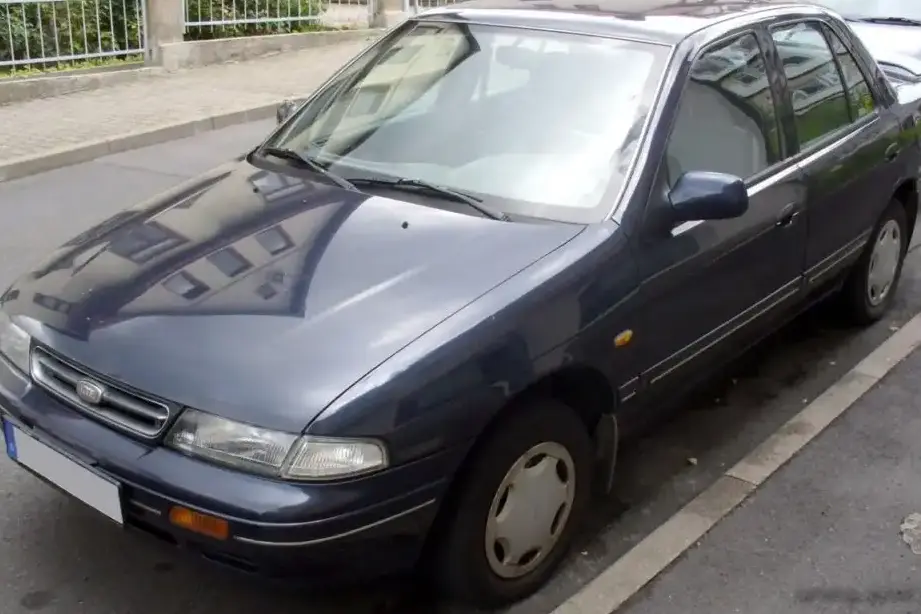
The Kia Sephia II 1.6i 16V, produced between 2001 and 2003, represented Kia’s second generation of the Sephia compact sedan. Positioned as a mainstream, affordable option in the North American and global markets, the Sephia II aimed to offer value and practicality. This particular 1.6-liter, 101 horsepower variant served as a core offering within the Sephia II lineup, providing a balance between fuel economy and acceptable performance for everyday driving. It was built upon the Kia Cerato/Nido platform, sharing many components with its Hyundai counterparts. The Sephia II was a key model for Kia as it continued to establish itself as a credible automotive manufacturer.
Technical Specifications
| Brand | Kia |
| Model | Sephia |
| Generation | Sephia II |
| Type (Engine) | 1.6i 16V (101 Hp) |
| Start of production | 2001 |
| End of production | 2003 |
| Powertrain Architecture | Internal Combustion engine |
| Body type | Sedan |
| Seats | 5 |
| Doors | 4 |
| Fuel consumption (urban) | 10.7 l/100 km (22 US mpg) |
| Fuel consumption (extra urban) | 6.5 l/100 km (36.2 US mpg) |
| Fuel Type | Petrol (Gasoline) |
| Acceleration 0 – 100 km/h | 11.5 sec |
| Acceleration 0 – 62 mph | 11.5 sec |
| Acceleration 0 – 60 mph | 10.9 sec |
| Maximum speed | 186 km/h (115.58 mph) |
| Weight-to-power ratio | 10.8 kg/Hp |
| Weight-to-torque ratio | 7.6 kg/Nm |
| Power | 101 Hp @ 5500 rpm |
| Torque | 144 Nm @ 4500 rpm (106.21 lb.-ft. @ 4500 rpm) |
| Engine layout | Front, Transverse |
| Engine displacement | 1594 cm3 (97.27 cu. in.) |
| Number of cylinders | 4 |
| Engine configuration | Inline |
| Cylinder Bore | 78 mm (3.07 in.) |
| Piston Stroke | 83.4 mm (3.28 in.) |
| Compression ratio | 9.5:1 |
| Number of valves per cylinder | 4 |
| Fuel injection system | Multi-port manifold injection |
| Engine aspiration | Naturally aspirated |
| Valvetrain | DOHC |
| Kerb Weight | 1095 kg (2414.06 lbs.) |
| Max. weight | 1600 kg (3527.4 lbs.) |
| Max load | 505 kg (1113.33 lbs.) |
| Trunk (boot) space – minimum | 416 l (14.69 cu. ft.) |
| Trunk (boot) space – maximum | 750 l (26.49 cu. ft.) |
| Fuel tank capacity | 50 l (13.21 US gal) |
| Length | 4510 mm (177.56 in.) |
| Width | 1720 mm (67.72 in.) |
| Height | 1415 mm (55.71 in.) |
| Wheelbase | 2560 mm (100.79 in.) |
| Front track | 1465 mm (57.68 in.) |
| Rear track | 1455 mm (57.28 in.) |
| Minimum turning circle | 9.8 m (32.15 ft.) |
| Drivetrain Architecture | Front wheel drive |
| Number of gears | 5 |
| Gearbox type | Manual transmission |
| Front suspension | Spring Strut |
| Rear suspension | Spring Strut |
| Front brakes | Ventilated discs |
| Rear brakes | Disc |
| Assisting systems | ABS (Anti-lock braking system) |
| Steering type | Steering rack and pinion |
| Power steering | Hydraulic |
| Tires size | 185/65 R14 |
| Wheel rims size | 14 |
Powertrain & Engine Architecture
The heart of the Sephia II 1.6i 16V is the Kia G4EH engine, a 1.6-liter inline-four cylinder gasoline engine. This engine utilizes a multi-port fuel injection (MPI) system, delivering fuel directly into the intake ports just before the intake valves. The engine features a double overhead camshaft (DOHC) valvetrain, operating 16 valves (four per cylinder) to optimize airflow and improve volumetric efficiency. The compression ratio of 9.5:1 strikes a balance between performance and fuel economy. The engine’s 101 horsepower output at 5500 rpm and 144 Nm (106 lb-ft) of torque at 4500 rpm were typical for a compact sedan of this era. The engine is transversely mounted, driving the front wheels. The standard transmission for this variant was a five-speed manual, although a four-speed automatic transmission was also available, albeit less common.
Driving Characteristics
The 1.6-liter engine paired with the five-speed manual transmission provided adequate, though not exhilarating, performance. Acceleration from 0-60 mph took approximately 10.9 seconds, and the top speed was around 115 mph. The engine felt somewhat strained at higher speeds, and passing maneuvers required careful planning. The five-speed manual allowed drivers to keep the engine in its optimal power band, improving responsiveness. The automatic transmission, while offering convenience, noticeably dulled acceleration due to its less efficient power delivery and wider gear ratios. Handling was generally predictable, but the Sephia II wasn’t designed for sporty driving. The suspension prioritized comfort over handling precision.
Equipment & Trim Levels
The Sephia II 1.6i 16V typically came standard with features considered essential for the time, including air conditioning, power steering, and an AM/FM radio. Higher trim levels, such as the “SE” or “LX”, added features like power windows and locks, keyless entry, and upgraded interior trim. Interior upholstery was typically cloth, with a relatively simple dashboard layout. Optional extras included a sunroof, alloy wheels, and a CD player. The base model was fairly spartan, focusing on affordability, while the higher trims offered a more comfortable and feature-rich experience.
Chassis & Braking
The Sephia II utilized a front independent suspension with MacPherson struts and a rear independent suspension, also with struts. This setup provided a reasonably comfortable ride, absorbing bumps and imperfections in the road surface. Braking consisted of ventilated discs on the front wheels and solid discs on the rear. Anti-lock Braking System (ABS) was standard, enhancing safety by preventing wheel lockup during hard braking. The steering was rack-and-pinion with hydraulic power assistance, providing light and easy steering feel. The relatively lightweight construction of the Sephia II (around 2414 lbs) helped to offset the modest engine output.
Market Reception & Comparison
The Kia Sephia II 1.6i 16V was generally well-received as an affordable and practical compact sedan. Critics praised its value for money and spacious interior. However, the engine was often criticized for being underpowered, especially when paired with the automatic transmission. Compared to competitors like the Honda Civic, Toyota Corolla, and Nissan Sentra, the Sephia II offered a lower price point but lacked the refinement and performance of those established models. Fuel economy was competitive, averaging around 22 mpg in the city and 36 mpg on the highway. Reliability was generally good, although some owners reported minor issues with the electrical system.
Legacy
The Kia Sephia II 1.6i 16V, while not a standout performer, played a significant role in Kia’s growth and recognition in the automotive market. The G4EH engine proved to be reasonably durable, and many examples are still on the road today. However, finding parts can become increasingly challenging as the vehicle ages. In the used car market, the Sephia II 1.6i 16V is typically valued as an inexpensive and reliable transportation option, appealing to budget-conscious buyers. Its simplicity and relatively low maintenance costs make it an attractive choice for those seeking a basic, functional vehicle.