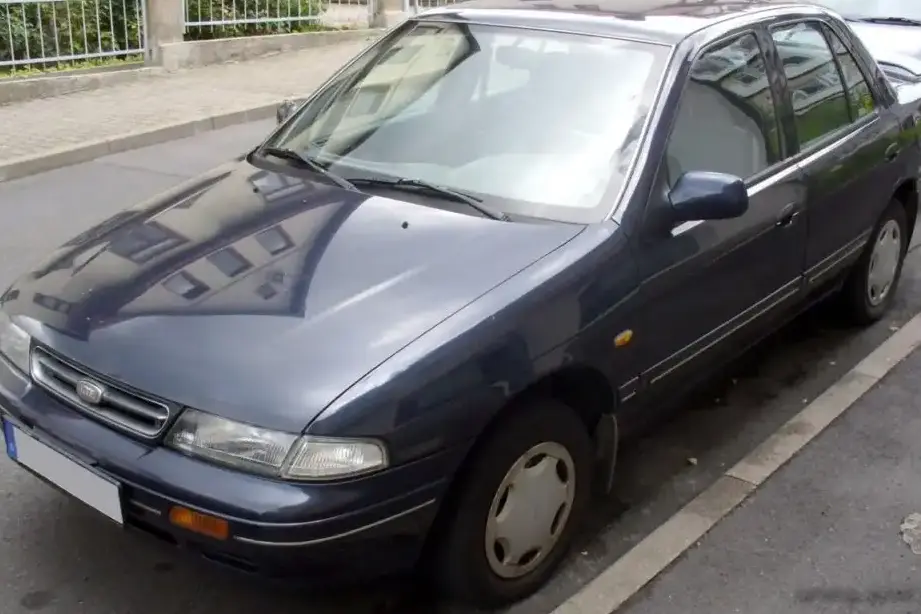
The Kia Sephia II 1.6i 16V Automatic, produced between 2001 and 2003, represented a significant step forward for Kia in the compact sedan market. Part of the second generation of the Sephia (internally designated as the B5 platform), this variant aimed to provide a comfortable and affordable transportation option for families and commuters. Positioned as a mid-range offering within the Sephia II lineup, it slotted between the base 1.5L engine and the slightly more powerful (though less commonly available in the US market) 1.8L versions. The Sephia II was Kia’s attempt to establish a stronger foothold in North America and Europe, offering a value proposition against established Japanese and European competitors.
Technical Specifications
| Brand | Kia |
| Model | Sephia |
| Generation | Sephia II |
| Type (Engine) | 1.6i 16V (101 Hp) Automatic |
| Start of production | 2001 |
| End of production | 2003 |
| Powertrain Architecture | Internal Combustion engine |
| Body type | Sedan |
| Seats | 5 |
| Doors | 4 |
| Fuel consumption (urban) | 11 l/100 km (21.4 US mpg) |
| Fuel consumption (extra urban) | 6.6 l/100 km (35.6 US mpg) |
| Fuel Type | Petrol (Gasoline) |
| Acceleration 0 – 100 km/h | 13.4 sec |
| Acceleration 0 – 62 mph | 13.4 sec |
| Acceleration 0 – 60 mph | 12.7 sec |
| Maximum speed | 175 km/h (108.74 mph) |
| Weight-to-power ratio | 10.8 kg/Hp |
| Weight-to-torque ratio | 7.6 kg/Nm |
| Power | 101 Hp @ 5500 rpm |
| Torque | 144 Nm @ 4500 rpm (106.21 lb.-ft. @ 4500 rpm) |
| Engine layout | Front, Transverse |
| Engine displacement | 1594 cm3 (97.27 cu. in.) |
| Number of cylinders | 4 |
| Engine configuration | Inline |
| Cylinder Bore | 78 mm (3.07 in.) |
| Piston Stroke | 83.4 mm (3.28 in.) |
| Compression ratio | 9.5:1 |
| Number of valves per cylinder | 4 |
| Fuel injection system | Multi-port manifold injection |
| Engine aspiration | Naturally aspirated engine |
| Valvetrain | DOHC |
| Kerb Weight | 1095 kg (2414.06 lbs.) |
| Max. weight | 1600 kg (3527.4 lbs.) |
| Max load | 505 kg (1113.33 lbs.) |
| Trunk (boot) space – minimum | 416 l (14.69 cu. ft.) |
| Trunk (boot) space – maximum | 750 l (26.49 cu. ft.) |
| Fuel tank capacity | 50 l (13.21 US gal | 11 UK gal) |
| Length | 4510 mm (177.56 in.) |
| Width | 1720 mm (67.72 in.) |
| Height | 1415 mm (55.71 in.) |
| Wheelbase | 2560 mm (100.79 in.) |
| Front track | 1465 mm (57.68 in.) |
| Rear (Back) track | 1455 mm (57.28 in.) |
| Minimum turning circle | 9.8 m (32.15 ft.) |
| Drivetrain Architecture | Front wheel drive |
| Number of gears | 4 |
| Gearbox type | Automatic transmission |
| Front suspension | Spring Strut |
| Rear suspension | Spring Strut |
| Front brakes | Ventilated discs |
| Rear brakes | Disc |
| Assisting systems | ABS (Anti-lock braking system) |
| Steering type | Steering rack and pinion |
| Power steering | Hydraulic Steering |
| Tires size | 185/65 R14 |
| Wheel rims size | 14 |
Powertrain & Engine Architecture
The heart of the Sephia II 1.6i Automatic is the Kia-developed, naturally aspirated 1.6-liter inline-four cylinder engine. This engine, often identified by internal codes depending on the specific market, utilizes a multi-port fuel injection system for precise fuel delivery. The engine features a double overhead camshaft (DOHC) valvetrain, operating 16 valves (four per cylinder) to optimize airflow and enhance volumetric efficiency. The 9.5:1 compression ratio was a standard figure for the time, balancing performance and fuel economy. Paired with this engine is a four-speed automatic transmission. While not the most modern transmission available even in the early 2000s, it provided smooth, if not particularly sporty, gear changes. The transmission was chosen to appeal to a broader audience seeking ease of use over outright performance.
Driving Characteristics
The 101 horsepower and 144 Nm (106 lb-ft) of torque produced by the 1.6L engine, when coupled with the four-speed automatic, resulted in a driving experience geared towards practicality rather than excitement. Acceleration from 0-60 mph took approximately 12.7 seconds, and top speed was around 108.74 mph. The automatic transmission’s gear ratios were tuned for fuel efficiency and comfortable cruising, meaning quick downshifts for overtaking required a deliberate push of the throttle. Compared to a manual transmission equipped Sephia II, or the rarer 1.8L variants, this version felt noticeably less responsive. However, the automatic offered a smoother and more relaxed driving experience, particularly in urban environments.
Equipment & Trim Levels
The 1.6i Automatic trim typically included standard features such as air conditioning, power steering, and an AM/FM radio. Depending on the market and optional packages selected, features like power windows and locks, a CD player, and alloy wheels could be added. Interior upholstery was generally cloth, with a relatively simple dashboard layout. Safety features were basic for the era, typically including dual airbags and ABS (Anti-lock Braking System). The Sephia II aimed to provide a good level of standard equipment for its price point, making it an attractive option for budget-conscious buyers.
Chassis & Braking
The Sephia II utilized a relatively conventional chassis design, featuring a MacPherson strut front suspension and a coil-sprung strut rear suspension. This setup provided a comfortable ride, though handling was not particularly sharp. The front brakes were ventilated discs, offering adequate stopping power, while the rear brakes were solid discs. The hydraulic power steering provided light and easy steering, making it easy to maneuver in tight spaces. The suspension tuning prioritized ride comfort over sporty handling, reflecting the car’s intended role as a family sedan.
Market Reception & Comparison
The Kia Sephia II 1.6i Automatic received mixed reviews from automotive critics. It was generally praised for its affordability, spacious interior, and comfortable ride. However, it was often criticized for its lack of performance, somewhat dated styling, and basic interior materials. Compared to competitors like the Honda Civic, Toyota Corolla, and Nissan Sentra, the Sephia II offered a lower price point but lacked the refinement and driving dynamics of those established models. Fuel economy was respectable, falling in line with other compact sedans of the time. Reliability was generally considered average, with some reports of minor mechanical issues.
Legacy
The Kia Sephia II, including the 1.6i Automatic variant, played a crucial role in Kia’s early efforts to gain recognition in the global automotive market. While not a groundbreaking vehicle, it offered a compelling value proposition for buyers seeking affordable transportation. Today, the Sephia II is a relatively uncommon sight on the roads, and parts availability can be challenging. However, well-maintained examples are often sought after by enthusiasts looking for a simple, reliable, and inexpensive classic car. The 1.6L engine and four-speed automatic transmission, while not known for exceptional durability, have proven to be reasonably reliable with proper maintenance, making these cars potentially viable for restoration projects or as affordable daily drivers.