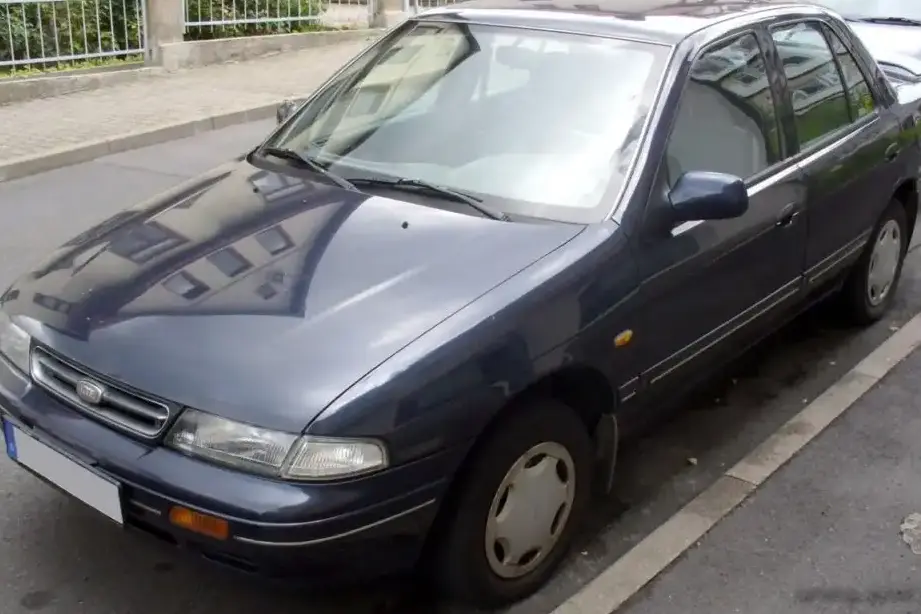
The Kia Sephia II 1.8 i 16V, produced between 1998 and 2003, represented a significant step forward for the South Korean automaker in the competitive North American and European compact sedan markets. Positioned as a mid-range offering within the Sephia II lineup, this variant aimed to balance affordability with a more potent engine option than the base models. It was part of the broader Sephia II generation (designated B5), built upon a revised platform derived from the original Sephia, and sought to offer a more refined and feature-rich experience compared to its predecessor. The Sephia II, and this 1.8L variant specifically, was Kia’s attempt to establish a stronger foothold in segments dominated by Japanese and European manufacturers.
Technical Specifications
| Brand | Kia |
| Model | Sephia |
| Generation | Sephia II |
| Type (Engine) | 1.8 i 16V (111 Hp) |
| Start of production | 1998 |
| End of production | 2003 |
| Powertrain Architecture | Internal Combustion engine |
| Body type | Sedan |
| Seats | 5 |
| Doors | 4 |
| Fuel consumption (urban) | 12.6 l/100 km (18.7 US mpg) |
| Fuel consumption (extra urban) | 7 l/100 km (33.6 US mpg) |
| Fuel Type | Petrol (Gasoline) |
| Acceleration 0 – 100 km/h | 10.3 sec |
| Acceleration 0 – 62 mph | 10.3 sec |
| Acceleration 0 – 60 mph | 9.8 sec |
| Maximum speed | 196 km/h (121.79 mph) |
| Weight-to-power ratio | 10 kg/Hp |
| Weight-to-torque ratio | 7.3 kg/Nm |
| Power | 111 Hp @ 5750 rpm |
| Power per litre | 61.9 Hp/l |
| Torque | 152 Nm @ 4400 rpm (112.11 lb.-ft. @ 4400 rpm) |
| Engine layout | Front, Transverse |
| Engine displacement | 1793 cm3 (109.42 cu. in.) |
| Number of cylinders | 4 |
| Engine configuration | Inline |
| Cylinder Bore | 81 mm (3.19 in.) |
| Piston Stroke | 87 mm (3.43 in.) |
| Compression ratio | 9.5:1 |
| Number of valves per cylinder | 4 |
| Fuel injection system | Multi-port manifold injection |
| Engine aspiration | Naturally aspirated engine |
| Kerb Weight | 1115 kg (2458.15 lbs.) |
| Max. weight | 1600 kg (3527.4 lbs.) |
| Max load | 485 kg (1069.24 lbs.) |
| Trunk (boot) space – minimum | 370 l (13.07 cu. ft.) |
| Trunk (boot) space – maximum | 692 l (24.44 cu. ft.) |
| Fuel tank capacity | 50 l (13.21 US gal | 11 UK gal) |
| Length | 4427 mm (174.29 in.) |
| Width | 1711 mm (67.36 in.) |
| Height | 1415 mm (55.71 in.) |
| Wheelbase | 2560 mm (100.79 in.) |
| Front track | 1465 mm (57.68 in.) |
| Rear (Back) track | 1455 mm (57.28 in.) |
| Drivetrain Architecture | The Internal combustion engine (ICE) drives the front wheels of the vehicle. |
| Drive wheel | Front wheel drive |
| Number of gears and type of gearbox | 5 gears, manual transmission |
| Front suspension | Spring Strut |
| Rear suspension | Spring Strut |
| Front brakes | Ventilated discs |
| Rear brakes | Disc |
| Assisting systems | ABS (Anti-lock braking system) |
| Steering type | Steering rack and pinion |
| Power steering | Hydraulic Steering |
| Tires size | 185/65 R14 |
Powertrain & Engine Architecture
The heart of the Sephia II 1.8 i 16V is the Kia-developed G4CR inline-four cylinder engine. Displacing 1793cc, this engine featured a dual overhead camshaft (DOHC) design with four valves per cylinder, contributing to its relatively high output for its displacement. The engine utilized a multi-point fuel injection system, delivering fuel directly to each intake port for improved combustion efficiency. The 9.5:1 compression ratio was a compromise between performance and the ability to run on readily available fuel grades. The engine’s 111 horsepower at 5750 rpm and 152 Nm (112 lb-ft) of torque at 4400 rpm provided a noticeable improvement over the base 1.6L engine offered in other Sephia II trims. The engine was transversely mounted, driving the front wheels. The standard transmission for this variant was a five-speed manual, although a four-speed automatic transmission was also available, albeit with a slight reduction in horsepower and a corresponding increase in fuel consumption.
Driving Characteristics
The 1.8L engine, paired with the five-speed manual transmission, provided a reasonably engaging driving experience. Acceleration to 60 mph took approximately 9.8 seconds, making it competitive with other compact sedans of the era. The engine felt responsive in the mid-range, offering sufficient power for everyday driving and highway merging. While not a sports car, the 1.8L Sephia II offered a more confident and capable feel than the lower-powered models. The automatic transmission, while offering convenience, did diminish the overall performance, resulting in slightly slower acceleration and a less direct connection to the engine. Gear ratios were tuned for fuel economy, with a relatively tall final drive. The steering was light and precise, making it easy to maneuver in urban environments.
Equipment & Trim Levels
The 1.8 i 16V trim typically included features such as power windows and locks, air conditioning, and an upgraded audio system. Higher trim levels, often denoted by “SE” or “LX” designations, added features like alloy wheels, a sunroof, and upgraded interior upholstery. Interior materials were generally durable but not luxurious, reflecting the Sephia II’s value-oriented positioning. The dashboard layout was functional and straightforward, with easy-to-read gauges. Optional extras included a CD player, cruise control, and a rear window defroster.
Chassis & Braking
The Sephia II utilized a MacPherson strut front suspension and a torsion beam rear suspension. This setup provided a comfortable ride, although it wasn’t particularly sporty. The front brakes were ventilated discs, offering adequate stopping power, while the rear brakes were solid discs. Anti-lock Braking System (ABS) was standard, enhancing safety. The steering system employed a rack-and-pinion setup with hydraulic power assistance. The 185/65 R14 tires provided a good balance of ride comfort and handling.
Market Reception & Comparison
The Sephia II 1.8 i 16V was generally well-received by automotive critics as a practical and affordable compact sedan. It was praised for its improved engine performance and relatively spacious interior. However, some reviewers noted that the interior materials and overall refinement were not on par with some of its Japanese competitors. Compared to the base 1.6L Sephia II, the 1.8L offered a significant performance boost, making it a more appealing option for drivers who prioritized acceleration and highway cruising. Fuel economy was comparable to other compact sedans of the time, averaging around 25 mpg in combined driving. Reliability was generally good, although some owners reported minor issues with the fuel injection system and electrical components.
Legacy
The Kia Sephia II 1.8 i 16V played a crucial role in establishing Kia as a viable competitor in the global automotive market. It demonstrated Kia’s ability to produce a well-rounded and affordable compact sedan that could challenge established brands. Today, the Sephia II 1.8L is a relatively affordable and readily available used car. The G4CR engine is known for its durability, and with proper maintenance, it can provide many years of reliable service. However, finding parts for older models can sometimes be challenging. The Sephia II, and this 1.8L variant in particular, represents a significant milestone in Kia’s history, marking its transition from a relatively unknown automaker to a major player in the automotive industry.