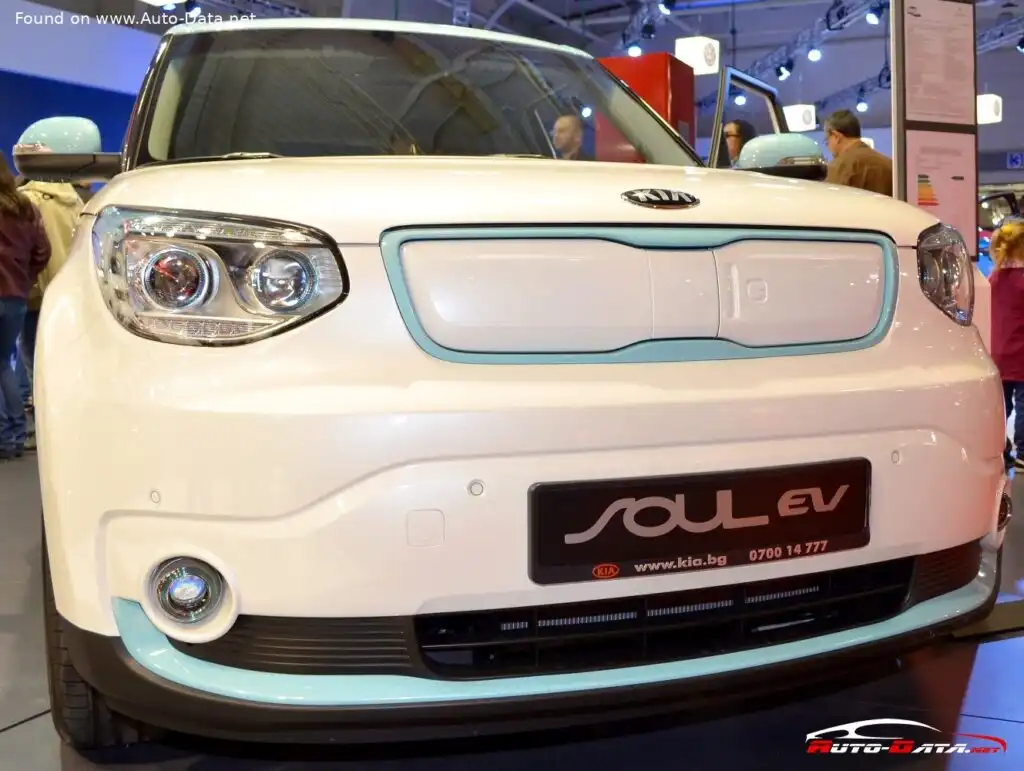
Technical Specifications
| Brand | Kia |
| Model | Soul |
| Generation | Soul II (facelift 2016) |
| Type (Engine) | 1.6 CRDI (136 Hp) |
| Start of production | 2016 |
| End of production | 2019 |
| Powertrain Architecture | Internal Combustion engine |
| Body type | Crossover |
| Seats | 5 |
| Doors | 5 |
| Fuel consumption (urban) | 5.7 l/100 km (41.3 US mpg, 49.6 UK mpg, 17.5 km/l) |
| Fuel consumption (extra urban) | 4.3 l/100 km (54.7 US mpg, 65.7 UK mpg, 23.3 km/l) |
| Fuel consumption (combined) | 4.8 l/100 km (49 US mpg, 58.9 UK mpg, 20.8 km/l) |
| CO2 emissions | 127 g/km |
| Fuel Type | Diesel |
| Acceleration 0 – 100 km/h | 11.2 sec |
| Acceleration 0 – 62 mph | 11.2 sec |
| Acceleration 0 – 60 mph | 10.6 sec |
| Maximum speed | 180 km/h (111.85 mph) |
| Emission standard | Euro 6 |
| Weight-to-power ratio | 9.7 kg/Hp, 103.4 Hp/tonne |
| Weight-to-torque ratio | 5.1 kg/Nm, 197.7 Nm/tonne |
| Power | 136 Hp @ 4000 rpm |
| Power per litre | 86 Hp/l |
| Torque | 260 Nm @ 1500-3000 rpm (191.77 lb.-ft. @ 1500-3000 rpm) |
| Engine layout | Front, Transverse |
| Engine Model/Code | D4FB |
| Engine displacement | 1582 cm3 (96.54 cu. in.) |
| Number of cylinders | 4 |
| Engine configuration | Inline |
| Cylinder Bore | 77.2 mm (3.04 in.) |
| Piston Stroke | 84.5 mm (3.33 in.) |
| Compression ratio | 16:1 |
| Number of valves per cylinder | 4 |
| Fuel injection system | Diesel Commonrail |
| Engine aspiration | Turbocharger, Intercooler |
| Engine oil capacity | 5.3 l (5.6 US qt | 4.66 UK qt) |
| Coolant | 6.8 l (7.19 US qt | 5.98 UK qt) |
| Kerb Weight | 1315-1457 kg (2899.08 – 3212.14 lbs.) |
| Max. weight | 1920 kg (4232.88 lbs.) |
| Max load | 463-605 kg (1020.74 – 1333.8 lbs.) |
| Trunk (boot) space – minimum | 238 l (8.4 cu. ft.) |
| Trunk (boot) space – maximum | 878 l (31.01 cu. ft.) |
| Fuel tank capacity | 54 l (14.27 US gal | 11.88 UK gal) |
| Max. roof load | 80 kg (176.37 lbs.) |
| Permitted trailer load with brakes (12%) | 1300 kg (2866.01 lbs.) |
| Permitted trailer load without brakes | 550 kg (1212.54 lbs.) |
| Permitted towbar download | 80 kg (176.37 lbs.) |
| Length | 4140 mm (162.99 in.) |
| Width | 1800 mm (70.87 in.) |
| Width including mirrors | 2100 mm (82.68 in.) |
| Height | 1618 mm (63.7 in.) |
| Wheelbase | 2570 mm (101.18 in.) |
| Front track | 1560-1576 mm (61.42 – 62.05 in.) |
| Rear (Back) track | 1573-1588 mm (61.93 – 62.52 in.) |
| Front overhang | 840 mm (33.07 in.) |
| Rear overhang | 730 mm (28.74 in.) |
| Ride height (ground clearance) | 143 mm (5.63 in.) |
| Minimum turning circle (turning diameter) | 10.6 m (34.78 ft.) |
| Drivetrain Architecture | The Internal combustion engine (ICE) drives the front wheels of the vehicle. |
| Drive wheel | Front wheel drive |
| Number of gears and type of gearbox | 6 gears, manual transmission |
| Front suspension | Independent, type McPherson with coil spring and anti-roll bar |
| Rear suspension | Semi-independent, coil spring |
| Front brakes | Ventilated discs |
| Rear brakes | Disc |
| Assisting systems | ABS (Anti-lock braking system) |
| Steering type | Steering rack and pinion |
| Power steering | Electric Steering |
| Tires size | 215/55 R17 94V; 235/45 R18 94V |
| Wheel rims size | 6.5J x 17; 7.5J x 18 |
Introduction
The Kia Soul II (facelift, introduced in 2016) 1.6 CRDI, producing 136 horsepower, represents a significant iteration within the second generation of Kia’s distinctive urban crossover. Launched as part of a mid-cycle refresh, this variant aimed to balance fuel efficiency with adequate performance for everyday driving. Production spanned from 2016 to 2019, positioning it within the broader 2HX series that debuted in 2013. The 1.6 CRDI trim served as a popular choice in European and Asian markets, offering a diesel-powered alternative to the gasoline engines available in other regions, including North America where the Soul was exclusively offered with gasoline engines. This model aimed to provide a more economical option for buyers prioritizing fuel costs and long-distance driving.
Powertrain & Engine Architecture
The heart of this Soul variant is the Kia-developed D4FB 1.6-liter inline-four cylinder diesel engine. This engine is a member of Kia’s ‘U’ engine family, known for its relatively compact size and efficiency. The D4FB utilizes a common-rail direct injection system, delivering fuel at extremely high pressure for optimized combustion. A turbocharger with an intercooler is employed to boost power output and improve torque across a wider RPM range. The engine produces 136 horsepower at 4,000 rpm and 260 Nm (191.77 lb-ft) of torque between 1,500 and 3,000 rpm. The engine features a 16:1 compression ratio and four valves per cylinder. The 6-speed manual transmission was standard, chosen for its balance of fuel economy and driver engagement. While an automatic transmission was offered on some Soul trims, it was not typically paired with the 1.6 CRDI engine in most markets. The engine’s design focused on minimizing friction and optimizing combustion efficiency to achieve competitive fuel economy figures.
Driving Characteristics
The 1.6 CRDI with the 6-speed manual transmission provides a practical and economical driving experience. Acceleration from 0 to 100 km/h (0-62 mph) takes approximately 11.2 seconds, which is adequate for urban and highway driving but doesn’t offer particularly sporty performance. The engine’s strong low-end torque makes it feel responsive in everyday situations, such as merging onto highways or overtaking slower vehicles. The gear ratios are well-spaced, allowing the engine to operate efficiently at cruising speeds. Compared to the higher-output gasoline engines available in the Soul lineup, the 1.6 CRDI prioritizes fuel economy over outright performance. The manual transmission provides a more engaging driving experience than an automatic would, allowing drivers to better control the engine’s power delivery. The engine is relatively quiet at cruising speeds, but can become noticeable under hard acceleration. Overall, the driving experience is geared towards comfort and efficiency rather than performance.
Equipment & Trim Levels
The 1.6 CRDI trim level typically included a reasonable level of standard equipment. Features commonly included air conditioning, power windows, central locking, a basic audio system with USB connectivity, and alloy wheels. Higher trim levels offered additional features such as a touchscreen infotainment system with navigation, a rearview camera, automatic climate control, and upgraded interior materials. Interior upholstery was typically cloth, with options for leather available on higher-spec models. Safety features included ABS, electronic stability control, and multiple airbags. Depending on the market, optional extras could include parking sensors, a panoramic sunroof, and upgraded sound systems. The Soul’s boxy shape provided ample headroom and cargo space, making it a practical choice for families and individuals alike.
Chassis & Braking
The Soul II utilizes a front-wheel-drive platform with an independent McPherson strut suspension in the front and a semi-independent torsion beam suspension in the rear. This setup provides a comfortable ride quality, suitable for everyday driving. The front brakes are ventilated discs, while the rear brakes are solid discs. The steering is electrically assisted, providing light and precise control. Stabilizer bars are fitted to both the front and rear axles to reduce body roll during cornering. The suspension tuning prioritized comfort over sporty handling, resulting in a smooth ride on most road surfaces. The braking system is adequate for everyday use, but may not offer the same stopping power as higher-performance vehicles.
Market Reception & Comparison
The 1.6 CRDI variant of the Kia Soul II was well-received in markets where diesel engines were popular, particularly in Europe. Critics praised its fuel efficiency and low running costs. Compared to the gasoline-powered Soul models, the 1.6 CRDI offered significantly better fuel economy, making it an attractive option for drivers who covered long distances. However, some reviewers noted that the diesel engine was slightly noisier and less refined than the gasoline engines. The manual transmission was generally considered a good match for the engine, providing a more engaging driving experience than an automatic would. The 1.6 CRDI positioned itself as a value-oriented option, appealing to buyers seeking practicality and economy over performance and luxury.
Legacy
The D4FB 1.6 CRDI engine has proven to be a relatively reliable powertrain, although, like all diesel engines, it requires regular maintenance, including oil changes and filter replacements. The Soul II 1.6 CRDI remains a popular choice in the used car market, particularly for buyers seeking a fuel-efficient and practical urban crossover. Its distinctive styling and spacious interior continue to appeal to a wide range of buyers. While modern diesel technology has advanced significantly, the D4FB engine still offers a viable and economical option for those seeking a dependable and fuel-efficient vehicle. Properly maintained examples of this Soul variant can provide years of reliable service, making it a sensible choice for budget-conscious buyers.