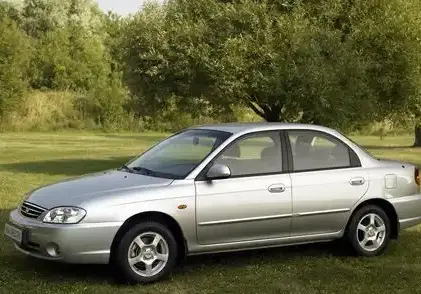
The Kia Spectra 1.8i, produced for the US market between 2001 and 2003, marked a pivotal moment for Kia as it sought to gain a foothold in the highly competitive compact sedan segment. This variant, part of the first-generation Spectra (internally designated as the B-platform), was engineered to deliver an affordable and dependable transportation solution for American consumers. It occupied a mid-range position within the Spectra lineup, striking a balance between performance and economy, positioned between the more basic trims and any potential future performance-oriented models. The 1.8i was specifically designed to appeal to buyers who prioritized practicality and value over exhilarating driving dynamics.
Technical Specifications
| Brand | Kia |
| Model | Spectra |
| Generation | Spectra (USA) |
| Type (Engine) | 1.8i (126 Hp) |
| Start of production | 2001 |
| End of production | 2003 |
| Powertrain Architecture | Internal Combustion engine |
| Body type | Sedan |
| Fuel Type | Petrol (Gasoline) |
| Power | 126 Hp @ 6000 rpm |
| Power per litre | 70.3 Hp/l |
| Torque | 162 Nm @ 4900 rpm |
| Torque (lb-ft) | 119.49 lb.-ft. @ 4900 rpm |
| Engine layout | Front, Transverse |
| Engine displacement | 1793 cm3 |
| Engine displacement (cu. in.) | 109.42 cu. in. |
| Number of cylinders | 4 |
| Engine configuration | Inline |
| Cylinder Bore | 81 mm |
| Cylinder Bore (in.) | 3.19 in. |
| Piston Stroke | 87 mm |
| Piston Stroke (in.) | 3.43 in. |
| Compression ratio | 9.5:1 |
| Number of valves per cylinder | 4 |
| Fuel injection system | Multi-port manifold injection |
| Engine aspiration | Naturally aspirated engine |
| Valvetrain | DOHC |
Powertrain & Engine Architecture
The 2001-2003 Kia Spectra 1.8i was powered by the G4EH engine, a 1.8-liter inline-four cylinder powerplant. This engine employed a naturally aspirated configuration coupled with multi-port fuel injection, generating 126 horsepower at 6000 rpm and 162 Nm (119.49 lb-ft) of torque at 4900 rpm. The engine featured a double overhead camshaft (DOHC) valvetrain with four valves per cylinder, contributing to its relatively efficient operation. The engine block was constructed from cast iron, while the cylinder head was aluminum, a common design choice balancing durability and weight. The engine’s design prioritized reliability and fuel economy over high-performance characteristics. The Spectra 1.8i was typically offered with a four-speed automatic transmission, although a five-speed manual transmission was also available. The automatic transmission was favored by many buyers for its convenience in daily commuting scenarios.
Driving Characteristics
The driving experience in the Spectra 1.8i equipped with the automatic transmission was focused on comfort and ease of use. Acceleration was adequate for typical city and highway driving, but it wasn’t particularly quick. The four-speed automatic transmission, while smooth, lacked the responsiveness of more modern transmissions with additional gears. The gear ratios were optimized for fuel efficiency, resulting in a somewhat relaxed pace. Compared to the manual transmission version, the automatic offered less driver engagement but greater convenience. The 1.8i’s power delivery was linear, with a noticeable dip in torque at lower RPMs. It wasn’t a car designed for spirited driving, but it provided a comfortable and predictable ride for everyday use. The automatic transmission did contribute to slightly lower fuel economy compared to the manual, but the difference wasn’t substantial.
Equipment & Trim Levels
The 1.8i trim level of the Kia Spectra generally included standard features such as air conditioning, power windows and locks, and an AM/FM radio with a cassette player. Higher trim levels offered upgrades like a CD player, upgraded interior fabrics, and alloy wheels. The interior was generally functional and straightforward, with durable materials. The dashboard layout was simple and easy to navigate. Optional extras included a sunroof, cruise control, and upgraded sound systems. Safety features included dual front airbags and anti-lock brakes (ABS) on some models. The Spectra 1.8i aimed to provide a strong value proposition, offering a reasonable level of equipment for its price point.
Chassis & Braking
The Kia Spectra 1.8i utilized a front-wheel-drive layout with an independent MacPherson strut suspension in the front and a torsion beam rear suspension. This suspension setup provided a comfortable ride, although it wasn’t particularly sporty. The front brakes were ventilated discs, while the rear brakes were typically drum brakes, a cost-saving measure common in this class of vehicle. The steering was power-assisted, providing light and easy maneuverability. Stabilizer bars were included in both the front and rear suspension to reduce body roll during cornering. The chassis was designed for durability and affordability, prioritizing practicality over handling precision.
Market Reception & Comparison
The Kia Spectra 1.8i received generally positive reviews for its affordability, reliability, and spacious interior. Critics acknowledged that it wasn’t the most exciting car to drive, but it offered a good value for the money. Compared to competitors like the Honda Civic, Toyota Corolla, and Nissan Sentra, the Spectra 1.8i was often priced lower, making it an attractive option for budget-conscious buyers. Fuel economy was competitive with other vehicles in its class. Reliability was generally good, although some owners reported minor issues with the automatic transmission. The Spectra 1.8i’s primary selling point was its combination of affordability, practicality, and the generous warranty offered by Kia at the time.
Legacy
The Kia Spectra 1.8i, while not a revolutionary vehicle, played a vital role in establishing Kia as a credible competitor in the US market. The G4EH engine proved to be a relatively durable and reliable powerplant, and many examples are still in operation today. The Spectra 1.8i’s affordability and practicality made it a popular choice for first-time car buyers and those seeking a dependable and economical mode of transportation. In the used car market, these Spectras are known for their low running costs and straightforward maintenance requirements, making them appealing options for those seeking a budget-friendly vehicle. While not highly sought after by collectors, the Spectra 1.8i represents a significant chapter in Kia’s history and its evolution into a major automotive manufacturer.