Technical Specifications
| Brand | Kia |
| Model | Sportage |
| Generation | Sportage III (facelift, 2014) |
| Type (Engine) | 2.0 CRDi (184 Hp) 4WD |
| Start of production | 2014 |
| End of production | 2016 |
| Powertrain Architecture | Internal Combustion engine |
| Body type | SUV |
| Seats | 5 |
| Doors | 5 |
| Fuel consumption (urban) | 7.2 l/100 km (32.7 US mpg) |
| Fuel consumption (extra urban) | 5.4 l/100 km (43.6 US mpg) |
| Fuel consumption (combined) | 6.1 l/100 km (38.6 US mpg) |
| CO2 emissions | 158 g/km |
| Fuel Type | Diesel |
| Acceleration 0 – 100 km/h | 9.8 sec |
| Acceleration 0 – 62 mph | 9.8 sec |
| Acceleration 0 – 60 mph | 9.3 sec |
| Maximum speed | 194 km/h (120.55 mph) |
| Emission standard | Euro 5 |
| Weight-to-power ratio | 8.7 kg/Hp |
| Weight-to-torque ratio | 4.2 kg/Nm |
| Power | 184 Hp @ 4000 rpm |
| Torque | 383 Nm @ 1800-2500 rpm (282.49 lb.-ft.) |
| Engine layout | Front, Transverse |
| Engine Model/Code | D4HA |
| Engine displacement | 1995 cm3 (121.74 cu. in.) |
| Number of cylinders | 4 |
| Engine configuration | Inline |
| Cylinder Bore | 84 mm (3.31 in.) |
| Piston Stroke | 90 mm (3.54 in.) |
| Compression ratio | 16.5:1 |
| Number of valves per cylinder | 4 |
| Fuel injection system | Diesel Commonrail |
| Engine aspiration | Turbocharger, Intercooler |
| Engine oil capacity | 8 l (8.45 US qt | 7.04 UK qt) |
| Coolant capacity | 8.5 l (8.98 US qt | 7.48 UK qt) |
| Kerb Weight | 1600 kg (3527.4 lbs.) |
| Max. weight | 2140 kg (4717.89 lbs.) |
| Max load | 540 kg (1190.5 lbs.) |
| Trunk (boot) space – minimum | 564 l (19.92 cu. ft.) |
| Trunk (boot) space – maximum | 1353 l (47.78 cu. ft.) |
| Fuel tank capacity | 58 l (15.32 US gal | 12.76 UK gal) |
| Permitted trailer load with brakes (12%) | 2000 kg (4409.25 lbs.) |
| Permitted trailer load without brakes | 750 kg (1653.47 lbs.) |
| Length | 4440 mm (174.8 in.) |
| Width | 1855 mm (73.03 in.) |
| Height | 1635 mm (64.37 in.) |
| Wheelbase | 2640 mm (103.94 in.) |
| Front track | 1600 mm (62.99 in.) |
| Rear (Back) track | 1601 mm (63.03 in.) |
| Ride height (ground clearance) | 172 mm (6.77 in.) |
| Drag coefficient (Cd) | 0.37 |
| Minimum turning circle | 10.58 m (34.71 ft.) |
| Approach angle | 22.7° |
| Departure angle | 28.2° |
| Ramp-over angle | 17.7° |
| Drive wheel | All wheel drive (4×4) |
| Number of gears | 6 |
| Gearbox type | Manual transmission |
| Front brakes | Ventilated discs |
| Rear brakes | Disc |
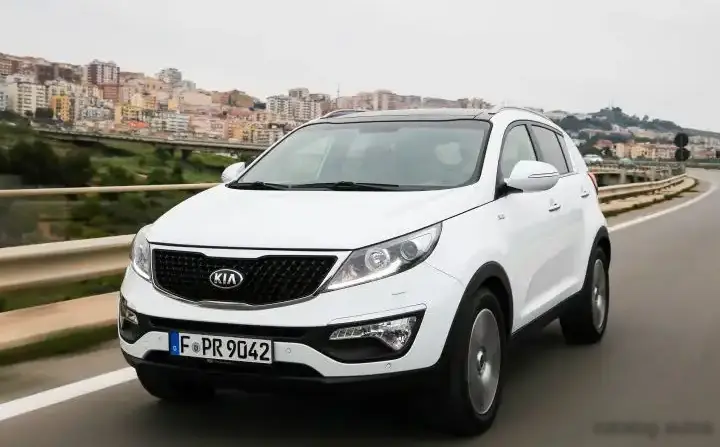
The 2014 facelift of the Kia Sportage III brought with it revised styling, improved interior materials, and updated technology. The 2.0 CRDi 4WD variant was positioned as a versatile option for drivers needing all-weather traction and reasonable fuel economy. Built on the platform shared with the Hyundai ix35 (Tucson), the Sportage aimed to challenge established players in the compact SUV market. This particular engine and drivetrain combination was popular in Europe and Asia, where diesel power and all-wheel drive were common preferences. It offered a step up in performance and capability compared to the base 1.6L gasoline engine, while remaining more affordable than the range-topping trims.
Powertrain & Engine Architecture
At the heart of the Sportage 2.0 CRDi 4WD lies the D4HA engine, a 1995cc inline-four cylinder diesel. This engine utilizes a second-generation common-rail direct injection system, delivering fuel at extremely high pressure for optimized combustion. A turbocharger with an intercooler further enhances power output and torque. The engine boasts a relatively high compression ratio of 16.5:1, contributing to its efficiency. The 4WD system is typically a part-time system, engaging the rear wheels when slip is detected at the front. The 6-speed manual transmission was standard, providing a good balance between fuel economy and driver control. The engine’s design prioritized low-end torque, making it well-suited for everyday driving and towing.
Driving Characteristics
The 2.0 CRDi 4WD Sportage offered a composed and capable driving experience. While not a sports SUV, the 184 horsepower and 282 lb-ft of torque provided adequate acceleration, with a 0-60 mph time of around 9.3 seconds. The manual transmission allowed for precise gear selection, and the turbocharger provided a noticeable boost in power during overtaking maneuvers. The all-wheel-drive system instilled confidence in slippery conditions, enhancing stability and traction. Compared to the base gasoline engine, the diesel offered significantly more torque, making it easier to carry a full load of passengers and cargo. However, it wasn’t as refined or quick as higher-output diesel variants available in some markets.
Equipment & Trim Levels
The 2.0 CRDi 4WD Sportage typically came equipped with a respectable level of standard features. These often included air conditioning, power windows and mirrors, a CD/MP3 stereo system, and alloy wheels. Higher trim levels added features such as leather upholstery, a panoramic sunroof, a touchscreen infotainment system with navigation, and parking sensors. Safety features like ABS, electronic stability control, and multiple airbags were standard across the range. The interior design was functional and modern, with a focus on practicality and durability.
Chassis & Braking
The Sportage III utilized a MacPherson strut front suspension and a multi-link rear suspension, providing a comfortable ride and good handling characteristics. The 4WD system added to the vehicle’s stability, particularly on loose surfaces. Braking duties were handled by ventilated discs at the front and solid discs at the rear. The braking system was generally effective, providing adequate stopping power for everyday driving. The suspension was tuned to prioritize comfort over outright sportiness, resulting in a slightly softer ride quality.
Market Reception & Comparison
The Kia Sportage III, and specifically the 2.0 CRDi 4WD variant, received generally positive reviews from automotive critics. It was praised for its stylish design, spacious interior, and competitive price. The diesel engine was noted for its fuel efficiency and strong torque output. However, some critics pointed out that the interior materials weren’t as premium as those found in some of its rivals. Compared to competitors like the Nissan Qashqai and Volkswagen Tiguan, the Sportage offered a compelling value proposition, often undercutting them on price while providing similar levels of equipment and performance. The fuel economy of the 2.0 CRDi was a significant selling point, particularly in Europe, where diesel fuel was often cheaper than gasoline.
Legacy
The Kia Sportage III played a crucial role in establishing Kia as a serious contender in the global automotive market. The 2.0 CRDi engine proved to be a reliable and durable unit, with many examples still on the road today. While diesel engines have faced increased scrutiny in recent years, the D4HA remains a relatively robust and long-lasting powertrain. On the used car market, the 2.0 CRDi 4WD Sportage represents a good value for buyers seeking a practical, capable, and fuel-efficient SUV. Regular maintenance, including timely oil changes and filter replacements, is key to ensuring the continued reliability of this powertrain.