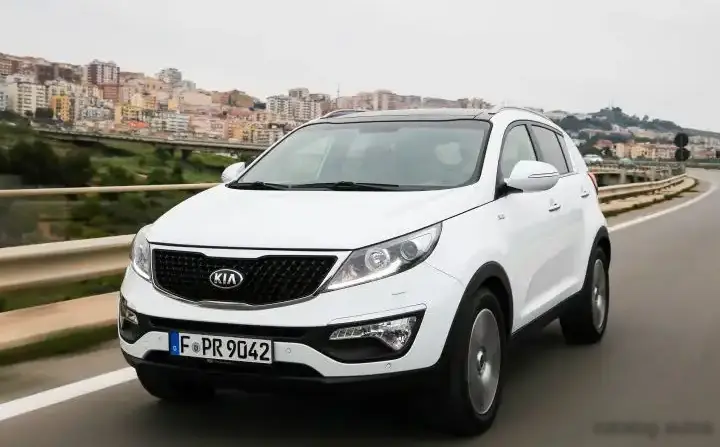
The Kia Sportage III (facelift, introduced in 2014) 2.0 GDI (166 Hp) Automatic represents a significant iteration of Kia’s popular compact SUV. Produced from 2014 to 2016, this variant occupied a mid-range position within the Sportage III lineup, offering a balance between performance, fuel efficiency, and features. It was primarily aimed at buyers seeking a comfortable and practical SUV with an automatic transmission, appealing to a broad demographic in both domestic Korean markets and export regions. This facelift brought styling updates and refinements to the already successful third-generation Sportage, enhancing its competitiveness in a crowded segment.
Technical Specifications
| Brand | Kia |
| Model | Sportage |
| Generation | Sportage III (facelift, 2014) |
| Type (Engine) | 2.0 GDI (166 Hp) Automatic |
| Start of production | 2014 |
| End of production | 2016 |
| Powertrain Architecture | Internal Combustion engine |
| Body type | SUV |
| Seats | 5 |
| Doors | 5 |
| Fuel consumption (urban) | 10.8 l/100 km (21.8 US mpg, 26.2 UK mpg, 9.3 km/l) |
| Fuel consumption (extra urban) | 6.2 l/100 km (37.9 US mpg, 45.6 UK mpg, 16.1 km/l) |
| Fuel consumption (combined) | 7.9 l/100 km (29.8 US mpg, 35.8 UK mpg, 12.7 km/l) |
| CO2 emissions | 184 g/km |
| Fuel Type | Petrol (Gasoline) |
| Acceleration 0 – 100 km/h | 10.4 sec |
| Acceleration 0 – 62 mph | 10.4 sec |
| Acceleration 0 – 60 mph | 9.9 sec |
| Maximum speed | 183 km/h (113.71 mph) |
| Emission standard | Euro 5 |
| Weight-to-power ratio | 8.9 kg/Hp, 112.8 Hp/tonne |
| Weight-to-torque ratio | 7.2 kg/Nm, 139.3 Nm/tonne |
| Power | 166 Hp @ 6200 rpm |
| Power per litre | 83 Hp/l |
| Torque | 205 Nm @ 4000 rpm (151.2 lb.-ft. @ 4000 rpm) |
| Engine layout | Front, Transverse |
| Engine Model/Code | G4NC |
| Engine displacement | 1999 cm3 (121.99 cu. in.) |
| Number of cylinders | 4 |
| Engine configuration | Inline |
| Cylinder Bore | 81 mm (3.19 in.) |
| Piston Stroke | 97 mm (3.82 in.) |
| Compression ratio | 11.5:1 |
| Number of valves per cylinder | 4 |
| Fuel injection system | Direct injection |
| Engine aspiration | Naturally aspirated engine |
| Valvetrain | DOHC |
| Engine oil capacity | 4 l (4.23 US qt | 3.52 UK qt) |
| Coolant | 6.7 l (7.08 US qt | 5.9 UK qt) |
| Kerb Weight | 1472 kg (3245.2 lbs.) |
| Max. weight | 1980 kg (4365.15 lbs.) |
| Max load | 508 kg (1119.95 lbs.) |
| Trunk (boot) space – minimum | 564 l (19.92 cu. ft.) |
| Trunk (boot) space – maximum | 1353 l (47.78 cu. ft.) |
| Fuel tank capacity | 58 l (15.32 US gal | 12.76 UK gal) |
| Permitted trailer load with brakes (12%) | 1600 kg (3527.4 lbs.) |
| Permitted trailer load without brakes | 750 kg (1653.47 lbs.) |
| Length | 4440 mm (174.8 in.) |
| Width | 1855 mm (73.03 in.) |
| Height | 1635 mm (64.37 in.) |
| Wheelbase | 2640 mm (103.94 in.) |
| Front track | 1611 mm (63.43 in.) |
| Rear (Back) track | 1612 mm (63.46 in.) |
| Ride height (ground clearance) | 172 mm (6.77 in.) |
| Drag coefficient (Cd) | 0.37 |
| Minimum turning circle (turning diameter) | 10.58 m (34.71 ft.) |
| Approach angle | 22.7° |
| Departure angle | 28.2° |
| Ramp-over (brakeover) angle | 17.7° |
| Drivetrain Architecture | The Internal combustion engine (ICE) drives the front wheels of the vehicle. |
| Drive wheel | Front wheel drive |
| Number of gears and type of gearbox | 6 gears, automatic transmission |
| Front brakes | Ventilated discs |
| Rear brakes | Disc |
| Assisting systems | ABS (Anti-lock braking system) |
| Steering type | Steering rack and pinion |
| Power steering | Electric Steering |
| Tires size | 225/60 R17 |
| Wheel rims size | 17 |
Powertrain & Engine Architecture
At the heart of the 2014-2016 Kia Sportage III 2.0 GDI Automatic lies the G4NC engine, a 1.999-liter (2.0L) inline-four cylinder gasoline engine. This engine utilizes Gasoline Direct Injection (GDI) technology, where fuel is injected directly into the combustion chamber, improving efficiency and power output. The G4NC features a double overhead camshaft (DOHC) valvetrain with four valves per cylinder, optimizing airflow for enhanced performance. The engine produces 166 horsepower at 6,200 rpm and 205 Nm (151.2 lb-ft) of torque at 4,000 rpm. Paired with this engine is a six-speed automatic transmission, designed for smooth shifting and optimized gear ratios for both city and highway driving. This transmission was a common choice for Sportage models aimed at comfort and ease of use.
Driving Characteristics
The 166 hp 2.0 GDI engine, coupled with the six-speed automatic, delivers adequate performance for everyday driving. Acceleration from 0 to 60 mph takes approximately 9.9 seconds, and 0-100 km/h in 10.4 seconds. While not a particularly sporty setup, it provides sufficient power for merging onto highways and overtaking slower traffic. The automatic transmission prioritizes smooth shifts over aggressive downshifting, making it a comfortable choice for daily commutes. Compared to the more powerful engines available in the Sportage III range (like the 2.4L GDI), this variant feels less responsive, especially when fully loaded. However, it offers better fuel economy than the larger engines. The gear ratios are tuned for fuel efficiency, meaning the engine can feel strained when climbing steep hills or accelerating quickly with a full passenger load.
Equipment & Trim Levels
The 2.0 GDI Automatic trim typically included standard features such as air conditioning, power windows and locks, a basic audio system with USB connectivity, and standard safety equipment like ABS, airbags, and stability control. Higher trim levels, available as options, added features like leather upholstery, a sunroof, a more advanced infotainment system with navigation, and automatic climate control. Interior upholstery was generally cloth on the base models, with leather available as an upgrade. Dashboard configurations were relatively straightforward, focusing on functionality and ease of use. Optional extras often included alloy wheels, parking sensors, and a rearview camera.
Chassis & Braking
The Kia Sportage III utilizes a front-wheel-drive platform with independent suspension in the front (typically McPherson strut) and a multi-link suspension in the rear. This setup provides a comfortable ride quality, absorbing bumps and irregularities in the road surface effectively. The 2.0 GDI Automatic variant typically featured ventilated disc brakes in the front and solid disc brakes in the rear. The braking system is assisted by ABS (Anti-lock Braking System), ensuring stable and controlled stopping power. Stabilizer bars were included both front and rear to reduce body roll during cornering, though the handling characteristics were geared more towards comfort than sporty driving.
Market Reception & Comparison
The 2.0 GDI Automatic Sportage was generally well-received as a practical and affordable SUV. Critics praised its comfortable ride, spacious interior, and good value for money. However, some reviewers noted that the engine could feel underpowered, especially when compared to competitors offering more powerful engine options. Fuel economy was considered competitive for its class, averaging around 29.8 US mpg in combined driving. Compared to the diesel variants (like the 1.7 CRDi), the 2.0 GDI offered a smoother and quieter driving experience but lacked the diesel’s superior fuel efficiency and low-end torque. Against gasoline-powered rivals like the Hyundai Tucson or Honda CR-V, the Sportage offered a similar level of performance and features at a competitive price point.
Legacy
The G4NC engine, when paired with the six-speed automatic transmission, has proven to be reasonably reliable over the long term. Common issues are relatively minor, often related to routine maintenance items like spark plugs, air filters, and oil changes. The automatic transmission is generally durable, but proper fluid changes are crucial for maintaining its performance and longevity. In the used car market, the 2014-2016 Kia Sportage III 2.0 GDI Automatic remains a popular choice due to its affordability, practicality, and relatively low running costs. Its reputation for reliability and the availability of affordable parts contribute to its continued appeal among budget-conscious buyers.