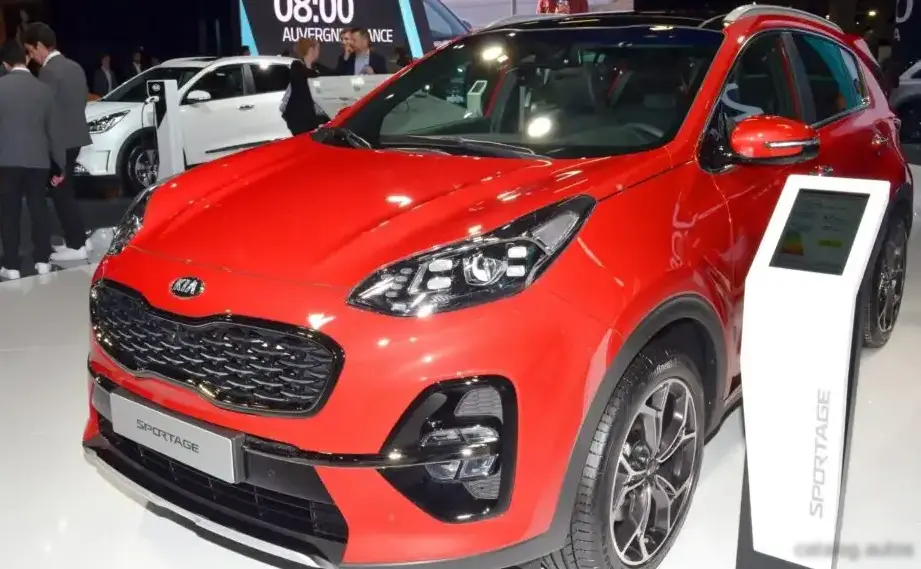
The Kia Sportage IV, specifically the facelifted version introduced in July 2018, represented a significant step forward for the South Korean automaker in the highly competitive compact SUV segment. The 1.6 T-GDI (177 hp) variant, produced through July 2021, was positioned as a mid-range offering, bridging the gap between the base engine options and the more powerful alternatives. This version aimed to balance fuel efficiency with acceptable performance for everyday driving, appealing to a broad customer base seeking a practical and well-equipped SUV. It was primarily marketed in Europe and other international markets, with the US market receiving different engine options for the Sportage.
Technical Specifications
| Brand | Kia |
| Model | Sportage |
| Generation | Sportage IV (facelift 2018) |
| Type (Engine) | 1.6 T-GDI (177 Hp) |
| Start of production | July, 2018 |
| End of production | July, 2021 |
| Powertrain Architecture | Internal Combustion engine |
| Body type | SUV |
| Seats | 5 |
| Doors | 5 |
| Fuel consumption (urban) | 9.2-9.8 l/100 km (25.6 – 24 US mpg) |
| Fuel consumption (extra urban) | 6.3-6.4 l/100 km (37.3 – 36.8 US mpg) |
| Fuel consumption (combined) | 7.4-7.6 l/100 km (31.8 – 30.9 US mpg) |
| CO2 emissions | 170-175 g/km |
| Fuel Type | Petrol (Gasoline) |
| Acceleration 0 – 100 km/h | 9.2 sec |
| Acceleration 0 – 62 mph | 9.2 sec |
| Acceleration 0 – 60 mph | 8.7 sec |
| Maximum speed | 205 km/h (127.38 mph) |
| Emission standard | Euro 6d – TEMP |
| Weight-to-power ratio | 8.3 kg/Hp, 120.4 Hp/tonne |
| Weight-to-torque ratio | 5.5 kg/Nm, 180.3 Nm/tonne |
| Power | 177 Hp @ 5500 rpm |
| Power per litre | 111.3 Hp/l |
| Torque | 265 Nm @ 1500-4500 rpm (195.45 lb.-ft. @ 1500-4500 rpm) |
| Engine layout | Front, Transverse |
| Engine Model/Code | Gamma II / G4FJ |
| Engine displacement | 1591 cm3 (97.09 cu. in.) |
| Number of cylinders | 4 |
| Engine configuration | Inline |
| Cylinder Bore | 77 mm (3.03 in.) |
| Piston Stroke | 85.44 mm (3.36 in.) |
| Compression ratio | 10:1 |
| Number of valves per cylinder | 4 |
| Fuel injection system | Direct injection |
| Engine aspiration | Turbocharger, Intercooler |
| Engine oil capacity | 4.5 l (4.76 US qt | 3.96 UK qt) |
| Coolant | 7.3 l (7.71 US qt | 6.42 UK qt) |
| Kerb Weight | 1470-1634 kg (3240.8 – 3602.35 lbs.) |
| Max. weight | 2110 kg (4651.75 lbs.) |
| Max load | 476-640 kg (1049.4 – 1410.96 lbs.) |
| Trunk (boot) space – minimum | 503 l (17.76 cu. ft.) |
| Trunk (boot) space – maximum | 1492 l (52.69 cu. ft.) |
| Fuel tank capacity | 62 l (16.38 US gal | 13.64 UK gal) |
| Max. roof load | 100 kg (220.46 lbs.) |
| Permitted trailer load with brakes (12%) | 1900 kg (4188.78 lbs.) |
| Permitted trailer load without brakes | 750 kg (1653.47 lbs.) |
| Permitted towbar download | 100 kg (220.46 lbs.) |
| Length | 4485 mm (176.57 in.) |
| Width | 1855 mm (73.03 in.) |
| Height | 1635-1645 mm (64.37 – 64.76 in.) |
| Wheelbase | 2670 mm (105.12 in.) |
| Front track | 1613-1625 mm (63.5 – 63.98 in.) |
| Rear (Back) track | 1625-1636 mm (63.98 – 64.41 in.) |
| Front overhang | 905 mm (35.63 in.) |
| Rear overhang | 910 mm (35.83 in.) |
| Ride height (ground clearance) | 172 mm (6.77 in.) |
| Minimum turning circle (turning diameter) | 11.0 m (36.09 ft.) |
| Approach angle | 16.8° |
| Departure angle | 26.1° |
| Ramp-over (brakeover) angle | 17.3° |
| Drivetrain Architecture | The Internal combustion engine (ICE) drives the front wheels of the vehicle. |
| Drive wheel | Front wheel drive |
| Number of gears and type of gearbox | 6 gears, manual transmission |
| Front suspension | Independent, type McPherson with coil spring and anti-roll bar |
| Rear suspension | Independent multi-link suspension |
| Front brakes | Ventilated discs |
| Rear brakes | Disc |
| Assisting systems | ABS (Anti-lock braking system) |
| Steering type | Steering rack and pinion |
| Power steering | Electric Steering |
| Tires size | 215/70 R16; 225/60 R17; 245/45 R19 |
| Wheel rims size | 6.5J x 16; 7.0J x 17; 7.5J x 19 |
INTRODUCTION
The Kia Sportage IV, launched in 2016 and receiving a significant facelift in 2018, quickly became a cornerstone of Kia’s global sales success. The facelift brought revised styling, updated technology, and refined engine options. The 1.6 T-GDI variant, producing 177 horsepower, was a key part of this update, designed to appeal to buyers seeking a balance between performance and economy. This engine was offered alongside diesel and larger gasoline options, catering to diverse market preferences. The Sportage IV is built on the 1HX0/A3 platform, shared with the Hyundai Tucson, and represents a substantial improvement over its predecessor in terms of refinement, space, and features.
Powertrain & Engine Architecture
The heart of this Sportage variant is the Gamma II 1.6 T-GDI engine, designated G4FJ. This is a four-cylinder, inline engine featuring direct fuel injection and a single turbocharger with an intercooler. The direct injection system allows for precise fuel delivery, optimizing combustion efficiency and power output. The turbocharger provides a boost in power and torque, overcoming the limitations of a relatively small displacement engine. The engine utilizes a timing chain, contributing to its longevity and reduced maintenance requirements. The 1.6 T-GDI engine is paired with a six-speed manual transmission in most configurations, although a seven-speed dual-clutch transmission (DCT) was also available in some markets. The DCT offered quicker shifts and improved fuel economy, but the manual transmission remained popular due to its simplicity and driver engagement.
Driving Characteristics
The 1.6 T-GDI Sportage delivers adequate performance for everyday driving. While not particularly sporty, the 177 hp engine provides sufficient power for highway cruising and overtaking maneuvers. Acceleration from 0 to 60 mph takes around 8.7 seconds, which is competitive within its class. The turbocharger provides a noticeable boost in torque at lower engine speeds, making it feel responsive in city driving. However, the engine can feel strained when pushed hard, particularly when fully loaded. The six-speed manual transmission offers a decent shift feel, but the gear ratios are geared more towards fuel efficiency than outright performance. Compared to the more powerful 2.0-liter gasoline or 1.7/2.0-liter diesel options, the 1.6 T-GDI feels less refined and offers less overall performance.
Equipment & Trim Levels
The 1.6 T-GDI Sportage typically came equipped with a respectable level of standard features. Depending on the specific trim level (often designated as ‘2’, ‘3’, or ‘GT-Line’), standard equipment included air conditioning, a touchscreen infotainment system with Apple CarPlay and Android Auto compatibility, Bluetooth connectivity, and a suite of safety features such as ABS, ESC, and multiple airbags. Higher trim levels added features like leather upholstery, heated front seats, a panoramic sunroof, and advanced driver-assistance systems (ADAS) such as lane departure warning and automatic emergency braking. Optional extras included a premium sound system, navigation system, and parking sensors.
Chassis & Braking
The Sportage IV utilizes a McPherson strut front suspension and a multi-link rear suspension, providing a comfortable and controlled ride. The suspension is tuned to prioritize comfort over sporty handling, but it still offers decent body control in corners. Front brakes are ventilated discs, while rear brakes are solid discs. ABS (Anti-lock Braking System) and ESC (Electronic Stability Control) are standard safety features. The steering is electrically assisted, providing a light and easy steering feel. Wheel sizes varied depending on the trim level, ranging from 16-inch to 19-inch alloy wheels.
Market Reception & Comparison
The 1.6 T-GDI Sportage received generally positive reviews from automotive critics. It was praised for its stylish design, spacious interior, and good value for money. However, some critics noted that the engine could feel underpowered at times, particularly when fully loaded or driving uphill. Compared to the diesel variants, the 1.6 T-GDI offered lower CO2 emissions but slightly higher fuel consumption in real-world driving. Against competitors like the Nissan Qashqai, Hyundai Tucson, and Volkswagen Tiguan, the Sportage offered a compelling package with a generous warranty and a well-equipped interior.
Legacy
The 1.6 T-GDI engine, while not without its quirks, has proven to be a relatively reliable powertrain. Common issues reported by owners include occasional turbocharger problems and potential issues with the fuel injectors. However, these issues are not widespread and can often be addressed with routine maintenance. In the used car market, the 1.6 T-GDI Sportage represents a good value proposition, offering a stylish and practical SUV at an affordable price. Its fuel efficiency and relatively low running costs make it an attractive option for buyers seeking a reliable and economical compact SUV.