
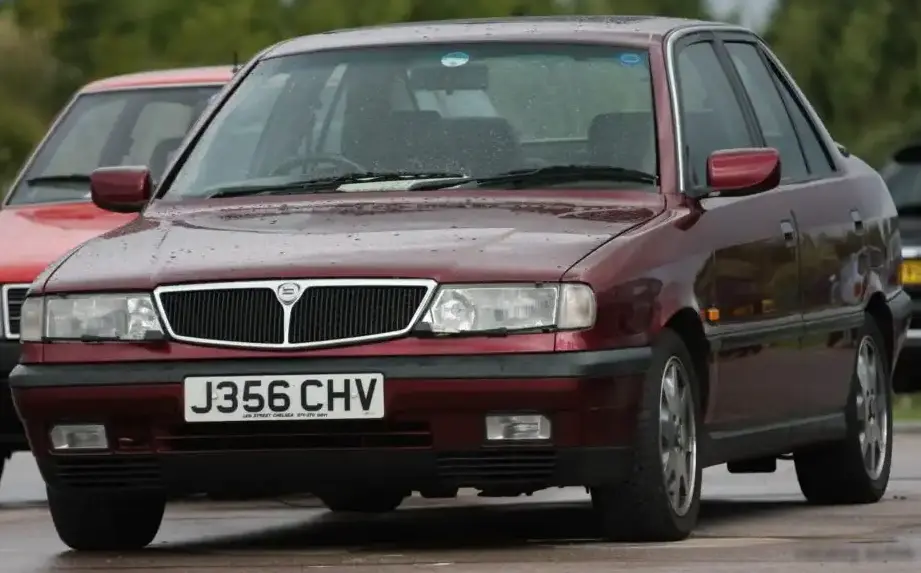
The Lancia Dedra 1.6 i.e. (75 hp) was a compact executive car produced by the Italian manufacturer Lancia between 1993 and 1999. Part of the 835 series, it represented Lancia’s offering in the D-segment, competing with vehicles like the Ford Mondeo, Opel Vectra, and Fiat Croma. This particular variant, powered by a 1.6-liter inline-four engine and typically paired with a five-speed manual transmission, served as the entry point into the Dedra range, prioritizing affordability and fuel economy over outright performance. It was positioned below the more powerful 1.8 and 2.0-liter versions, as well as the turbocharged models.
Technical Specifications
| Brand | Lancia |
| Model | Dedra |
| Generation | Dedra (835) |
| Type (Engine) | 1.6 i.e. (75 Hp) |
| Start of production | 1993 |
| End of production | 1999 |
| Powertrain Architecture | Internal Combustion engine |
| Body type | Sedan |
| Seats | 5 |
| Doors | 4 |
| Fuel consumption (combined) | 8.3 l/100 km |
| Fuel consumption (US mpg) | 28.3 US mpg |
| Fuel consumption (UK mpg) | 34 UK mpg |
| Fuel consumption (km/l) | 12 km/l |
| Fuel Type | Petrol (Gasoline) |
| Acceleration 0 – 100 km/h | 13.8 sec |
| Acceleration 0 – 62 mph | 13.8 sec |
| Acceleration 0 – 60 mph | 13.1 sec |
| Maximum speed | 170 km/h (105.63 mph) |
| Weight-to-power ratio | 14.6 kg/Hp |
| Weight-to-torque ratio | 8.7 kg/Nm |
| Power | 75 Hp @ 6000 rpm |
| Power per litre | 47.4 Hp/l |
| Torque | 125 Nm @ 3000 rpm (92.2 lb.-ft. @ 3000 rpm) |
| Engine layout | Front, Transverse |
| Engine Model/Code | 835 C1.000 |
| Engine displacement | 1581 cm3 (96.48 cu. in.) |
| Number of cylinders | 4 |
| Engine configuration | Inline |
| Cylinder Bore | 86.4 mm (3.4 in.) |
| Piston Stroke | 67.4 mm (2.65 in.) |
| Compression ratio | 9.2:1 |
| Number of valves per cylinder | 2 |
| Fuel injection system | Single-point injection |
| Engine aspiration | Naturally aspirated engine |
| Valvetrain | OHC |
| Engine oil capacity | 4.3 l (4.54 US qt | 3.78 UK qt) |
| Coolant capacity | 4.9 l (5.18 US qt | 4.31 UK qt) |
| Kerb Weight | 1093 kg (2409.65 lbs.) |
| Max. weight | 1620 kg (3571.49 lbs.) |
| Max load | 527 kg (1161.84 lbs.) |
| Trunk (boot) space – minimum | 480 l (16.95 cu. ft.) |
| Fuel tank capacity | 63 l (16.64 US gal | 13.86 UK gal) |
| Length | 4340 mm (170.87 in.) |
| Width | 1700 mm (66.93 in.) |
| Height | 1417 mm (55.79 in.) |
| Wheelbase | 2540 mm (100 in.) |
| Front track | 1436 mm (56.54 in.) |
| Rear track | 1417 mm (55.79 in.) |
| Drivetrain Architecture | The Internal combustion engine (ICE) drives the front wheels of the vehicle. |
| Drive wheel | Front wheel drive |
| Number of gears and type of gearbox | 5 gears, manual transmission |
| Front suspension | Spring Strut |
| Rear suspension | Trailing arm |
| Front brakes | Disc |
| Rear brakes | Disc |
| Assisting systems | ABS (Anti-lock braking system) |
| Steering type | Steering rack and pinion |
| Power steering | Hydraulic Steering |
| Tires size | 175/65 R14 |
INTRODUCTION
The Lancia Dedra, launched in 1989 and remaining in production until 1999, was a significant model for Lancia, representing a move towards more mainstream, contemporary designs. The 835 series, encompassing the Dedra and its sister car, the Fiat Chroma, was built on the Tipo Four platform. The 1.6 i.e. variant, introduced in 1993, offered a balance between affordability and usability, targeting buyers who prioritized fuel efficiency and lower running costs. It was a popular choice in Italy and other European markets where smaller-displacement engines were favored due to taxation and fuel prices.
Powertrain & Engine Architecture
The Dedra 1.6 i.e. was powered by the 835 C1.000 engine, a 1581cc inline-four cylinder unit. This engine featured a single overhead camshaft (OHC) and utilized a single-point fuel injection system. While not as sophisticated as multi-point injection found in higher-spec Dedra models, the system provided adequate fuel delivery for the engine’s modest power output. The engine produced 75 horsepower at 6000 rpm and 125 Nm (92.2 lb-ft) of torque at 3000 rpm. The engine’s compression ratio was 9.2:1. The standard transmission was a five-speed manual gearbox, although an optional four-speed automatic transmission was available, albeit less common. The automatic transmission, while offering convenience, noticeably impacted performance and fuel economy.
Driving Characteristics
The Dedra 1.6 i.e. offered a comfortable, if not particularly exciting, driving experience. With 75 hp, acceleration was leisurely, taking approximately 13.8 seconds to reach 62 mph (100 km/h). The engine felt strained when pushed hard, and overtaking required careful planning. The five-speed manual gearbox was well-matched to the engine, allowing drivers to keep the engine in its optimal power band. The automatic transmission, while smooth, further dulled performance and increased fuel consumption. Handling was secure and predictable, thanks to the front-wheel-drive layout and well-tuned suspension. The steering, while hydraulic, lacked significant feedback.
Equipment & Trim Levels
The Dedra 1.6 i.e. typically came equipped with a reasonable level of standard equipment. This included central locking, power steering, and electric front windows. Interior upholstery was typically cloth, with a relatively simple dashboard layout. Optional extras included air conditioning, alloy wheels, and a more advanced stereo system. Higher trim levels, such as the LX, added features like upgraded upholstery, a sunroof, and more comprehensive exterior trim. The Dedra was designed with practicality in mind, offering a spacious interior and a generous 480-liter trunk.
Chassis & Braking
The Dedra 1.6 i.e. utilized a front-wheel-drive layout with independent front suspension using spring struts and a trailing arm rear suspension. This setup provided a comfortable ride, absorbing bumps and imperfections in the road surface effectively. Braking was handled by disc brakes on all four wheels, supplemented by an anti-lock braking system (ABS) as standard equipment. The ABS system enhanced braking performance and stability, particularly on slippery surfaces. The car’s relatively light weight (approximately 1093 kg or 2409.65 lbs) helped to compensate for the engine’s modest power output.
Market Reception & Comparison
The Dedra 1.6 i.e. was generally well-received by automotive critics as a practical and affordable family car. However, its performance was often criticized as being underwhelming, particularly when compared to the more powerful Dedra variants, such as the 1.8 and 2.0-liter models. The 1.8-liter offered a noticeable performance boost, while the turbocharged versions provided significantly more power and torque. In terms of fuel economy, the 1.6 i.e. was the most efficient Dedra model, achieving around 34 UK mpg. Reliability was generally good, although the single-point fuel injection system could be prone to issues over time.
Legacy
The Lancia Dedra 1.6 i.e. remains a relatively affordable and accessible classic car in the used market. The 835 C1.000 engine is generally considered to be reliable, although regular maintenance is essential. Parts availability can be a challenge, as the Dedra is no longer in production. However, a dedicated community of Lancia enthusiasts exists, providing support and access to spare parts. While not a performance icon, the Dedra 1.6 i.e. represents a significant chapter in Lancia’s history, offering a blend of Italian style, practicality, and affordability.
