
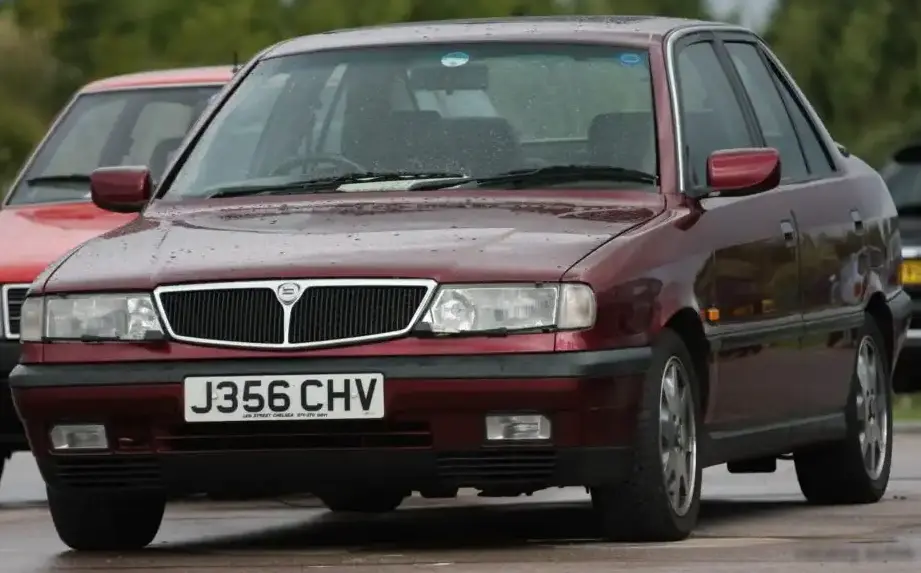
The Lancia Dedra 1.6 LE (90 hp) was a four-door sedan produced between 1994 and 1999, representing a key variant within the 835 series of the Dedra model. Positioned as an entry-level to mid-range offering, it aimed to provide comfortable and economical transportation for families and commuters. The Dedra itself was Lancia’s replacement for the aging Prisma, built upon the shared Tipo/Tempra/Croma platform – internally designated as the Type Three project, and more specifically the 1HX0 platform for the Dedra. The 1.6 LE trim offered a balance between affordability and acceptable performance, making it a popular choice in European markets, particularly Italy, where Lancia maintained a strong brand presence.
Technical Specifications
| Brand | Lancia |
| Model | Dedra |
| Generation | Dedra (835) |
| Type (Engine) | 1.6 LE (90 Hp) |
| Start of production | 1994 |
| End of production | 1999 |
| Powertrain Architecture | Internal Combustion engine |
| Body type | Sedan |
| Seats | 5 |
| Doors | 4 |
| Fuel consumption (urban) | 9.3 l/100 km (25.3 US mpg) |
| Fuel consumption (extra urban) | 5.5 l/100 km (42.8 US mpg) |
| Fuel consumption (combined) | 7.3 l/100 km (32.2 US mpg) |
| Fuel Type | Petrol (Gasoline) |
| Acceleration 0 – 100 km/h | 12.1 sec |
| Acceleration 0 – 62 mph | 12.1 sec |
| Acceleration 0 – 60 mph | 11.5 sec |
| Maximum speed | 180 km/h (111.85 mph) |
| Weight-to-power ratio | 11.8 kg/Hp |
| Weight-to-torque ratio | 8.3 kg/Nm |
| Power | 90 Hp @ 5750 rpm |
| Torque | 127 Nm @ 2750 rpm (93.67 lb.-ft. @ 2750 rpm) |
| Engine layout | Front, Transverse |
| Engine Model/Code | 159 B9.000 |
| Engine displacement | 1581 cm3 (96.48 cu. in.) |
| Number of cylinders | 4 |
| Engine configuration | Inline |
| Cylinder Bore | 86.4 mm (3.4 in.) |
| Piston Stroke | 67.4 mm (2.65 in.) |
| Compression ratio | 9.5:1 |
| Number of valves per cylinder | 2 |
| Fuel injection system | Multi-port manifold injection |
| Engine aspiration | Naturally aspirated engine |
| Valvetrain | OHC |
| Engine oil capacity | 4.3 l (4.54 US qt | 3.78 UK qt) |
| Coolant capacity | 4.9 l (5.18 US qt | 4.31 UK qt) |
| Kerb Weight | 1060 kg (2336.9 lbs.) |
| Max. weight | 1600 kg (3527.4 lbs.) |
| Max load | 540 kg (1190.5 lbs.) |
| Trunk (boot) space – minimum | 480 l (16.95 cu. ft.) |
| Fuel tank capacity | 63 l (16.64 US gal | 13.86 UK gal) |
| Length | 4340 mm (170.87 in.) |
| Width | 1700 mm (66.93 in.) |
| Height | 1417 mm (55.79 in.) |
| Wheelbase | 2540 mm (100 in.) |
| Front track | 1436 mm (56.54 in.) |
| Rear track | 1417 mm (55.79 in.) |
| Drivetrain Architecture | Front wheel drive |
| Number of gears | 5 |
| Gearbox type | Manual transmission |
| Front suspension | Spring Strut |
| Rear suspension | Trailing arm |
| Front brakes | Disc |
| Rear brakes | Disc |
| Assisting systems | ABS (Anti-lock braking system) |
| Steering type | Steering rack and pinion |
| Power steering | Hydraulic Steering |
| Tires size | 175/65 R14 |
Introduction
The Lancia Dedra 1.6 LE, produced from 1994 to 1999, was a significant model within the Dedra range (835 series). It occupied a crucial position in Lancia’s lineup, offering a more accessible entry point into the Dedra family compared to the more powerful 2.0-liter and turbocharged variants. Built on the Tipo/Tempra/Croma platform, the Dedra aimed to combine Italian styling with practical family car attributes. The 1.6 LE specifically targeted buyers seeking a comfortable, reliable, and reasonably economical sedan. It was primarily sold in European markets, with a strong focus on Italy, where Lancia enjoyed a loyal customer base.
Powertrain & Engine Architecture
The heart of the Dedra 1.6 LE is the 159 B9.000 engine, a 1.6-liter inline-four cylinder gasoline engine. This engine is a naturally aspirated unit featuring a single overhead camshaft (OHC) valvetrain with two valves per cylinder. Fuel delivery is managed by a multi-port fuel injection system, providing a balance between efficiency and performance. The engine produces 90 horsepower at 5750 rpm and 127 Nm (93.67 lb-ft) of torque at 2750 rpm. The engine’s design prioritized smooth operation and fuel economy over outright power. The 1.6L engine was paired with a five-speed manual transmission as standard, although an optional four-speed automatic transmission was available, impacting the car’s acceleration and fuel consumption. The automatic transmission, while offering convenience, was known to slightly diminish performance compared to the manual counterpart.
Driving Characteristics
The Dedra 1.6 LE, particularly in manual form, offered a reasonably engaging driving experience for its class. Acceleration from 0 to 60 mph took around 11.5 seconds, and it had a top speed of 180 km/h (111.85 mph). The 90 hp engine provided adequate power for everyday driving, but it wasn’t particularly sporty. The automatic transmission version saw a slight decrease in acceleration, typically around 12.1 seconds for 0-60 mph. The gear ratios were tuned for fuel efficiency and comfortable cruising rather than rapid acceleration. Handling was generally safe and predictable, with the front-wheel-drive layout providing good stability. Compared to the more powerful Dedra variants, such as the 2.0 i.e. or the turbocharged models, the 1.6 LE felt noticeably less responsive, but it offered a more forgiving and relaxed driving experience.
Equipment & Trim Levels
The “LE” designation indicated a relatively well-equipped trim level. Standard features typically included central locking, power windows, power steering, and an adjustable steering column. Interior upholstery was usually cloth, with a focus on durability and comfort. Optional extras available for the 1.6 LE included air conditioning, alloy wheels, and a radio/cassette player. The dashboard layout was functional and straightforward, typical of Italian cars of the era. The interior space was generous for a sedan of its size, offering ample room for passengers and luggage. The 1.6 LE trim aimed to provide a good balance of features without the higher price tag of the more luxurious Dedra variants.
Chassis & Braking
The Dedra 1.6 LE utilized a front-wheel-drive chassis with independent front suspension using spring struts and a trailing arm rear suspension. This setup provided a comfortable ride quality, absorbing bumps and imperfections in the road effectively. Braking was handled by disc brakes on all four wheels, supplemented by an Anti-lock Braking System (ABS) as standard, enhancing safety and control during emergency braking. The suspension was tuned for comfort rather than sporty handling, prioritizing a smooth and stable ride. The tires were typically 175/65 R14, providing a good balance between grip and fuel efficiency.
Market Reception & Comparison
The Dedra 1.6 LE was generally well-received by automotive critics as a practical and comfortable family sedan. It was praised for its spacious interior, comfortable ride, and reasonable fuel economy. However, some critics noted that the 90 hp engine could feel underpowered, especially when fully loaded or tackling steep hills. Compared to the 2.0-liter Dedra models, the 1.6 LE offered significantly lower running costs but sacrificed performance. The 1.9 TDI diesel variant provided even better fuel economy but lacked the refinement of the gasoline engine. The 1.6 LE appealed to buyers who prioritized affordability, comfort, and reliability over outright performance.
Legacy
The Lancia Dedra 1.6 LE, while not a performance icon, remains a fondly remembered car for many owners. The 159 B9.000 engine is generally considered to be a reliable unit, although regular maintenance is essential. Today, the Dedra 1.6 LE can be found in the used car market at relatively affordable prices. Its simplicity and relatively low running costs make it an attractive option for those seeking a classic Italian sedan. Parts availability can be a challenge, but a dedicated community of Lancia enthusiasts helps to keep these cars on the road. The Dedra, in general, represents a final flourish of Lancia’s independent spirit before its integration into the Fiat group became more pronounced.
