
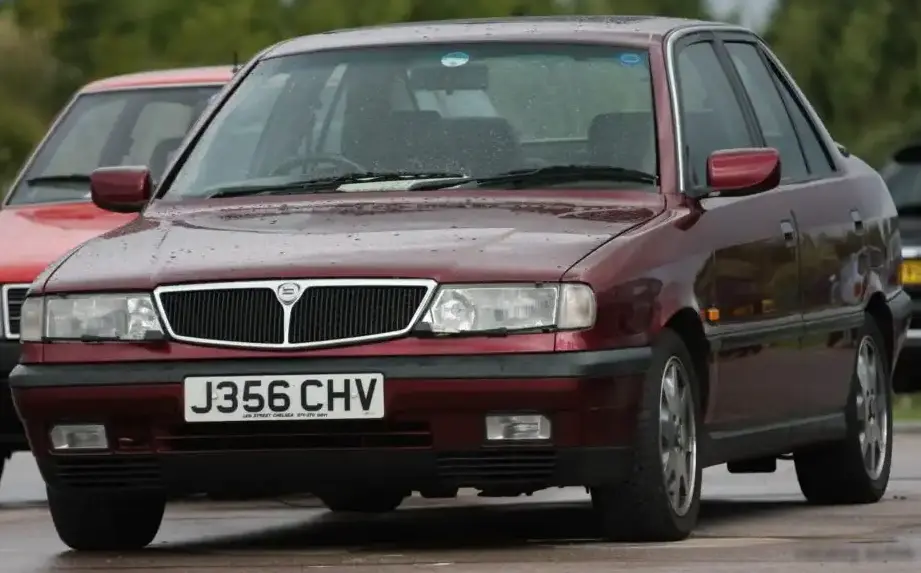
The Lancia Dedra (835) 2.0 HF Integrale 4WD, produced between 1990 and 1995, represents a high-performance variant of the Dedra sedan. Positioned as the flagship of the range, it combined Lancia’s engineering prowess with a potent turbocharged engine and all-wheel drive, aimed at enthusiasts seeking a capable and refined family car. The Dedra itself was a replacement for the aging Lancia Prisma, and was based on the Fiat Tipo platform (Type 835), sharing many components but offering a more premium experience. The HF Integrale specifically targeted drivers desiring a blend of performance and practicality, offering a compelling alternative to more mainstream offerings.
Technical Specifications
| Brand | Lancia |
| Model | Dedra |
| Generation | Dedra (835) |
| Type (Engine) | 2.0 HF Integrale 4WD (169 Hp) |
| Start of production | 1990 |
| End of production | 1995 |
| Powertrain Architecture | Internal Combustion engine |
| Body type | Sedan |
| Seats | 5 |
| Doors | 4 |
| Fuel consumption (urban) | 13 l/100 km (18.1 US mpg, 21.7 UK mpg, 7.7 km/l) |
| Fuel consumption (extra urban) | 7.8 l/100 km (30.2 US mpg, 36.2 UK mpg, 12.8 km/l) |
| Fuel consumption (combined) | 9.9 l/100 km (23.8 US mpg, 28.5 UK mpg, 10.1 km/l) |
| Fuel Type | Petrol (Gasoline) |
| Acceleration 0 – 100 km/h | 8 sec |
| Acceleration 0 – 62 mph | 8 sec |
| Acceleration 0 – 60 mph | 7.6 sec |
| Maximum speed | 215 km/h (133.59 mph) |
| Weight-to-power ratio | 8 kg/Hp, 125.7 Hp/tonne |
| Weight-to-torque ratio | 5.1 kg/Nm, 196.3 Nm/tonne |
| Power | 169 Hp @ 5500 rpm |
| Power per litre | 84.7 Hp/l |
| Torque | 264 Nm @ 3250 rpm (194.72 lb.-ft. @ 3250 rpm) |
| Engine layout | Front, Transverse |
| Engine Model/Code | 835 A7.046 |
| Engine displacement | 1995 cm3 (121.74 cu. in.) |
| Number of cylinders | 4 |
| Engine configuration | Inline |
| Cylinder Bore | 84 mm (3.31 in.) |
| Piston Stroke | 90 mm (3.54 in.) |
| Compression ratio | 7.5:1 |
| Number of valves per cylinder | 2 |
| Fuel injection system | Multi-port manifold injection |
| Engine aspiration | Turbocharger |
| Valvetrain | DOHC |
| Engine oil capacity | 6 l (6.34 US qt | 5.28 UK qt) |
| Coolant | 6.9 l (7.29 US qt | 6.07 UK qt) |
| Kerb Weight | 1345 kg (2965.22 lbs.) |
| Max. weight | 1780 kg (3924.23 lbs.) |
| Max load | 435 kg (959.01 lbs.) |
| Trunk (boot) space – minimum | 480 l (16.95 cu. ft.) |
| Fuel tank capacity | 63 l (16.64 US gal | 13.86 UK gal) |
| Length | 4340 mm (170.87 in.) |
| Width | 1700 mm (66.93 in.) |
| Height | 1417 mm (55.79 in.) |
| Wheelbase | 2540 mm (100 in.) |
| Front track | 1436 mm (56.54 in.) |
| Rear (Back) track | 1417 mm (55.79 in.) |
| Drive wheel | All wheel drive (4×4) |
| Number of gears and type of gearbox | 5 gears, manual transmission |
| Front suspension | Spring Strut |
| Rear suspension | Trailing arm |
| Front brakes | Ventilated discs |
| Rear brakes | Disc |
| Assisting systems | ABS (Anti-lock braking system) |
| Steering type | Steering rack and pinion |
| Power steering | Hydraulic Steering |
| Tires size | 195/50 R15 |
Powertrain & Engine Architecture
The heart of the Dedra 2.0 HF Integrale is the 835 A7.046 engine, a 1,995 cc inline-four cylinder unit. This engine is notable for its use of a Garrett turbocharger with an intercooler, boosting power output to 169 horsepower at 5,500 rpm and 264 Nm (194.72 lb-ft) of torque at 3,250 rpm. The engine utilizes multi-port fuel injection and a double overhead camshaft (DOHC) valvetrain, contributing to its responsive nature. The compression ratio is set at 7.5:1. The five-speed manual transmission was the only gearbox option, designed to handle the increased power and torque delivered by the turbocharged engine. The transmission’s gear ratios were tuned for a balance between acceleration and cruising efficiency.
Driving Characteristics
The 2.0 HF Integrale offered a significantly more engaging driving experience than the standard Dedra models. The turbocharger provides a noticeable surge of power, particularly in the mid-range, making overtaking maneuvers effortless. While not a dedicated sports car, the Integrale’s all-wheel drive system provides excellent traction, especially on slippery surfaces. The steering is precise, and the suspension, while tuned for comfort, offers a reasonable level of control. Compared to the naturally aspirated 1.6L and 1.8L versions, the Integrale delivers a substantial performance upgrade. The manual transmission allows for greater driver involvement, unlike the automatic options available on lower trims. However, the turbo lag, typical of older turbocharged engines, is present, requiring drivers to anticipate power delivery.
Equipment & Trim Levels
The HF Integrale trim level was well-equipped for its time. Standard features included power windows, central locking, and an upgraded interior with sport seats upholstered in a combination of fabric and Alcantara. Air conditioning was often included, and optional extras such as a sunroof, upgraded audio system, and alloy wheels were available. The dashboard featured a distinctive instrument cluster with additional gauges monitoring turbo boost pressure. The overall interior design aimed for a balance between comfort and a sporty aesthetic.
Chassis & Braking
The Dedra 2.0 HF Integrale featured a robust chassis designed to handle the increased power and all-wheel drive system. The front suspension utilized a spring strut setup, while the rear employed a trailing arm configuration. The braking system consisted of ventilated discs on the front wheels and solid discs on the rear, providing adequate stopping power. An anti-lock braking system (ABS) was standard, enhancing safety. The all-wheel drive system employed a viscous coupling to distribute torque between the front and rear axles, providing optimal traction in various conditions.
Market Reception & Comparison
The Lancia Dedra 2.0 HF Integrale was generally well-received by automotive critics. It was praised for its performance, handling, and comfortable interior. However, some reviewers noted the turbo lag and the relatively high price compared to other family sedans. Compared to the lower-spec Dedra models, the Integrale offered a significant performance advantage but came at a higher cost and with slightly reduced fuel economy. It competed with other performance-oriented sedans of the era, such as the Ford Sierra Cosworth and the Volkswagen Golf GTI, offering a more refined and comfortable alternative.
Legacy
The Lancia Dedra 2.0 HF Integrale remains a sought-after model among Lancia enthusiasts. The 835 A7.046 engine, while not without its quirks, is generally considered reliable when properly maintained. The all-wheel drive system and robust chassis contribute to the car’s longevity. Today, well-maintained examples are becoming increasingly rare and are valued for their unique blend of performance, comfort, and Italian styling. The car represents a high point in Lancia’s engineering history, showcasing the brand’s ability to create compelling and capable automobiles.
