
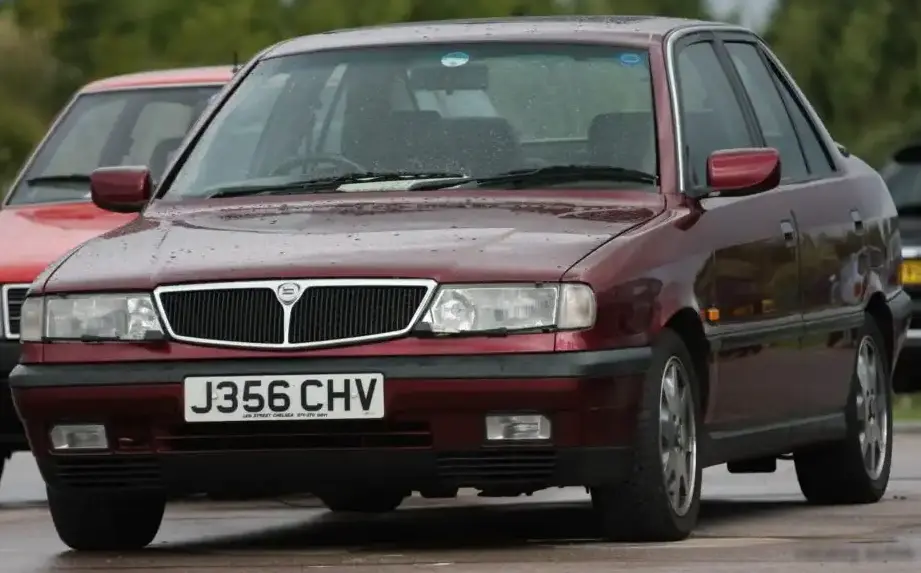
The Lancia Dedra 2000 Turbo, produced between May 1991 and October 1994, represented a performance-oriented variant within the Dedra (835) model range. Positioned as a sporty offering, it aimed to provide a more engaging driving experience than the base models. The Dedra itself was Lancia’s replacement for the aging Prisma, built upon the Tipo/Tempra platform – internally known as the 835 project – and shared many components with Fiat, Alfa Romeo, and Saab vehicles of the era. The 2000 Turbo was a key part of Lancia’s attempt to maintain a sporting image, appealing to drivers seeking a blend of Italian style and respectable performance in a practical, family-sized sedan.
Technical Specifications
| Brand | Lancia |
| Model | Dedra |
| Generation | Dedra (835) |
| Type (Engine) | 2000 Turbo (165 Hp) |
| Start of production | May, 1991 |
| End of production | October, 1994 |
| Powertrain Architecture | Internal Combustion engine |
| Body type | Sedan |
| Seats | 5 |
| Doors | 4 |
| Fuel consumption (urban) | 11.9 l/100 km (19.8 US mpg) |
| Fuel consumption (extra urban) | 7.2 l/100 km (32.7 US mpg) |
| Fuel Type | Petrol (Gasoline) |
| Acceleration 0 – 100 km/h | 8.3 sec |
| Acceleration 0 – 62 mph | 8.3 sec |
| Acceleration 0 – 60 mph | 7.9 sec |
| Maximum speed | 215 km/h (133.59 mph) |
| Weight-to-power ratio | 7.6 kg/Hp |
| Weight-to-torque ratio | 4.6 kg/Nm |
| Power | 165 Hp @ 5500 rpm |
| Power per litre | 82.7 Hp/l |
| Torque | 274 Nm @ 3000 rpm (202.09 lb.-ft. @ 3000 rpm) |
| Engine layout | Front, Transverse |
| Engine displacement | 1995 cm3 (121.74 cu. in.) |
| Number of cylinders | 4 |
| Engine configuration | Inline |
| Cylinder Bore | 84 mm (3.31 in.) |
| Piston Stroke | 90 mm (3.54 in.) |
| Compression ratio | 7.5:1 |
| Number of valves per cylinder | 4 |
| Fuel injection system | Multi-port manifold injection |
| Engine aspiration | Turbocharger, Intercooler |
| Valvetrain | DOHC |
| Engine oil capacity | 5.2 l (5.49 US qt | 4.58 UK qt) |
| Coolant | 6.9 l (7.29 US qt | 6.07 UK qt) |
| Kerb Weight | 1259 kg (2775.62 lbs.) |
| Trunk (boot) space – minimum | 405 l (14.3 cu. ft.) |
| Fuel tank capacity | 63 l (16.64 US gal | 13.86 UK gal) |
| Permitted trailer load with brakes (12%) | 1300 kg (2866.01 lbs.) |
| Length | 4343 mm (170.98 in.) |
| Width | 1700 mm (66.93 in.) |
| Height | 1430 mm (56.3 in.) |
| Wheelbase | 2540 mm (100 in.) |
| Front track | 1449 mm (57.05 in.) |
| Rear (Back) track | 1411 mm (55.55 in.) |
| Minimum turning circle | 10.5 m (34.45 ft.) |
| Drivetrain Architecture | Front wheel drive |
| Number of gears and type of gearbox | 5 gears, manual transmission |
| Front suspension | Independent, type McPherson with coil spring and anti-roll bar |
| Rear suspension | Wishbone |
| Front brakes | Ventilated discs, 284 mm |
| Rear brakes | Disc, 240 mm |
| Assisting systems | ABS (Anti-lock braking system) |
| Steering type | Steering rack and pinion |
| Power steering | Hydraulic Steering |
| Tires size | 195/50 R15 |
| Wheel rims size | 6J x 15 |
Introduction
The Lancia Dedra 2000 Turbo, launched in 1991, was a significant variant of the 835 series. It aimed to inject some excitement into the Dedra lineup, offering a more potent engine and a slightly more focused driving experience. Built as a four-door sedan, it competed in the mid-size segment, primarily in European markets. The Dedra, and by extension the 2000 Turbo, was intended to be a more sophisticated and stylish alternative to mainstream offerings like the Ford Mondeo or Opel/Vauxhall Vectra. It represented Lancia’s continued effort to blend performance with practicality and Italian design flair.
Powertrain & Engine Architecture
At the heart of the Dedra 2000 Turbo lies the 1995cc inline-four cylinder engine, designated as the 835A2.000. This engine is a derivative of the Fiat/Alfa Romeo Twin Cam engine family, known for its robust construction and tuning potential. The key feature, of course, is the Garrett T25 turbocharger with an intercooler, boosting power output to 165 horsepower at 5500 rpm and 274 Nm (202 lb-ft) of torque at 3000 rpm. Fuel delivery is managed by a Bosch multi-port fuel injection system. The engine utilizes a double overhead camshaft (DOHC) valvetrain with four valves per cylinder, contributing to its relatively high specific output. The 2000 Turbo was exclusively offered with a five-speed manual transmission, chosen to complement the engine’s performance characteristics. This transmission was a robust unit, designed to handle the increased torque output of the turbocharged engine.
Driving Characteristics
The Dedra 2000 Turbo offered a noticeable step up in performance compared to the naturally aspirated versions. Acceleration to 60 mph was achieved in around 7.9 seconds, and it could reach a top speed of 133.59 mph. The turbocharger provided a surge of power in the mid-range, making overtaking maneuvers relatively effortless. However, turbo lag was present, requiring the driver to downshift to maintain optimal power delivery. The five-speed manual transmission was well-matched to the engine, offering precise shifts and allowing the driver to keep the engine within its power band. The suspension, while comfortable for everyday driving, was firm enough to provide decent handling, although it wasn’t as sporty as some of its rivals. The steering was light and precise, making the car easy to maneuver in urban environments.
Equipment & Trim Levels
The Dedra 2000 Turbo typically came equipped with a higher level of standard features than the base models. This included central locking, electric windows, power steering, and an upgraded interior trim. Upholstery was generally cloth, but leather options were available. The dashboard featured a comprehensive instrument cluster with gauges for oil pressure and temperature, in addition to the standard speedometer, tachometer, and fuel gauge. Optional extras included air conditioning, a sunroof, and upgraded audio systems. The overall interior design was typically Italian – stylish and functional, with a focus on comfort.
Chassis & Braking
The Dedra 2000 Turbo utilized an independent McPherson strut suspension at the front and a semi-independent wishbone suspension at the rear. This setup provided a good balance between ride comfort and handling. Braking duties were handled by ventilated discs at the front and solid discs at the rear, equipped with an anti-lock braking system (ABS) as standard. The ABS system helped to maintain stability during hard braking. The car rode on 15-inch alloy wheels, typically fitted with 195/50 R15 tires.
Market Reception & Comparison
The Dedra 2000 Turbo was generally well-received by automotive critics, who praised its performance, stylish design, and comfortable interior. However, some criticized its turbo lag and relatively high fuel consumption. Compared to its siblings, the 2000 Turbo offered a significant performance advantage over the naturally aspirated 1.6 and 2.0-liter models. It was also more expensive, positioning it as a premium offering within the Dedra range. The 1.9 TDI diesel version offered superior fuel economy but lacked the performance of the 2000 Turbo. The 2000 Turbo appealed to drivers who wanted a blend of performance and practicality, while the diesel version catered to those prioritizing fuel efficiency.
Legacy
The Lancia Dedra 2000 Turbo, while not a massive sales success, remains a fondly remembered car among enthusiasts. The 835A2.000 engine proved to be relatively reliable, provided it was properly maintained. Today, well-maintained examples are becoming increasingly sought after by collectors and classic car enthusiasts. The turbocharger and fuel injection system require regular attention, but the engine itself is generally robust. The Dedra 2000 Turbo represents a unique chapter in Lancia’s history, showcasing the brand’s commitment to performance and Italian design. Its blend of style, performance, and practicality continues to appeal to those seeking a distinctive and engaging driving experience.
