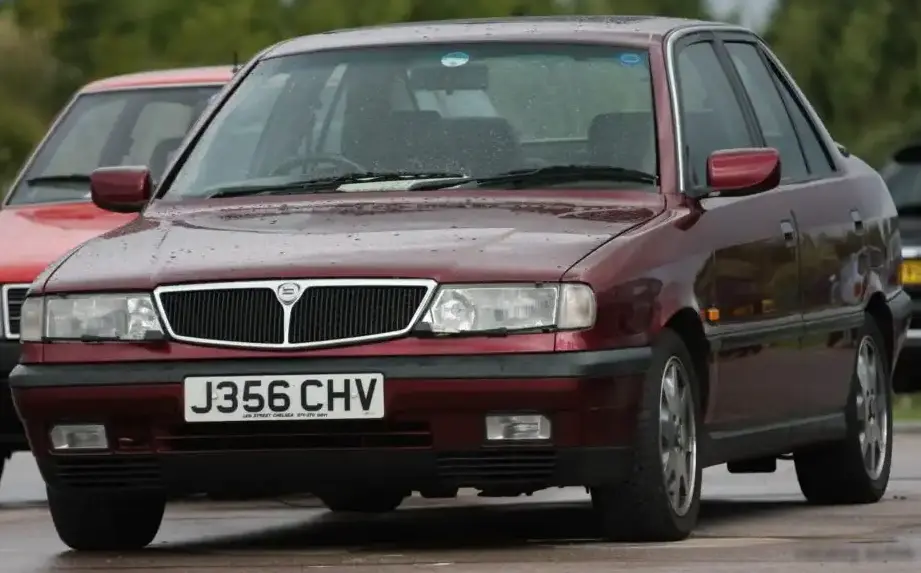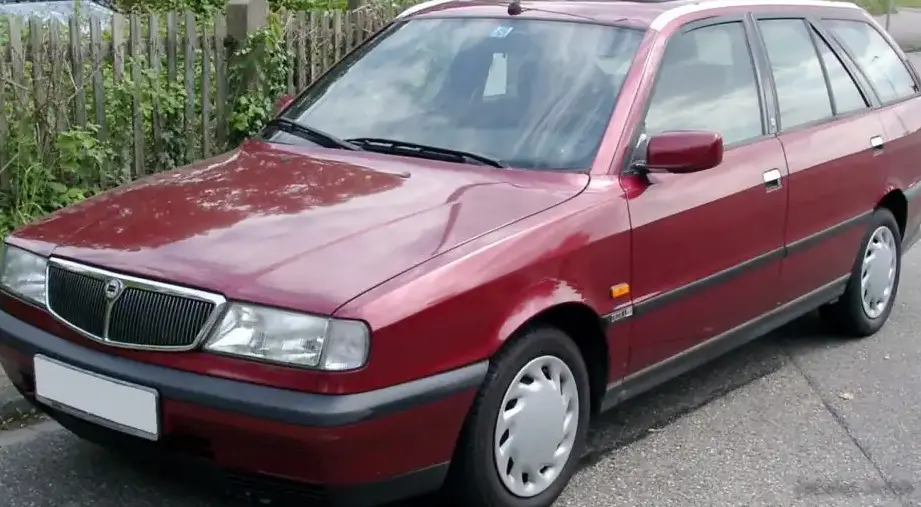
The Lancia Dedra Station Wagon (835) 1.6, producing 90 horsepower, was a practical and relatively affordable variant of the Dedra range, produced between 1994 and 1999. Positioned as an entry-level option within the second generation Dedra (introduced in 1994), it aimed to provide family-oriented buyers with a spacious and comfortable estate car. The Dedra itself was a significant model for Lancia, representing a move towards more mainstream, contemporary designs, and sharing its underpinnings with the Fiat Croma and Alfa Romeo 164 – all built on the Type Four platform, internally known as the 835 project. This 1.6L variant offered a balance between fuel economy and usability, making it a popular choice in European markets where estate cars held a strong appeal.
Technical Specifications
| Brand | Lancia |
| Model | Dedra |
| Generation | Dedra Station Wagon (835) |
| Type (Engine) | 1.6 (90 Hp) |
| Start of production | 1994 |
| End of production | 1999 |
| Powertrain Architecture | Internal Combustion engine |
| Body type | Station wagon (estate) |
| Seats | 5 |
| Doors | 5 |
| Fuel consumption (combined) | 7.9 l/100 km |
| Fuel consumption (US mpg) | 29.8 US mpg |
| Fuel consumption (UK mpg) | 35.8 UK mpg |
| Fuel consumption (km/l) | 12.7 km/l |
| Fuel Type | Petrol (Gasoline) |
| Acceleration 0 – 100 km/h | 13.3 sec |
| Acceleration 0 – 62 mph | 13.3 sec |
| Acceleration 0 – 60 mph | 12.6 sec |
| Maximum speed | 175 km/h (108.74 mph) |
| Weight-to-power ratio | 13.1 kg/Hp |
| Weight-to-torque ratio | 9.3 kg/Nm |
| Power | 90 Hp @ 5750 rpm |
| Power per litre | 56.9 Hp/l |
| Torque | 127 Nm @ 2750 rpm (93.67 lb.-ft. @ 2750 rpm) |
| Engine layout | Front, Transverse |
| Engine Model/Code | 159 B9.000 |
| Engine displacement | 1581 cm3 (96.48 cu. in.) |
| Number of cylinders | 4 |
| Engine configuration | Inline |
| Cylinder Bore | 86.4 mm (3.4 in.) |
| Piston Stroke | 67.4 mm (2.65 in.) |
| Compression ratio | 9.5:1 |
| Number of valves per cylinder | 2 |
| Fuel injection system | Multi-port manifold injection |
| Engine aspiration | Naturally aspirated engine |
| Valvetrain | OHC |
| Engine oil capacity | 4.3 l (4.54 US qt | 3.78 UK qt) |
| Coolant capacity | 4.9 l (5.18 US qt | 4.31 UK qt) |
| Kerb Weight | 1180 kg (2601.45 lbs.) |
| Trunk (boot) space – minimum | 448 l (15.82 cu. ft.) |
| Trunk (boot) space – maximum | 1338 l (47.25 cu. ft.) |
| Fuel tank capacity | 60 l (15.85 US gal | 13.2 UK gal) |
| Length | 4343 mm (170.98 in.) |
| Width | 1703 mm (67.05 in.) |
| Height | 1449 mm (57.05 in.) |
| Wheelbase | 2540 mm (100 in.) |
| Front track | 1436 mm (56.54 in.) |
| Rear track | 1415 mm (55.71 in.) |
| Drivetrain Architecture | Front wheel drive |
| Number of gears | 5 |
| Gearbox type | Manual transmission |
| Front suspension | Spring Strut |
| Rear suspension | Trailing arm |
| Front brakes | Disc |
| Rear brakes | Disc |
| Assisting systems | ABS (Anti-lock braking system) |
| Steering type | Steering rack and pinion |
| Power steering | Hydraulic Steering |
| Tires size | 175/65 R14 |
Powertrain & Engine Architecture
The Dedra 1.6 utilized the Fiat-developed 159 B9.000 engine, a 1581cc inline-four cylinder unit. This engine featured a single overhead camshaft (OHC) design operating two valves per cylinder. Fuel delivery was managed by a multi-port fuel injection system, contributing to improved efficiency and smoother operation compared to earlier carbureted designs. The engine produced 90 horsepower at 5750 rpm and 127 Nm (93.67 lb-ft) of torque at 2750 rpm. The engine’s relatively modest output was typical for this displacement in the early 1990s, prioritizing fuel economy and reliability over outright performance. The five-speed manual transmission was the standard offering, providing a reasonable spread of gears for everyday driving. The transmission was known for its relatively light shift action, though it wasn’t particularly sporty in feel.
Driving Characteristics
The 1.6L Dedra Station Wagon offered a comfortable, if not particularly exciting, driving experience. Acceleration from 0-60 mph took around 12.6 seconds, and top speed was approximately 108.74 mph. The engine felt adequate for typical commuting and highway cruising, but struggled when fully loaded or attempting brisk overtaking maneuvers. The five-speed manual transmission helped to keep the engine in its optimal power band, but the lack of significant low-end torque meant frequent downshifts were often necessary. Compared to the more powerful 1.9 TDI diesel or the sportier 2.0L versions, the 1.6L felt noticeably slower. However, it offered a smoother and quieter ride, making it a more appealing option for drivers prioritizing comfort.
Equipment & Trim Levels
The 1.6L Dedra Station Wagon typically came with a fairly basic level of equipment, reflecting its position as the entry-level model. Standard features generally included central locking, power steering, and an adjustable steering column. Interior upholstery was typically cloth, and the dashboard featured a functional, if somewhat dated, design. Optional extras included air conditioning, electric windows, and a radio/cassette player. Higher trim levels, available with the larger engines, offered features like alloy wheels, upgraded upholstery, and more sophisticated audio systems. The focus with the 1.6L was on providing a practical and affordable family car, rather than luxury or performance.
Chassis & Braking
The Dedra Station Wagon utilized a front-wheel-drive layout with independent front suspension employing MacPherson struts and a trailing arm rear suspension. This setup provided a comfortable ride, although it wasn’t particularly sporty in handling. Braking was initially equipped with disc brakes on all four wheels, offering adequate stopping power for the vehicle’s weight and performance. Anti-lock braking system (ABS) was standard, enhancing safety in emergency braking situations. The suspension was tuned for comfort, prioritizing ride quality over sharp handling. Stabilizer bars were fitted to both the front and rear axles to reduce body roll during cornering.
Market Reception & Comparison
The Lancia Dedra 1.6 Station Wagon was generally well-received as a practical and affordable family car. Critics praised its spacious interior, comfortable ride, and reasonable fuel economy. However, the engine’s lack of power was often cited as a drawback. Compared to the 1.9 TDI diesel, the 1.6L offered less torque but a smoother and quieter driving experience. The diesel also achieved significantly better fuel economy. Against the 2.0L petrol versions, the 1.6L was noticeably slower but more affordable to purchase and insure. The Dedra competed with other mainstream European estate cars such as the Ford Mondeo Estate, Vauxhall/Opel Vectra Estate, and Peugeot 405 Estate.
Legacy
The Lancia Dedra 1.6 Station Wagon, while not a performance icon, proved to be a reliable and durable vehicle. The 159 B9.000 engine is known for its robustness, and with regular maintenance, can provide many years of service. Today, these cars are relatively rare, and well-maintained examples are sought after by enthusiasts and collectors. The Dedra represents a unique chapter in Lancia’s history, showcasing a period when the brand attempted to broaden its appeal with more mainstream models. While not as glamorous as some of Lancia’s earlier creations, the Dedra 1.6 Station Wagon remains a testament to Italian automotive engineering and design.