Technical Specifications
| Brand | Lancia |
| Model | Delta |
| Generation | Delta III (844) |
| Type (Engine) | 1.6 Multijet 16V (115 Hp) DPF |
| Start of production | September, 2008 |
| End of production | June, 2011 |
| Powertrain Architecture | Internal Combustion engine |
| Body type | Hatchback |
| Seats | 5 |
| Doors | 5 |
| Fuel consumption (urban) | 5.9 l/100 km (39.9 US mpg, 47.9 UK mpg, 16.9 km/l) |
| Fuel consumption (extra urban) | 4.1 l/100 km (57.4 US mpg, 68.9 UK mpg, 24.4 km/l) |
| Fuel consumption (combined) | 4.8 l/100 km (49 US mpg, 58.9 UK mpg, 20.8 km/l) |
| CO2 emissions | 125 g/km |
| Fuel Type | Diesel |
| Maximum speed | 194 km/h (120.55 mph) |
| Emission standard | Euro 5 |
| Weight-to-power ratio | 12.3 kg/Hp |
| Weight-to-torque ratio | 4.7 kg/Nm |
| Power | 115 Hp @ 4000 rpm |
| Power per litre | 72 Hp/l |
| Torque | 300 Nm @ 1500 rpm (221.27 lb.-ft. @ 1500 rpm) |
| Engine layout | Front, Transverse |
| Engine Model/Code | 955A4000 |
| Engine displacement | 1598 cm3 (97.52 cu. in.) |
| Number of cylinders | 4 |
| Engine configuration | Inline |
| Cylinder Bore | 79.5 mm (3.13 in.) |
| Piston Stroke | 80.5 mm (3.17 in.) |
| Compression ratio | 16.5:1 |
| Number of valves per cylinder | 4 |
| Fuel injection system | Diesel Commonrail |
| Engine aspiration | Turbocharger, Intercooler |
| Valvetrain | DOHC |
| Engine oil capacity | 4.6 l (4.86 US qt | 4.05 UK qt) |
| Coolant capacity | 7.1 l (7.5 US qt | 6.25 UK qt) |
| Kerb Weight | 1410 kg (3108.52 lbs.) |
| Max. weight | 1980 kg (4365.15 lbs.) |
| Max load | 570 kg (1256.63 lbs.) |
| Trunk (boot) space (min) | 420 l (14.83 cu. ft.) |
| Trunk (boot) space (max) | 1190 l (42.02 cu. ft.) |
| Fuel tank capacity | 57 l (15.06 US gal | 12.54 UK gal) |
| Max. roof load | 80 kg (176.37 lbs.) |
| Permitted trailer load (braked) | 1300 kg (2866.01 lbs.) |
| Permitted trailer load (unbraked) | 600 kg (1322.77 lbs.) |
| Permitted towbar download | 60 kg (132.28 lbs.) |
| Length | 4520 mm (177.95 in.) |
| Width | 1797 mm (70.75 in.) |
| Height | 1499 mm (59.02 in.) |
| Wheelbase | 2700 mm (106.3 in.) |
| Front track | 1538 mm (60.55 in.) |
| Rear track | 1531 mm (60.28 in.) |
| Front overhang | 1017 mm (40.04 in.) |
| Rear overhang | 803 mm (31.61 in.) |
| Minimum turning circle | 10.6 m (34.78 ft.) |
| Drivetrain | Front wheel drive |
| Number of gears | 6 |
| Gearbox type | Manual transmission |
| Front suspension | Independent, McPherson with coil spring and anti-roll bar |
| Rear suspension | Torsion bar, Transverse stabilizer |
| Front brakes | Ventilated discs, 284×22 mm |
| Rear brakes | Disc, 251×10 mm |
| Assisting systems | ABS (Anti-lock braking system) |
| Steering type | Steering rack and pinion |
| Power steering | Electric |
| Tires size | 205/55 R16; 225/45 R17; 225/40 R18 |
| Wheel rims size | 7J x 16; 7J x 17; 7.5J x 18 |
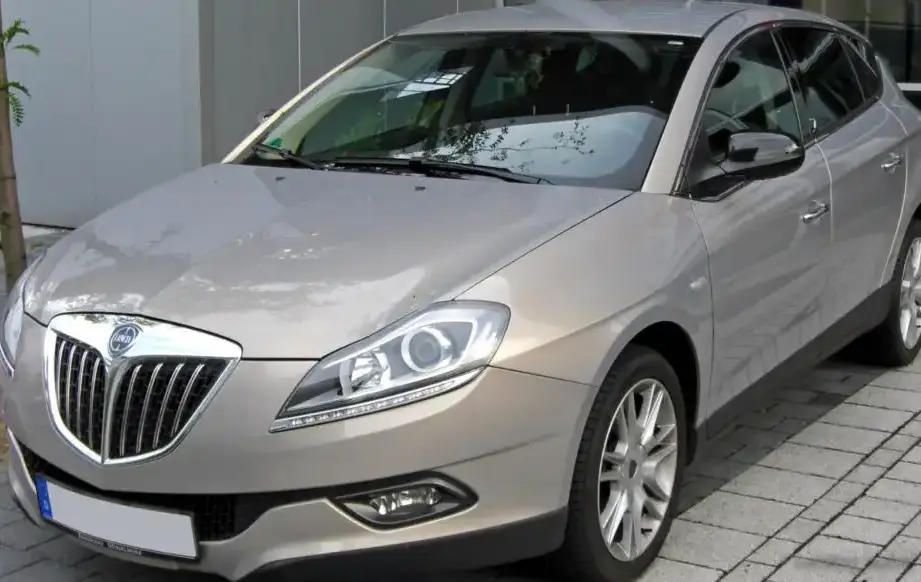
The Lancia Delta III (844) 1.6 Multijet 16V, produced from September 2008 to June 2011, served as the entry-level model within the revived Delta range. Designed to broaden the Delta’s appeal, particularly in the European market, it offered a more economical alternative to the higher-performance variants. Built on the Fiat/Chrysler C-segment platform – internally designated 1HX0/A3, also shared with the Fiat Bravo and Alfa Romeo Giulietta – the 1.6 Multijet 16V aimed to deliver a balance of fuel efficiency and acceptable performance for everyday use, targeting buyers who prioritized practicality and running costs.
Powertrain & Engine Architecture
The 1.6 Multijet 16V Delta is powered by the 955A4000 engine, a 1.6-liter inline-four cylinder diesel. This engine is part of Fiat’s Multijet family, renowned for its second-generation common rail direct injection system. Multijet technology allows for multiple fuel injections during each combustion cycle, resulting in improved combustion efficiency, reduced engine noise, and lower emissions. A turbocharger with an intercooler is employed to increase power output. The 16-valve DOHC (Double Overhead Camshaft) configuration further optimizes airflow and contributes to the engine’s performance characteristics. The engine’s compression ratio of 16.5:1 is typical for diesel engines, aiding in efficient combustion. A 6-speed manual transmission was standard, providing a good balance between fuel economy and drivability.
Driving Characteristics
The 1.6 Multijet engine produces 115 horsepower and 300 Nm (221 lb-ft) of torque. While not a particularly powerful engine, it provided adequate performance for daily driving. Acceleration from 0 to 62 mph (0-100 km/h) took approximately 10.8 seconds, with a top speed of 194 km/h (120.55 mph). The engine’s peak torque is readily available from 1500 rpm, offering good responsiveness in urban environments and making highway overtaking manageable. Compared to the more potent 1.9 JTD variants, the 1.6 Multijet felt less stressed during acceleration, but lacked the same level of outright power. The 6-speed manual gearbox was well-matched to the engine, with gear ratios optimized for both fuel efficiency and smooth driving.
Equipment & Trim Levels
The 1.6 Multijet 16V typically represented the base trim level for the Delta range. Standard features included air conditioning, electric front windows, a radio/CD player, and ABS brakes. Safety equipment, such as driver and passenger airbags, was also standard. Higher trim levels, like the Argenta and Oro, added features such as alloy wheels, climate control, rear parking sensors, and upgraded interior materials. Optional extras included a sunroof, a navigation system, and leather upholstery. The interior design was functional and durable, though somewhat understated in its aesthetic.
Chassis & Braking
The Delta III featured an independent McPherson strut suspension at the front and a torsion beam suspension at the rear. This configuration offered a reasonable compromise between ride comfort and handling. An anti-roll bar was incorporated into the front suspension to minimize body roll during cornering. Braking was provided by ventilated discs at the front and solid discs at the rear. ABS (Anti-lock Braking System) was standard, enhancing braking performance and stability. The steering system was electrically assisted, providing light and precise control.
Market Reception & Comparison
The Lancia Delta 1.6 Multijet 16V was generally well-received by automotive critics as a practical and fuel-efficient family hatchback. Its fuel economy, averaging around 4.8 l/100 km (49 US mpg), was a significant selling point. Some reviewers, however, found the engine to be somewhat underpowered, especially when the vehicle was fully loaded. Compared to the 1.9 JTD models, the 1.6 Multijet offered lower running costs but sacrificed performance. The 1.6 Multijet was often considered a more sensible choice for buyers prioritizing economy and practicality over driving excitement.
Legacy
The 1.6 Multijet engine has proven to be relatively reliable, although, like all diesel engines, it can be susceptible to issues with the diesel particulate filter (DPF) if not properly maintained. Regular servicing and the use of high-quality diesel fuel are essential for ensuring long-term reliability. In the used car market, the Delta 1.6 Multijet 16V offers an affordable entry point into Lancia ownership. Its fuel efficiency and practicality continue to appeal to buyers seeking a comfortable and economical family hatchback. However, prospective buyers should be aware of the potential for DPF-related problems and conduct a thorough inspection before making a purchase.