
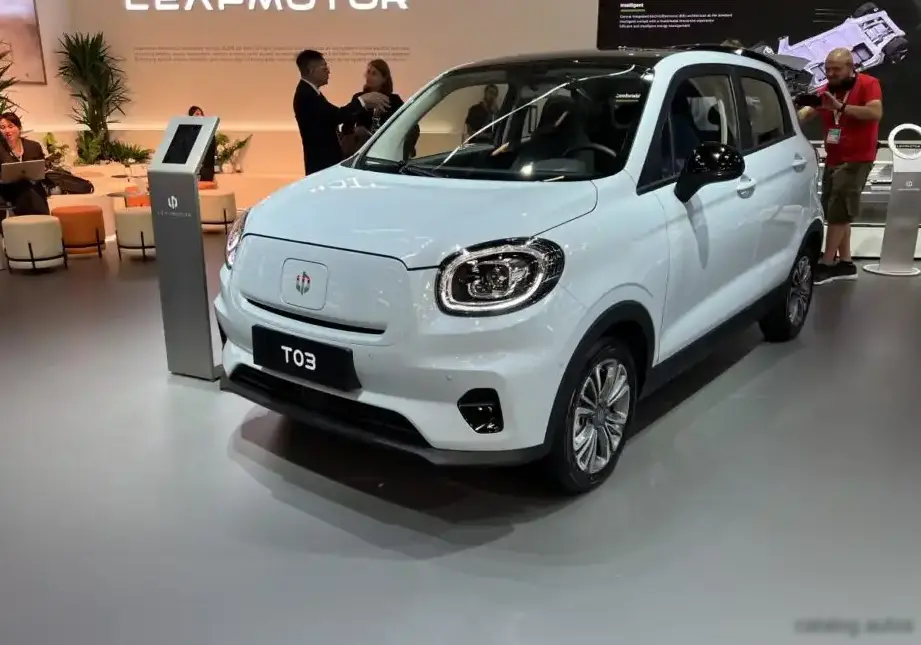
The Leapmotor T03 21.6 kWh is a battery electric vehicle (BEV) produced by the Chinese automotive manufacturer Leapmotor. Introduced in May 2020, the T03 represents Leapmotor’s initial foray into the burgeoning electric vehicle market, specifically targeting urban commuters seeking an affordable and practical electric hatchback. This particular variant, equipped with a 21.6 kWh battery pack and a 54 horsepower electric motor, serves as the entry-level model within the T03 lineup. It’s designed to offer a balance between range, performance, and cost, making it an accessible option for first-time EV buyers in China and select export markets.
Technical Specifications
| Brand | Leapmotor |
| Model | T03 |
| Generation | T03 |
| Type (Engine) | 21.6 kWh (54 Hp) BEV |
| Start of production | May, 2020 |
| Powertrain Architecture | BEV (Electric Vehicle) |
| Body type | Hatchback |
| Seats | 4 |
| Doors | 5 |
| Fuel Type | Electricity |
| Maximum speed | 100 km/h (62.14 mph) |
| Gross battery capacity | 21.6 kWh |
| Battery technology | Lithium iron phosphate (LiFePO4) |
| Battery location | Below the floor |
| All-electric range (CLTC) | 200 km (124.27 mi) |
| Electric motor power | 54 Hp |
| Electric motor Torque | 96 Nm (70.81 lb.-ft.) |
| Electric motor location | Front axle, Transverse |
| Electric motor type | Synchronous |
| System power | 54 Hp |
| System torque | 96 Nm (70.81 lb.-ft.) |
| Trunk (boot) space – minimum | 210 l (7.42 cu. ft.) |
| Length | 3620 mm (142.52 in.) |
| Width | 1652 mm (65.04 in.) |
| Height | 1605 mm (63.19 in.) |
| Wheelbase | 2400 mm (94.49 in.) |
| Drivetrain Architecture | One electric motor drives the front wheels. |
| Drive wheel | Front wheel drive |
| Number of gears and type of gearbox | 1 gears, automatic transmission |
| Front suspension | Independent type McPherson |
| Rear suspension | Torsion |
| Front brakes | Ventilated discs |
| Rear brakes | Drum |
| Assisting systems | ABS (Anti-lock braking system) |
| Steering type | Steering rack and pinion |
| Power steering | Electric Steering |
| Tires size | 165/70 R14 |
| Wheel rims size | 14 |
Powertrain & Engine Architecture
The Leapmotor T03 21.6 kWh utilizes a single synchronous electric motor mounted transversely on the front axle. This motor produces a peak output of 54 horsepower and 96 Nm (70.81 lb.-ft.) of torque. Power is delivered through a single-speed automatic transmission, characteristic of most electric vehicles, providing seamless acceleration. The vehicle is powered by a 21.6 kWh Lithium Iron Phosphate (LiFePO4) battery pack, chosen for its cost-effectiveness, thermal stability, and relatively long cycle life. The battery is positioned under the floor of the vehicle, contributing to a lower center of gravity and maximizing interior space. The T03 employs a standard charging port compatible with AC charging infrastructure. DC fast charging capability is limited in this base model.
Driving Characteristics
The 54 horsepower output of the T03 21.6 kWh results in modest, but adequate, performance for urban driving. Acceleration is linear and predictable, suitable for navigating city streets. The single-speed transmission eliminates the need for gear changes, providing a smooth driving experience. While not designed for high-speed cruising, the T03 can comfortably maintain highway speeds, although range will be significantly impacted. Compared to higher-trim T03 models with larger battery packs and more powerful motors, this variant offers a more economical entry point, but sacrifices some performance and range. The steering is light and responsive, making it easy to maneuver in tight spaces.
Equipment & Trim Levels
The base T03 21.6 kWh trim typically includes standard features such as air conditioning, power windows, a basic infotainment system with Bluetooth connectivity, and ABS. Interior upholstery is generally cloth, and the dashboard features a minimalist design. Optional extras, depending on the market, may include a rearview camera, parking sensors, and upgraded infotainment features. The focus of this trim level is on providing essential features at an affordable price point, prioritizing functionality over luxury.
Chassis & Braking
The Leapmotor T03 utilizes a McPherson strut independent suspension system at the front, providing a comfortable ride quality. The rear suspension employs a torsion beam setup, which is a cost-effective solution for compact hatchbacks. The braking system consists of ventilated discs at the front and drum brakes at the rear. ABS (Anti-lock Braking System) is standard, enhancing safety during emergency braking situations. The vehicle’s relatively light weight, due to the compact battery pack and simple construction, contributes to its nimble handling characteristics.
Market Reception & Comparison
The Leapmotor T03 21.6 kWh has been well-received in the Chinese market as an affordable and practical electric vehicle. Critics have praised its value for money and ease of use, particularly for urban commuters. Compared to other entry-level EVs in China, the T03 offers a competitive range and feature set at a lower price point. However, its limited range and modest performance may not appeal to drivers who frequently undertake longer journeys. Fuel economy, expressed as electricity consumption, is competitive with other EVs in its class. Reliability reports are still emerging, but the LiFePO4 battery technology is known for its durability.
Legacy
The Leapmotor T03 21.6 kWh played a crucial role in establishing Leapmotor as a viable player in the Chinese EV market. It demonstrated the company’s ability to produce affordable and well-equipped electric vehicles. While newer models with improved range and performance have since been introduced, the T03 21.6 kWh remains a popular choice in the used car market, offering a cost-effective entry point into electric vehicle ownership. The powertrain, while not groundbreaking, has proven to be relatively reliable, and the availability of spare parts is expected to remain good for the foreseeable future. The T03 helped pave the way for wider EV adoption in China by making electric mobility more accessible to a broader range of consumers.
