
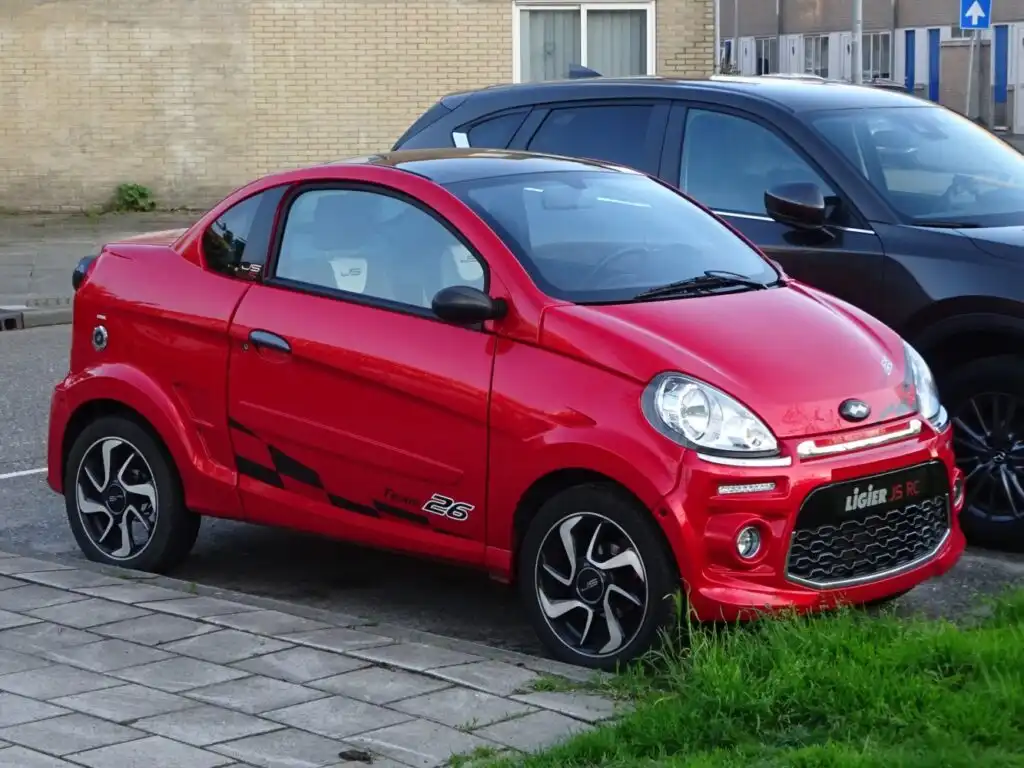
The Ligier JS RC 0.5 Progress, produced between 2012 and 2016, represents a unique segment of microcars designed for urban mobility. Classified as a quadricycle, it offered a highly economical and practical transportation solution, particularly within European cities. This specific variant, powered by a 505cc diesel engine producing just 5 horsepower and coupled with a continuously variable transmission (CVT), was positioned as the entry-level model within the JS RC range. It catered to a specific demographic – young drivers, city commuters, and those seeking an alternative to traditional automobiles for short-distance travel.
Technical Specifications
| Brand | Ligier |
| Model | JS RC |
| Generation | JS RC |
| Type (Engine) | 0.5 Progress (5 Hp) CVT |
| Start of production | 2012 |
| End of production | 2016 |
| Powertrain Architecture | Internal Combustion engine |
| Body type | Coupe, Quadricycle |
| Seats | 2 |
| Doors | 2 |
| Fuel consumption (combined) | 3.57 l/100 km (65.9 US mpg, 79.1 UK mpg, 28 km/l) |
| CO2 emissions | 92.9 g/km |
| Fuel Type | Diesel |
| Maximum speed | 45 km/h (27.96 mph) |
| Weight-to-power ratio | 69.8 kg/Hp, 14.3 Hp/tonne |
| Weight-to-torque ratio | 20.5 kg/Nm, 48.7 Nm/tonne |
| Power | 5 Hp @ 3000 rpm |
| Power per litre | 9.9 Hp/l |
| Torque | 17 Nm @ 1700 rpm (12.54 lb.-ft. @ 1700 rpm) |
| Maximum engine speed | 3200 rpm |
| Engine layout | Front, Transverse |
| Engine Model/Code | LDW502M3 |
| Engine displacement | 505 cm3 (30.82 cu. in.) |
| Number of cylinders | 2 |
| Engine configuration | Inline |
| Cylinder Bore | 72 mm (2.83 in.) |
| Piston Stroke | 62 mm (2.44 in.) |
| Number of valves per cylinder | 2 |
| Fuel injection system | Pump-nozzle (Unit Injector) |
| Engine aspiration | Naturally aspirated engine |
| Valvetrain | SOHC |
| Engine oil capacity | 1.4 l (1.48 US qt | 1.23 UK qt) |
| Coolant | 3.2 l (3.38 US qt | 2.82 UK qt) |
| Kerb Weight | 349 kg (769.41 lbs.) |
| Max. weight | 675 kg (1488.12 lbs.) |
| Max load | 326 kg (718.71 lbs.) |
| Fuel tank capacity | 17.5 l (4.62 US gal | 3.85 UK gal) |
| Length | 3030 mm (119.29 in.) |
| Width | 1505 mm (59.25 in.) |
| Width including mirrors | 1673 mm (65.87 in.) |
| Height | 1465 mm (57.68 in.) |
| Wheelbase | 2020 mm (79.53 in.) |
| Front track | 1294 mm (50.94 in.) |
| Rear track | 1307 mm (51.46 in.) |
| Minimum turning circle | 9.2 m (30.18 ft.) |
| Drivetrain Architecture | The Internal combustion engine (ICE) drives the front wheels of the vehicle. |
| Drive wheel | Front wheel drive |
| Number of gears and type of gearbox | automatic transmission CVT |
| Front suspension | Independent type McPherson |
| Rear suspension | Independent coil spring |
| Front brakes | Disc, 220 mm |
| Rear brakes | Disc, 180 mm |
| Steering type | Steering rack and pinion |
| Tires size | 145/80 R13; 155/65 R14; 155/60 R15 |
| Wheel rims size | 13; 14; 15 |
Powertrain & Engine Architecture
The heart of the JS RC 0.5 Progress is the LDW502M3, a 505cc two-cylinder diesel engine. This engine, sourced from a specialized manufacturer, is characterized by its compact size and simplicity. It employs a pump-nozzle (unit injector) fuel injection system, a technology known for its efficiency and precise fuel delivery. The engine features a single overhead camshaft (SOHC) valvetrain, operating two valves per cylinder. The modest 5 horsepower output is achieved at 3000 rpm, with a peak torque of 17 Nm (12.54 lb.-ft.) available from 1700 rpm. This configuration prioritizes fuel economy and low-end usability over outright performance. The engine is transversely mounted at the front of the vehicle, driving the front wheels.
The engine is paired with a continuously variable transmission (CVT). CVTs offer seamless gear changes and help maintain the engine within its optimal operating range, further enhancing fuel efficiency. However, they often lack the direct feel and responsiveness of traditional automatic or manual transmissions. The CVT in the JS RC 0.5 Progress is tuned for smooth, economical operation rather than sporty acceleration.
Driving Characteristics
The driving experience in the JS RC 0.5 Progress is dictated by its limited power output. Acceleration is understandably slow, and the vehicle is best suited for urban environments with low speed limits. The CVT contributes to a smooth, albeit somewhat uninspiring, driving experience. The engine’s torque curve, peaking at 1700 rpm, provides adequate pulling power for navigating city streets and gentle inclines. However, overtaking maneuvers require careful planning and ample space. Compared to higher-powered versions of the JS RC, such as those equipped with larger engines, the 0.5 Progress offers significantly reduced performance but a substantial improvement in fuel economy.
Equipment & Trim Levels
As the entry-level model, the JS RC 0.5 Progress was equipped with a basic but functional set of features. Standard equipment typically included basic instrumentation, manually adjustable seats, and a heating system. Interior upholstery was typically vinyl or a durable cloth material. Optional extras, depending on the market and year, could include power windows, a radio/CD player, and upgraded interior trim. The overall interior design was minimalist and focused on practicality.
Chassis & Braking
The JS RC 0.5 Progress utilizes a lightweight chassis to maximize efficiency. The front suspension employs an independent McPherson strut setup, providing a reasonable level of ride comfort. The rear suspension features an independent coil spring arrangement. Braking duties are handled by disc brakes on all four wheels, with the front discs measuring 220mm and the rear discs at 180mm. While adequate for the vehicle’s weight and speed, the braking system is not designed for aggressive stopping. The steering system is a rack and pinion type, offering relatively precise steering feel.
Market Reception & Comparison
The Ligier JS RC 0.5 Progress was generally well-received as a niche vehicle offering a unique solution for urban transportation. Critics praised its exceptional fuel economy and low running costs. However, the limited performance and basic features were often noted. Compared to other trims in the JS RC lineup, the 0.5 Progress offered the lowest price point and the highest fuel efficiency, making it attractive to budget-conscious buyers. Its main competitors were other microcars and quadricycles, such as the Aixam and Chatenet models.
Legacy
The Ligier JS RC 0.5 Progress, and the JS RC platform as a whole, has established a reputation for reliability, particularly regarding the powertrain. The simple diesel engine, while low on power, is known for its durability and relatively low maintenance requirements. In the used car market, these vehicles remain popular as affordable and economical city runabouts. However, potential buyers should be aware of the vehicle’s limited performance and the availability of spare parts, which can sometimes be challenging due to its specialized nature. The JS RC 0.5 Progress represents a unique chapter in automotive history, demonstrating a viable alternative to traditional cars for specific urban mobility needs.
