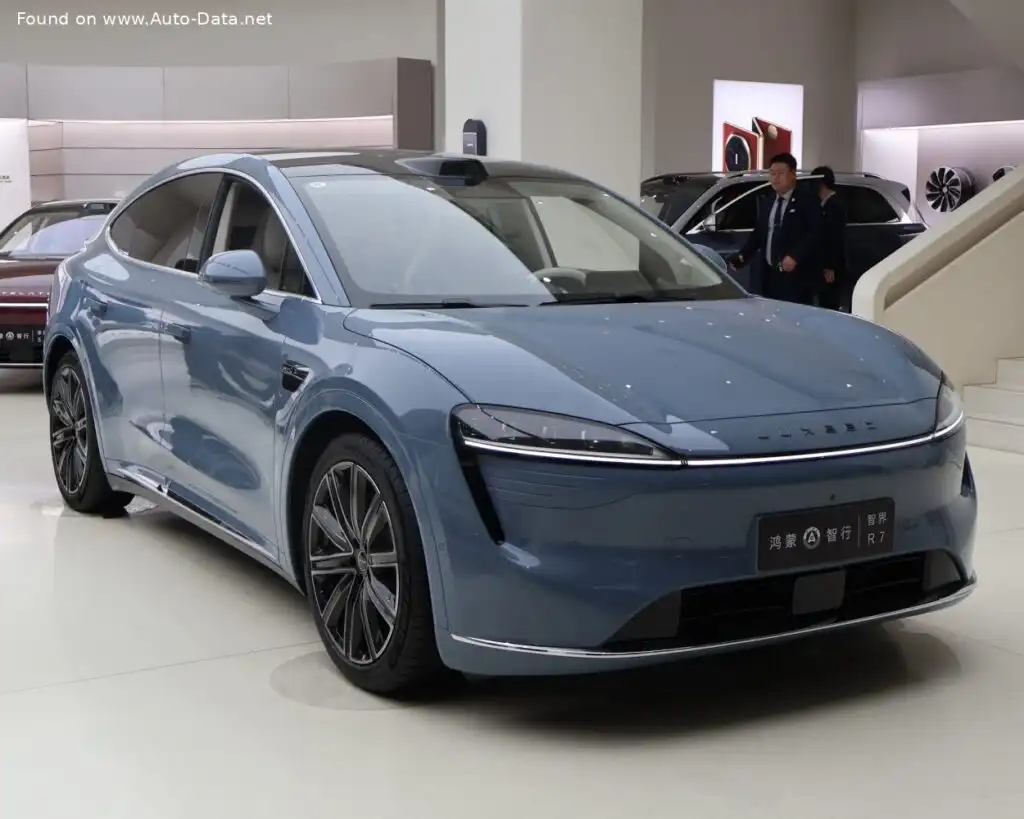
The Luxeed R7 (facelift 2025) 1.5T 37 kWh (309 Hp) Extended Range represents a significant iteration of Luxeed’s foray into the competitive plug-in hybrid electric vehicle (PHEV) market. Introduced in August 2025, this variant builds upon the original R7 platform, aiming to deliver enhanced electric range and overall efficiency. Positioned as a mid-to-upper range offering within the R7 lineup, it caters to consumers seeking a blend of electric driving capability and the reassurance of a gasoline engine for extended journeys. The R7 blends coupe-like styling with SUV practicality, offering five seats and five doors, and is designed to appeal to a market increasingly focused on sustainable transportation solutions.
Technical Specifications
| Brand | Luxeed |
| Model | R7 |
| Generation | R7 (facelift 2025) |
| Type (Engine) | 1.5T 37 kWh (309 Hp) Extended Range |
| Start of production | August, 2025 |
| Powertrain Architecture | PHEV (Plug-in Hybrid Electric Vehicle) |
| Body type | Coupe, SUV |
| Seats | 5 |
| Doors | 5 |
| Fuel consumption (economy) – combined (WLTC) | 0.46-5.68 l/100 km (511.3 – 41.4 US mpg, 614.1 – 49.7 UK mpg, 217.4 – 17.6 km/l) |
| Fuel Type | Petrol / electricity |
| Acceleration 0 – 100 km/h | 7.4 sec |
| Acceleration 0 – 62 mph | 7.4 sec |
| Acceleration 0 – 60 mph | 7 sec |
| Maximum speed | 200 km/h (124.27 mph) |
| Weight-to-power ratio | 7.4 kg/Hp, 134.5 Hp/tonne |
| Weight-to-torque ratio | 7.2 kg/Nm, 139.3 Nm/tonne |
| Gross battery capacity | 37 kWh |
| Battery voltage | 400 V |
| Battery technology | Lithium iron phosphate (LiFePO4) |
| Battery location | Below the floor |
| All-electric range | 201-251 km (124.9 – 155.96 mi) |
| Average Energy consumption | 18.5 kWh/100 km (29.77 kWh/100 mi, 113 MPGe, 5.4 km/kWh, 3.4 mi/kWh) |
| Electric motor power | 309 Hp |
| Electric motor Torque | 320 Nm (236.02 lb.-ft.) |
| Electric motor model/code | TZ210XYAP4 |
| Electric motor location | Rear axle, Transverse |
| Electric motor type | Synchronous |
| System power | 309 Hp |
| System torque | 320 Nm (236.02 lb.-ft.) |
| Power | 156 Hp @ 5200 rpm (104.1 Hp/l) |
| Torque | 220 Nm @ 2500 rpm (162.26 lb.-ft. @ 2500 rpm) |
| Engine layout | Front, Transverse |
| Engine Model/Code | SQRH4J15 |
| Engine displacement | 1499 cm3 (91.47 cu. in.) |
| Number of cylinders | 4 |
| Engine configuration | Inline |
| Cylinder Bore | 74.5 mm (2.93 in.) |
| Piston Stroke | 85.9 mm (3.38 in.) |
| Number of valves per cylinder | 4 |
| Fuel injection system | Direct injection |
| Engine aspiration | Turbocharger, Intercooler |
| Valvetrain | DOHC |
| Kerb Weight | 2298 kg (5066.22 lbs.) |
| Max. weight | 2735 kg (6029.64 lbs.) |
| Max load | 437 kg (963.42 lbs.) |
| Trunk (boot) space – minimum | 796 l (28.11 cu. ft.) |
| Trunk (boot) space – maximum | 2089 l (73.77 cu. ft.) |
| Fuel tank capacity | 67 l (17.7 US gal | 14.74 UK gal) |
| Length | 4982 mm (196.14 in.) |
| Width | 1981 mm (77.99 in.) |
| Height | 1650 mm (64.96 in.) |
| Wheelbase | 2950 mm (116.14 in.) |
| Front track | 1692 mm (66.61 in.) |
| Rear (Back) track | 1695 mm (66.73 in.) |
| Drag coefficient (Cd) | 0.247 |
| Minimum turning circle | 11.34 m (37.2 ft.) |
| Approach angle | 16° |
| Departure angle | 18° |
| Drivetrain Architecture | The Internal combustion engine (ICE) drives the generator only, with no mechanical connection to the drive. An electric motor drives the rear wheels. |
| Drive wheel | Rear wheel drive |
| Number of gears and type of gearbox | 1 gears, automatic transmission |
| Front suspension | Coil spring, Double wishbone, Transverse stabilizer |
| Rear suspension | Independent multi-link spring suspension with stabilizer |
| Front brakes | Ventilated discs |
| Rear brakes | Ventilated discs |
| Assisting systems | ABS (Anti-lock braking system) |
| Steering type | Steering rack and pinion |
| Power steering | Electric Steering |
| Tires size | 255/50 R20; 255/45 R21 |
| Wheel rims size | 20; 21 |
Powertrain & Engine Architecture
The Luxeed R7 1.5T Extended Range utilizes a sophisticated PHEV powertrain. The core of the system is a 1.5-liter turbocharged four-cylinder gasoline engine (code SQRH4J15) producing 156 horsepower and 220 Nm (162.26 lb.-ft.) of torque. This engine doesn’t directly drive the wheels; instead, it functions primarily as a generator to charge the 37 kWh lithium iron phosphate (LiFePO4) battery pack. The electric motor, a synchronous unit (TZ210XYAP4) located on the rear axle, delivers 309 horsepower and 320 Nm (236.02 lb.-ft.) of torque. This configuration results in a combined system output of 309 horsepower. The single-speed automatic transmission efficiently delivers power from the electric motor to the rear wheels. The engine features direct fuel injection and a double overhead camshaft (DOHC) valvetrain, optimizing combustion efficiency and power delivery.
Driving Characteristics
The R7 1.5T Extended Range offers a distinct driving experience compared to purely gasoline-powered vehicles. In electric mode, acceleration is brisk and linear, with the instant torque of the electric motor providing responsive performance. The 0-60 mph sprint is achieved in approximately 7 seconds. When the battery is depleted, the gasoline engine seamlessly kicks in to act as a generator, maintaining drive power. While the engine’s operation is audible, it’s generally well-isolated from the cabin. The rear-wheel-drive configuration contributes to a balanced feel, although it may require some adjustment for drivers accustomed to front-wheel-drive vehicles in slippery conditions. The single-speed transmission provides smooth, uninterrupted acceleration, but lacks the gear ratios found in traditional automatic transmissions.
Equipment & Trim Levels
The 1.5T 37 kWh Extended Range trim typically includes a comprehensive suite of standard features. These commonly include a large touchscreen infotainment system with navigation, a digital instrument cluster, leather upholstery, heated and ventilated front seats, a panoramic sunroof, and advanced driver-assistance systems (ADAS) such as adaptive cruise control, lane-keeping assist, and automatic emergency braking. Optional extras may include premium audio systems, upgraded interior trim materials, and a head-up display. The interior design emphasizes a modern aesthetic with a focus on user-friendly technology and comfortable seating.
Chassis & Braking
The R7’s chassis is tuned to balance comfort and handling. The front suspension utilizes a coil spring, double wishbone setup with a transverse stabilizer bar, while the rear employs an independent multi-link spring suspension, also with a stabilizer bar. This configuration provides a comfortable ride quality while minimizing body roll during cornering. Ventilated disc brakes are used on all four wheels, providing ample stopping power. The inclusion of ABS (Anti-lock braking system) enhances safety and control during emergency braking situations. The R7’s relatively high curb weight (2298 kg / 5066.22 lbs) is partially offset by the low center of gravity afforded by the battery pack’s placement beneath the floor.
Market Reception & Comparison
The Luxeed R7 1.5T Extended Range has been generally well-received by automotive critics, particularly for its extended electric range and stylish design. Compared to other PHEV models in its class, the R7 offers a competitive level of performance and efficiency. Its fuel economy, ranging from 0.46-5.68 l/100 km, is a significant advantage for environmentally conscious consumers. However, some reviewers have noted that the interior materials, while well-designed, may not feel as premium as those found in some European competitors. Compared to lower-trim R7 models, the 1.5T Extended Range justifies its higher price tag with its increased electric range and more powerful powertrain.
Legacy
The long-term reliability of the Luxeed R7 1.5T Extended Range powertrain remains to be fully established, as it is a relatively new model. However, the use of proven technologies such as the LiFePO4 battery chemistry and a turbocharged gasoline engine suggests a reasonable expectation of durability. The R7’s position in the used car market is likely to be strong, particularly as demand for PHEVs continues to grow. Its combination of electric driving capability, stylish design, and competitive pricing should ensure its continued appeal to a wide range of buyers.