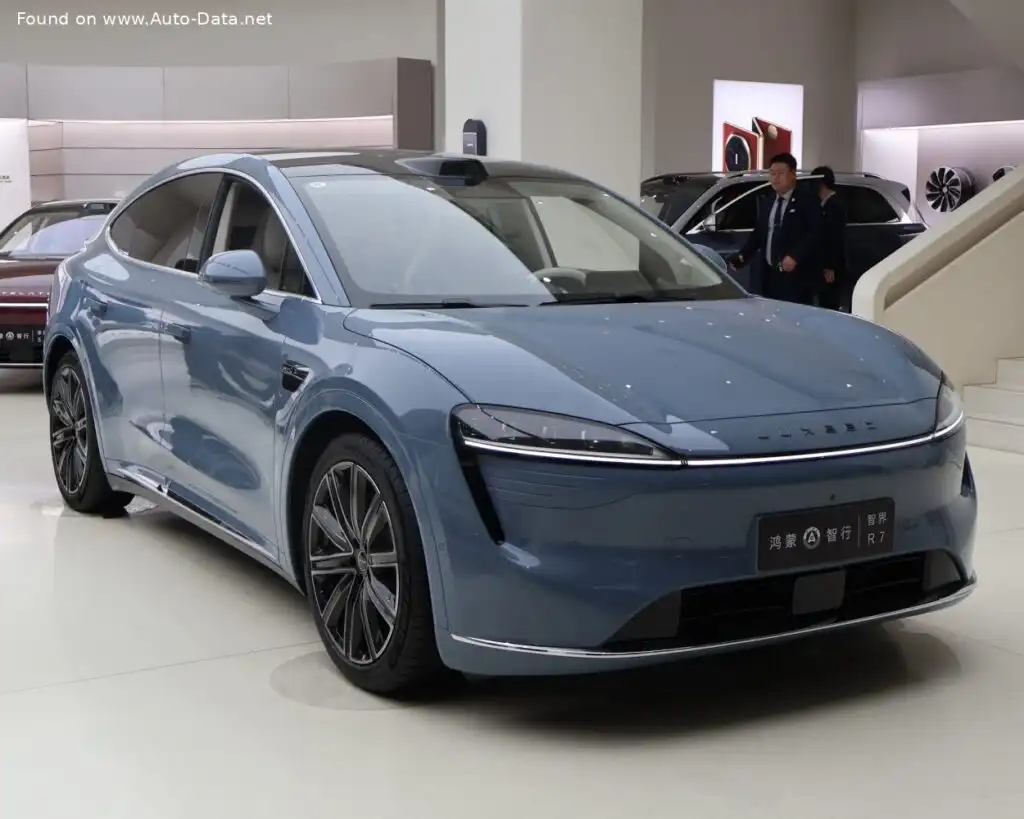
The Luxeed R7 (facelift 2025) 1.5T 53.4 kWh (520 Hp) Extended Range 4WD represents a significant iteration of Luxeed’s flagship SUV-coupe, launched in August 2025. Positioned as a premium offering within the R7 lineup, this variant combines a relatively small turbocharged gasoline engine with a substantial battery pack and dual electric motors to deliver both all-electric range and extended overall driving distance. It’s designed to appeal to consumers seeking a blend of performance, efficiency, and sophisticated technology, primarily targeting the growing market for plug-in hybrid electric vehicles (PHEVs). The R7 competes with other luxury PHEV SUVs, offering a unique proposition through its focus on both sporty handling and extended electric driving capabilities.
Technical Specifications
| Brand | Luxeed |
| Model | R7 |
| Generation | R7 (facelift 2025) |
| Type (Engine) | 1.5T 53.4 kWh (520 Hp) Extended Range 4WD |
| Start of production | August, 2025 |
| Powertrain Architecture | PHEV (Plug-in Hybrid Electric Vehicle) |
| Body type | Coupe, SUV |
| Seats | 5 |
| Doors | 5 |
| Fuel consumption (economy) – combined (WLTC) | 0.32-6.15 l/100 km (735 – 38.2 US mpg, 882.8 – 45.9 UK mpg, 312.5 – 16.3 km/l) |
| Fuel Type | Petrol / electricity |
| Acceleration 0 – 100 km/h | 4.9 sec |
| Acceleration 0 – 62 mph | 4.9 sec |
| Acceleration 0 – 60 mph | 4.7 sec |
| Maximum speed | 200 km/h (124.27 mph) |
| Weight-to-power ratio | 4.6 kg/Hp, 217.8 Hp/tonne |
| Weight-to-torque ratio | 4.3 kg/Nm, 230.3 Nm/tonne |
| Gross battery capacity | 53.4 kWh |
| Battery voltage | 400 V |
| Battery technology | Lithium nickel manganese cobalt oxides (Li-NMC) |
| Battery location | Below the floor |
| All-electric range | 258-331 km (160.31 – 205.67 mi) |
| Average Energy consumption | 20.3 kWh/100 km (32.67 kWh/100 mi, 103 MPGe, 4.9 km/kWh, 3.1 mi/kWh) |
| Electric motor 1 power | 309 Hp |
| Electric motor 1 Torque | 320 Nm (236.02 lb.-ft.) |
| Electric motor 1 model/code | TZ210XYAP4 |
| Electric motor 1 location | Rear axle, Transverse |
| Electric motor 1 type | Synchronous |
| Electric motor 2 power | 211 Hp |
| Electric motor 2 Torque | 230 Nm (169.64 lb.-ft.) |
| Electric motor 2 model/code | YS210XYA52 |
| Electric motor 2 location | Front axle, Transverse |
| Electric motor 2 type | Asynchronous |
| System power | 520 Hp |
| System torque | 550 Nm (405.66 lb.-ft.) |
| Power | 156 Hp @ 5200 rpm |
| Torque | 220 Nm @ 2500 rpm (162.26 lb.-ft. @ 2500 rpm) |
| Engine layout | Front, Transverse |
| Engine Model/Code | SQRH4J15 |
| Engine displacement | 1499 cm3 (91.47 cu. in.) |
| Number of cylinders | 4 |
| Engine configuration | Inline |
| Cylinder Bore | 74.5 mm (2.93 in.) |
| Piston Stroke | 85.9 mm (3.38 in.) |
| Number of valves per cylinder | 4 |
| Fuel injection system | Direct injection |
| Engine aspiration | Turbocharger, Intercooler |
| Valvetrain | DOHC |
| Kerb Weight | 2388 kg (5264.64 lbs.) |
| Max. weight | 2817 kg (6210.42 lbs.) |
| Max load | 429 kg (945.78 lbs.) |
| Trunk (boot) space – minimum | 796 l (28.11 cu. ft.) |
| Trunk (boot) space – maximum | 2089 l (73.77 cu. ft.) |
| Fuel tank capacity | 67 l (17.7 US gal | 14.74 UK gal) |
| Length | 4982 mm (196.14 in.) |
| Width | 1981 mm (77.99 in.) |
| Height | 1634 mm (64.33 in.) |
| Wheelbase | 2950 mm (116.14 in.) |
| Front track | 1692 mm (66.61 in.) |
| Rear (Back) track | 1695 mm (66.73 in.) |
| Drag coefficient (Cd) | 0.247 |
| Minimum turning circle | 11.34 m (37.2 ft.) |
| Approach angle | 15° |
| Departure angle | 18° |
| Drivetrain Architecture | The Internal combustion engine (ICE) drives the generator only, with no mechanical connection to the drive. Two electric motors drive the front and rear wheels. |
| Drive wheel | All wheel drive (4×4) |
| Number of gears and type of gearbox | 1 gears, automatic transmission |
| Front suspension | Double wishbone, Transverse stabilizer, Air suspension |
| Rear suspension | Independent multi-link suspension, Air suspension, Transverse stabilizer |
| Front brakes | Ventilated discs |
| Rear brakes | Ventilated discs |
| Assisting systems | ABS (Anti-lock braking system) |
| Steering type | Steering rack and pinion |
| Power steering | Electric Steering |
| Tires size | 255/50 R20; 255/45 R21 |
| Wheel rims size | 20; 21 |
Powertrain & Engine Architecture
The Luxeed R7 1.5T utilizes a plug-in hybrid powertrain. The core of the system is a 1.5-liter turbocharged inline-four cylinder engine (code SQRH4J15) producing 156 horsepower and 220 Nm of torque. This engine is not directly connected to the wheels; instead, it functions as a generator, charging the 53.4 kWh battery pack. Power is delivered to all four wheels via two electric motors – a 309 hp synchronous motor driving the rear axle and a 211 hp asynchronous motor powering the front axle, resulting in a combined system output of 520 horsepower and 550 Nm of torque. The engine features direct fuel injection and a double overhead camshaft (DOHC) valvetrain. The single-speed automatic transmission is dedicated to the electric motors, optimizing efficiency and responsiveness. The battery pack, utilizing Lithium Nickel Manganese Cobalt Oxide (Li-NMC) technology, is positioned under the vehicle floor to maintain a low center of gravity.
Driving Characteristics
The R7 1.5T offers a distinctly different driving experience compared to traditional internal combustion vehicles. In electric mode, the vehicle provides near-silent acceleration and a smooth, linear power delivery. The combined output of the two electric motors provides instant torque, resulting in a 0-60 mph time of approximately 4.7 seconds. When the battery is depleted or requires assistance during high-demand situations, the 1.5-liter engine seamlessly kicks in to act as a generator, maintaining power to the electric motors. The single-speed transmission ensures smooth transitions between electric and hybrid modes. The all-wheel-drive system provides excellent traction and stability in various driving conditions. While the engine itself isn’t directly driving the wheels, its contribution to the overall power output is significant, especially during extended highway driving.
Equipment & Trim Levels
The R7 1.5T Extended Range 4WD typically comes standard with a high level of equipment, reflecting its premium positioning. Standard features include a large touchscreen infotainment system, advanced driver-assistance systems (ADAS) such as adaptive cruise control and lane-keeping assist, premium upholstery, and a panoramic sunroof. Optional extras often include upgraded audio systems, ventilated and massaging seats, and advanced parking assistance features. Interior trim levels vary, offering choices in leather color and material, as well as accent trim options. The focus is on creating a luxurious and technologically advanced cabin environment.
Chassis & Braking
The R7 features a sophisticated chassis designed to balance comfort and handling. The front suspension utilizes a double wishbone setup with a transverse stabilizer and air suspension, while the rear employs an independent multi-link suspension, also with air suspension and a transverse stabilizer. This air suspension system allows for adjustable ride height and improved ride quality. Braking duties are handled by ventilated discs on all four wheels, coupled with an anti-lock braking system (ABS) for enhanced safety. The vehicle’s relatively high curb weight (2388 kg) is mitigated by the instant torque of the electric motors and the sophisticated suspension system.
Market Reception & Comparison
The Luxeed R7 1.5T has been generally well-received by automotive critics, who praise its blend of performance, efficiency, and technology. The extended electric range and relatively low fuel consumption are key selling points. Compared to other trims in the R7 lineup, the 1.5T offers a compelling balance between power and efficiency. While the higher-performance variants may offer quicker acceleration, the 1.5T provides a more practical and fuel-efficient option for everyday driving. Its fuel economy of 0.32-6.15 l/100 km is competitive within the PHEV segment.
Legacy
As a relatively new model, the long-term reliability of the Luxeed R7 1.5T powertrain remains to be fully established. However, the use of proven technologies such as Li-NMC batteries and turbocharged engines suggests a reasonable expectation of durability. The increasing popularity of PHEVs and the growing demand for electric vehicles position the R7 as a potentially significant model in the evolving automotive landscape. Its status in the used car market will likely depend on factors such as battery health and overall maintenance history.