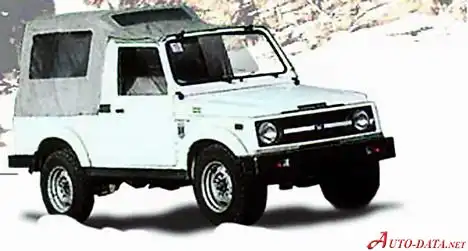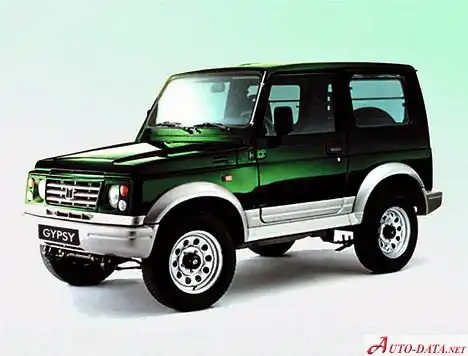
The Maruti Gypsy 1.3 i 16V Gypsy King (80 Hp) represents a significant iteration of India’s long-running, domestically produced off-road vehicle. Produced from 2000 to 2019, this variant occupied a crucial position within the Gypsy lineup, offering a balance between affordability, capability, and relative refinement. It was based on the second-generation Gypsy (introduced in 1985), which itself was heavily derived from the Suzuki SJ30/40 series – a lineage tracing back to the original 1970 Jeep design. The Gypsy King, specifically with the 1.3-liter engine and 80 horsepower output, became a popular choice for both private buyers seeking a rugged utility vehicle and for institutional customers like the Indian Army and police forces.
Technical Specifications
| Brand | Maruti |
| Model | Gypsy |
| Type | 1.3 i 16V Gypsy King (80 Hp) |
| Start of production | 2000 year |
| End of production | 2019 year |
| Powertrain Architecture | Internal Combustion engine |
| Body type | Off-road vehicle |
| Seats | 5 |
| Doors | 3 |
| Fuel Type | Petrol (Gasoline) |
| Maximum speed | 130 km/h (80.78 mph) |
| Weight-to-power ratio | 12.8 kg/Hp, 78.4 Hp/tonne |
| Weight-to-torque ratio | 9.9 kg/Nm, 101 Nm/tonne |
| Power | 80 Hp @ 6000 rpm |
| Power per litre | 61.6 Hp/l |
| Torque | 103 Nm @ 4500 rpm (75.97 lb.-ft. @ 4500 rpm) |
| Engine layout | Front, Longitudinal |
| Engine Model/Code | G13B |
| Engine displacement | 1299 cm3 (79.27 cu. in.) |
| Number of cylinders | 4 |
| Engine configuration | Inline |
| Cylinder Bore | 74 mm (2.91 in.) |
| Piston Stroke | 75.5 mm (2.97 in.) |
| Compression ratio | 9.2:1 |
| Number of valves per cylinder | 4 |
| Fuel injection system | Multi-port manifold injection |
| Engine aspiration | Naturally aspirated engine |
| Engine oil capacity | 4.2 l (4.44 US qt | 3.7 UK qt) |
| Kerb Weight | 1020 kg (2248.72 lbs.) |
| Max. weight | 1495 kg (3295.91 lbs.) |
| Max load | 475 kg (1047.2 lbs.) |
| Fuel tank capacity | 40 l (10.57 US gal | 8.8 UK gal) |
| Length | 4100 mm (161.42 in.) |
| Width | 1540 mm (60.63 in.) |
| Height | 1845 mm (72.64 in.) |
| Wheelbase | 2375 mm (93.5 in.) |
| Front track | 1300 mm (51.18 in.) |
| Rear track | 1310 mm (51.57 in.) |
| Drive wheel | All wheel drive (4×4) |
| Number of gears and type of gearbox | 5 gears, manual transmission |
| Front suspension | Leaf spring |
| Rear suspension | Leaf spring |
| Front brakes | Disc |
| Rear brakes | Drum |
| Assisting systems | ABS (Anti-lock braking system) |
| Tires size | 205/70 R15 |
| Wheel rims size | 15 |
Powertrain & Engine Architecture
The heart of the Gypsy King 1.3 was the G13B engine, a 1.3-liter, inline-four cylinder gasoline engine. This engine, a Suzuki design, featured a single overhead camshaft (SOHC) and multi-point fuel injection. The 16-valve configuration (four valves per cylinder) contributed to its relatively high output for its displacement. While 80 horsepower might seem modest by modern standards, it was a respectable figure for a small, lightweight off-road vehicle in the Indian market. The G13B engine was known for its durability and relatively simple maintenance requirements, a key factor in its longevity and popularity. The engine’s longitudinal mounting within the chassis, coupled with a rear-wheel drive bias in the four-wheel drive system, contributed to its off-road prowess. The five-speed manual transmission was the only gearbox option available for this variant, providing a good balance of gearing for both on-road cruising and low-speed off-road maneuvering.
Driving Characteristics
The 1.3-liter Gypsy King, with its 80 hp and manual transmission, offered a driving experience that prioritized capability over outright speed. Acceleration was adequate, but not brisk, and the engine needed to be revved to extract its full potential. The five-speed gearbox was well-matched to the engine’s characteristics, allowing drivers to keep the engine in its optimal power band. Compared to the later, more powerful 1.6-liter versions, the 1.3 felt less strained on inclines and in challenging terrain. However, it lacked the higher top speed and more effortless cruising ability of its larger-engined siblings. The leaf spring suspension, while providing excellent articulation for off-road use, resulted in a somewhat firm and bouncy ride on paved roads. The four-wheel drive system, selectable via a lever, provided enhanced traction in slippery conditions, making it a capable performer in mud, sand, and snow.
Equipment & Trim Levels
The Gypsy King 1.3 was generally sparsely equipped, reflecting its utilitarian origins and target market. Standard features typically included basic steel wheels, vinyl upholstery, a simple dashboard layout, and minimal creature comforts. Air conditioning was often an optional extra, as were power windows and central locking. The interior was designed for practicality and ease of cleaning, rather than luxury. The focus was on providing a durable and functional vehicle that could withstand the rigors of off-road use. The “King” designation denoted a slightly higher trim level than the base Gypsy, often including features like a more robust front bumper and upgraded interior trim.
Chassis & Braking
The Gypsy’s chassis was a body-on-frame construction, providing exceptional strength and durability. The leaf spring suspension at both the front and rear was a key element of its off-road capability, allowing for significant wheel travel and articulation. Front disc brakes and rear drum brakes provided adequate stopping power, although the braking system was not particularly sophisticated. The inclusion of an Anti-lock Braking System (ABS) in later models improved braking performance and safety. The relatively narrow track width contributed to its maneuverability in tight spaces, while the high ground clearance allowed it to navigate obstacles with ease.
Market Reception & Comparison
The Gypsy King 1.3 was well-received in the Indian market as a rugged, reliable, and affordable off-road vehicle. Critics praised its simplicity, durability, and off-road capability. Compared to other vehicles in its class, such as the Mahindra Armada and Tata Sumo, the Gypsy offered a more refined driving experience and a more modern design. However, it was often criticized for its basic interior and lack of creature comforts. The 1.3-liter engine offered a good balance between fuel economy and performance, making it a practical choice for everyday use. Compared to the higher-powered 1.6-liter Gypsy, the 1.3 was more affordable and offered slightly better fuel efficiency, appealing to a wider range of buyers.
Legacy
The Maruti Gypsy, and particularly the 1.3-liter variant, has achieved iconic status in India. Its long production run and widespread use by the military and police have cemented its place in the country’s automotive history. While production ceased in 2019 due to stricter safety and emissions regulations, the Gypsy remains a popular choice among off-road enthusiasts and collectors. The G13B engine is known for its reliability and relatively simple maintenance, making it a relatively easy engine to keep running. Today, well-maintained examples of the Gypsy King 1.3 command a premium in the used car market, reflecting its enduring appeal and legendary reputation.