
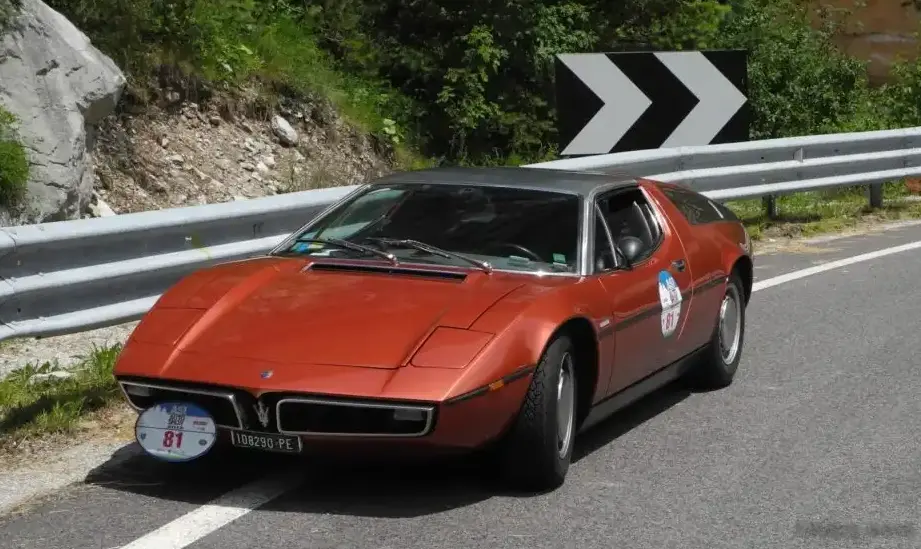
The Maserati Bora 5.0, produced between 1976 and 1980, represents the pinnacle of the original Bora model line. As the final and most potent iteration of Maserati’s first mid-engine production car, the 5.0 distinguished itself with a significant power increase over its predecessors. The Bora, named after the cold, dry wind that blows down from the Balkans, was intended to compete directly with the Lamborghini Countach and Ferrari Daytona, offering a blend of Italian style, performance, and luxury. The 5.0 variant, while sharing the same fundamental chassis and body design as earlier Boras, was positioned as the ultimate expression of the model, aimed at discerning enthusiasts seeking a high-performance grand tourer. It was built on a steel monocoque chassis, a relatively advanced construction technique for the time, and penned by the renowned design house of Giorgetto Giugiaro.
Technical Specifications
| Brand | Maserati |
| Model | Bora |
| Generation | Bora |
| Type (Engine) | 5.0 (320 Hp) |
| Start of production | 1976 |
| End of production | 1980 |
| Powertrain Architecture | Internal Combustion engine |
| Body type | Coupe |
| Seats | 2 |
| Doors | 2 |
| Fuel Type | Petrol (Gasoline) |
| Power | 320 Hp |
| Engine Model/Code | AM117/49 |
| Engine aspiration | Naturally aspirated engine |
Powertrain & Engine Architecture
The heart of the Bora 5.0 is the AM117/49 engine, a 4.941 liter (301.6 cubic inch) naturally aspirated V8. This engine is a significant upgrade from the 4.7-liter and 4.9-liter engines found in earlier Boras. It features a 90-degree V-angle, four overhead camshafts, and four Weber 38 DCOE carburetors. The increased displacement, coupled with revised camshaft profiles and larger carburetors, resulted in a substantial power increase to 320 horsepower at 6,200 rpm and 350 lb-ft of torque at 4,000 rpm. The engine’s block is cast iron, while the cylinder heads are aluminum alloy. Lubrication is handled by a dry-sump system, a feature commonly found in high-performance engines, which allows for a lower engine placement in the chassis, improving the car’s center of gravity. The Bora 5.0 exclusively utilized a ZF 5-speed manual transmission, considered robust and well-suited to handling the engine’s power output. Unlike some contemporary supercars, the Bora did not offer an automatic transmission option.
Driving Characteristics
The Bora 5.0 delivers a driving experience characterized by its smooth power delivery and impressive acceleration. The 4.9-liter V8 provides a broad torque curve, making the car responsive at almost any engine speed. The ZF 5-speed manual transmission offers precise shifts, contributing to the engaging driving experience. With 320 horsepower propelling a relatively lightweight (around 3,300 lbs) chassis, the Bora 5.0 could achieve a 0-60 mph time of approximately 5.5 seconds and a top speed exceeding 170 mph. The car’s independent suspension, featuring double wishbones and coil springs all around, provides a comfortable ride while maintaining good handling characteristics. However, the Bora’s steering, while precise, can feel somewhat heavy at low speeds. Compared to the earlier 4.7 and 4.9-liter Boras, the 5.0 offers a noticeable increase in performance, particularly in the mid-range, making it more effortless to drive at high speeds. It also feels more planted and stable due to the improved power-to-weight ratio.
Equipment & Trim Levels
The Bora 5.0 was a luxury grand tourer, and as such, came equipped with a generous array of standard features. The interior was typically trimmed in high-quality leather, with Connolly leather being a common choice. Power windows, air conditioning, and a leather-wrapped steering wheel were standard. The dashboard layout was clean and functional, with a comprehensive array of gauges providing the driver with essential information. Optional extras included a sunroof, upgraded audio systems, and custom leather upholstery. The Bora 5.0 did not offer a wide range of trim levels; it was essentially a fully equipped model with limited customization options. The focus was on providing a refined and luxurious driving experience, rather than offering a multitude of choices.
Chassis & Braking
The Bora’s chassis is a steel monocoque construction, providing a good balance of strength and rigidity. The suspension system consists of independent double wishbones with coil springs and anti-roll bars at all four corners. The braking system features ventilated disc brakes on all four wheels, providing ample stopping power. The braking system is not assisted by ABS, which was not common on high-performance cars of this era. The steering is a recirculating ball system, which, while precise, can feel somewhat heavy, particularly at low speeds. The Bora 5.0 utilizes 215/70 VR15 Pirelli Cinturato tires, which provide good grip and handling characteristics. The car’s relatively low weight distribution (approximately 42/58 front/rear) contributes to its balanced handling.
Market Reception & Comparison
The Maserati Bora 5.0 was generally well-received by automotive critics, who praised its performance, handling, and luxurious interior. However, it was also criticized for its relatively high price and occasional reliability issues. Compared to its rivals, the Lamborghini Countach and Ferrari Daytona, the Bora offered a more comfortable and refined driving experience, but lacked the outright exotic appeal of the Lamborghini and the racing pedigree of the Ferrari. Fuel economy was predictably poor, averaging around 12-15 mpg in real-world driving. The Bora 5.0’s reliability was somewhat questionable, with some owners reporting issues with the electrical system and the carburetors. However, with proper maintenance, the Bora 5.0 can be a reliable and enjoyable classic car.
Legacy
The Maserati Bora 5.0 represents the culmination of Maserati’s efforts to create a world-class grand tourer. While production numbers were relatively low (approximately 289 Bora 5.0s were built), the car has become a highly sought-after collectible. The AM117/49 engine is considered a masterpiece of Italian engineering, and the Bora’s striking design continues to turn heads today. In the used car market, Bora 5.0s command high prices, reflecting their rarity and desirability. The powertrain, while requiring diligent maintenance, is generally considered robust when properly cared for. The Bora 5.0’s legacy lies in its pioneering mid-engine layout, its elegant design, and its embodiment of the Italian grand touring tradition. It remains a testament to Maserati’s engineering prowess and design flair.
