
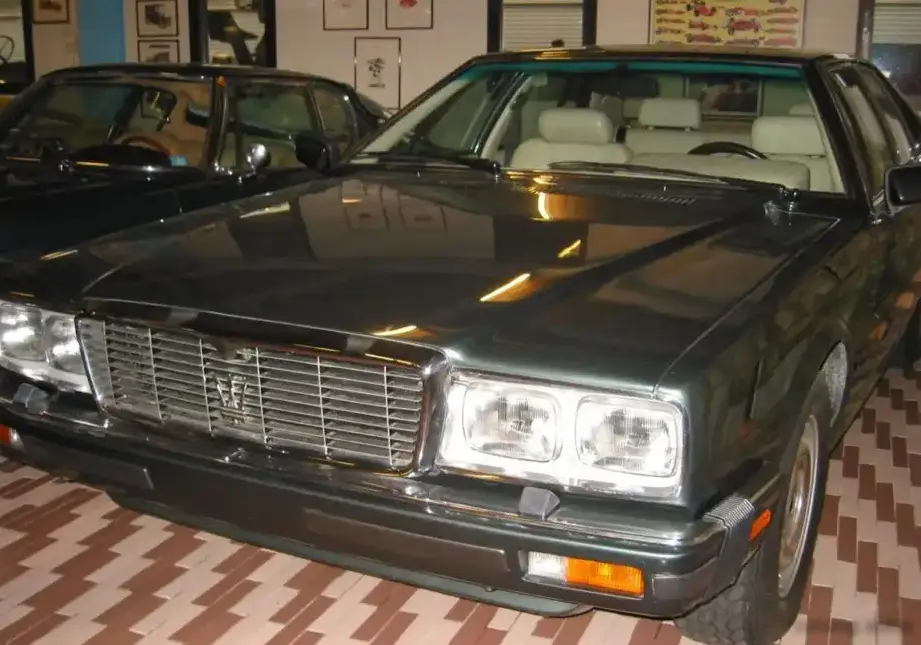
The Maserati Royale 4.9 V8, produced between 1985 and 1993, represented a significant, though often overlooked, chapter in the storied Italian automaker’s history. Positioned as a large, luxurious sedan, the Royale aimed to recapture some of the prestige and grand touring spirit of earlier Maserati models, while offering a more contemporary package. It was built during a period of financial instability for Maserati, and its production numbers reflect this, making it a relatively rare vehicle today. The Royale was based on a lengthened version of the De Tomaso chassis, and represented Maserati’s attempt to enter the executive sedan market dominated by German manufacturers.
Technical Specifications
| Brand | Maserati |
| Model | Royale |
| Generation | Royale |
| Type (Engine) | 4.9 V8 (280 Hp) |
| Start of production | 1985 |
| End of production | 1993 |
| Powertrain Architecture | Internal Combustion engine |
| Body type | Sedan |
| Seats | 5 |
| Doors | 4 |
| Fuel consumption (economy) – urban | 20 l/100 km (11.8 US mpg, 14.1 UK mpg, 5 km/l) |
| Fuel consumption (economy) – extra urban | 18 l/100 km (13.1 US mpg, 15.7 UK mpg, 5.6 km/l) |
| Fuel Type | Petrol (Gasoline) |
| Acceleration 0 – 100 km/h | 6.5 sec |
| Acceleration 0 – 62 mph | 6.5 sec |
| Acceleration 0 – 60 mph | 6.2 sec |
| Maximum speed | 240 km/h (149.13 mph) |
| Weight-to-power ratio | 7.1 kg/Hp, 140.7 Hp/tonne |
| Weight-to-torque ratio | 5.1 kg/Nm, 197 Nm/tonne |
| Power | 280 Hp @ 5600 rpm |
| Power per litre | 56.8 Hp/l |
| Torque | 392 Nm @ 3000 rpm (289.12 lb.-ft. @ 3000 rpm) |
| Engine displacement | 4930 cm3 (300.85 cu. in.) |
| Number of cylinders | 8 |
| Engine configuration | V-engine |
| Cylinder Bore | 93.9 mm (3.7 in.) |
| Piston Stroke | 89 mm (3.5 in.) |
| Compression ratio | 8.5:1 |
| Number of valves per cylinder | 2 |
| Fuel injection system | Carburettor |
| Engine aspiration | Naturally aspirated engine |
| Kerb Weight | 1990 kg (4387.2 lbs.) |
| Trunk (boot) space – minimum | 600 l (21.19 cu. ft.) |
| Fuel tank capacity | 100 l (26.42 US gal | 22 UK gal) |
| Length | 4910 mm (193.31 in.) |
| Width | 1890 mm (74.41 in.) |
| Height | 1385 mm (54.53 in.) |
| Wheelbase | 2800 mm (110.24 in.) |
| Front track | 1525 mm (60.04 in.) |
| Rear (Back) track | 1525 mm (60.04 in.) |
| Drivetrain Architecture | The Internal combustion engine (ICE) drives the rear wheels of the vehicle. |
| Drive wheel | Rear wheel drive |
| Number of gears and type of gearbox | 5 gears, manual transmission |
| Front suspension | Coil spring |
| Rear suspension | Coil spring |
| Front brakes | Ventilated discs |
| Rear brakes | Disc |
| Assisting systems | ABS (Anti-lock braking system) |
| Power steering | Hydraulic Steering |
| Tires size | 215/70 R15; 225/70 R15 |
| Wheel rims size | 15 |
Powertrain & Engine Architecture
The heart of the Royale 4.9 was its 4.9-liter V8 engine. This engine, while bearing the Maserati name, had its roots in a design originally developed by Citroën during their ownership of Maserati. It featured a 90-degree V-angle, a cast-iron block, and aluminum cylinder heads. The engine utilized a single overhead camshaft per bank, operating two valves per cylinder. Fuel delivery was managed by a Weber carburetor system, a somewhat outdated technology for the mid-1980s, but one that contributed to the engine’s character. The 4.9 V8 produced 280 horsepower at 5600 rpm and 392 Nm (289 lb-ft) of torque at 3000 rpm. The engine was mated to a five-speed manual transmission, sending power to the rear wheels. While an automatic transmission was offered in some markets, the manual was generally preferred by enthusiasts for its responsiveness and engagement.
Driving Characteristics
The Royale 4.9, with its relatively large displacement and manual transmission, offered a spirited driving experience. Acceleration to 60 mph was achieved in around 6.2-6.5 seconds, and it could reach a top speed of 149 mph. The engine delivered a broad torque curve, making it flexible in various driving situations. However, the car’s considerable weight (approximately 4,387 lbs) meant it wasn’t as nimble as some of its competitors. The suspension, while comfortable, leaned towards a softer setup, prioritizing ride quality over sharp handling. The five-speed manual transmission had well-spaced ratios, allowing the driver to keep the engine in its sweet spot. Compared to potential automatic versions, the manual offered a more direct connection to the engine and a more engaging driving experience.
Equipment & Trim Levels
The Royale 4.9 was generously equipped for its time, reflecting its luxury positioning. Standard features included leather upholstery, power windows, power steering, air conditioning, and an anti-lock braking system (ABS). The interior was characterized by a classic Italian aesthetic, with wood trim and a comfortable, spacious cabin. Optional extras included a sunroof, upgraded audio systems, and various customization options for the interior trim. The Royale didn’t have a complex trim level structure; it was largely offered as a well-equipped base model with options for personalization.
Chassis & Braking
The Royale’s chassis was based on a modified De Tomaso Longchamp platform, providing a robust foundation for the large sedan. The suspension utilized coil springs and hydraulic shock absorbers all around. The front suspension featured independent double wishbones, while the rear employed a solid axle. Braking duties were handled by ventilated discs at the front and solid discs at the rear. The ABS system helped to improve braking performance and stability, particularly in adverse conditions. The Royale’s tires were typically 215/70 R15 or 225/70 R15, mounted on 15-inch wheels.
Market Reception & Comparison
The Maserati Royale 4.9 received mixed reviews from automotive critics. While praised for its powerful engine, luxurious interior, and distinctive Italian styling, it was often criticized for its relatively high price, dated technology (particularly the carburetor fuel system), and build quality issues. Compared to its German rivals, such as the BMW 7 Series and Mercedes-Benz S-Class, the Royale lacked the refinement and technological sophistication. Fuel economy was also a concern, with reported figures of around 11.8 mpg in the city and 13.1 mpg on the highway. However, the Royale offered a unique character and a sense of exclusivity that appealed to a niche group of buyers.
Legacy
The Maserati Royale 4.9, despite its limited production run and mixed reception, remains a significant vehicle in Maserati’s history. It represents a transitional period for the company, bridging the gap between its traditional grand touring roots and its more modern aspirations. Today, the Royale 4.9 is a sought-after classic car, particularly among Maserati enthusiasts. The 4.9 V8 engine, while not known for its exceptional reliability, is generally considered robust when properly maintained. Parts availability can be a challenge, but a dedicated community of owners and specialists exists to support the upkeep of these rare vehicles. The Royale 4.9 serves as a reminder of a time when Maserati was striving to create a truly unique and luxurious grand touring sedan.
