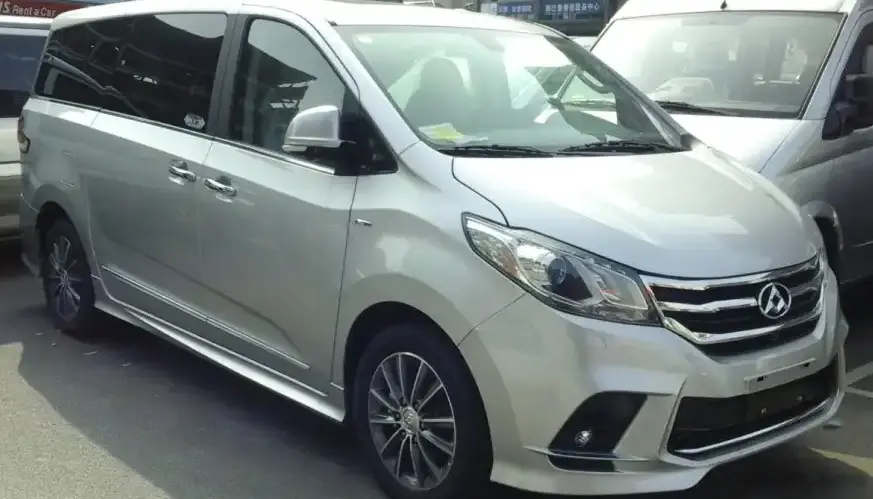
The Maxus G10 Passenger 2.4 16V, producing 143 horsepower, was a commercial vehicle aimed at providing affordable and spacious transportation. Produced between 2014 and 2016, it represented a significant offering from SAIC Motor, under the Maxus brand, primarily targeting markets outside of North America where large passenger vans remained popular. The G10 Passenger occupied a niche as a budget-friendly alternative to established European and Asian competitors, offering a high seating capacity and a utilitarian focus. It was built on a body-on-frame chassis, a construction method increasingly uncommon in modern passenger vehicles, prioritizing durability and cost-effectiveness over refined handling.
Technical Specifications
| Brand | Maxus |
| Model | G10 |
| Generation | G10 Passenger |
| Type (Engine) | 2.4 16V (143 Hp) |
| Start of production | 2014 |
| End of production | 2016 |
| Powertrain Architecture | Internal Combustion engine |
| Body type | Minivan |
| Seats | 9 |
| Doors | 5 |
| Fuel consumption (combined) | 10.2 l/100 km (23.1 US mpg, 27.7 UK mpg, 9.8 km/l) |
| Fuel Type | Petrol (Gasoline) |
| Maximum speed | 160 km/h (99.42 mph) |
| Emission standard | Euro 5 |
| Weight-to-power ratio | 13.3 kg/Hp (75 Hp/tonne) |
| Weight-to-torque ratio | 9.1 kg/Nm (110.1 Nm/tonne) |
| Power | 143 Hp |
| Power per litre | 60.1 Hp/l |
| Torque | 210 Nm (154.89 lb.-ft.) |
| Engine layout | Front, Transverse |
| Engine displacement | 2378 cm3 (145.11 cu. in.) |
| Number of cylinders | 4 |
| Engine configuration | Inline |
| Cylinder Bore | 87 mm (3.43 in.) |
| Piston Stroke | 100 mm (3.94 in.) |
| Number of valves per cylinder | 4 |
| Fuel injection system | Multi-port manifold injection |
| Engine aspiration | Naturally aspirated engine |
| Valvetrain | SOHC |
| Kerb Weight | 1907 kg (4204.22 lbs.) |
| Max. weight | 3000 kg (6613.87 lbs.) |
| Max load | 1093 kg (2409.65 lbs.) |
| Fuel tank capacity | 75 l (19.81 US gal | 16.5 UK gal) |
| Permitted trailer load with brakes (12%) | 1500 kg (3306.93 lbs.) |
| Permitted trailer load without brakes | 750 kg (1653.47 lbs.) |
| Length | 5168 mm (203.46 in.) |
| Width | 1980 mm (77.95 in.) |
| Height | 1928 mm (75.91 in.) |
| Wheelbase | 3210 mm (126.38 in.) |
| Ride height (ground clearance) | 134 mm (5.28 in.) |
| Minimum turning circle | 11.8 m (38.71 ft.) |
| Drivetrain Architecture | The Internal combustion engine (ICE) drives the front wheels of the vehicle. |
| Drive wheel | Front wheel drive |
| Number of gears and type of gearbox | 5 gears, manual transmission |
| Front suspension | Independent type McPherson |
| Rear suspension | Independent multi-link suspension |
| Front brakes | Disc |
| Rear brakes | Disc |
| Assisting systems | ABS (Anti-lock braking system) |
| Steering type | Steering rack and pinion |
| Power steering | Hydraulic Steering |
| Tires size | 215/70 R16 |
| Wheel rims size | 6.5J x 16 |
Powertrain & Engine Architecture
The G10 Passenger 2.4 16V was powered by a 2.4-liter inline-four cylinder engine. This engine, while not particularly advanced, was chosen for its reliability and relatively low production cost. It featured a single overhead camshaft (SOHC) valvetrain operating four valves per cylinder. Fuel delivery was handled by a multi-port fuel injection system, a common setup for vehicles of this class during the production period. The engine produced 143 horsepower and 210 Nm (155 lb-ft) of torque. The engine was transversely mounted, driving the front wheels. The standard transmission was a five-speed manual gearbox. While an automatic transmission was offered in some markets, it wasn’t commonly paired with this specific engine configuration.
Driving Characteristics
The driving experience in the G10 Passenger 2.4 16V was largely defined by its utilitarian nature. The 143 hp engine, while adequate for moving the relatively heavy vehicle, didn’t offer particularly brisk acceleration. The five-speed manual transmission provided a reasonable level of control, but the gear ratios were geared towards fuel economy rather than performance. Compared to potential higher-output variants (which were not widely available), the 2.4L engine felt noticeably less responsive, especially when fully loaded with passengers and cargo. The focus was on providing reliable and affordable transportation, not a sporty driving experience.
Equipment & Trim Levels
The G10 Passenger 2.4 16V was typically equipped with basic, functional features. Standard equipment generally included air conditioning, power steering, and a basic audio system. Interior upholstery was typically vinyl or a durable cloth material. Higher trim levels, if available, might have added features such as power windows, central locking, and upgraded audio systems. However, the G10 Passenger was generally positioned as an entry-level or mid-range offering, prioritizing practicality over luxury.
Chassis & Braking
The G10 Passenger utilized a body-on-frame construction, which contributed to its robust nature but also resulted in a less refined ride compared to vehicles with unibody construction. The front suspension employed an independent McPherson strut setup, while the rear suspension featured an independent multi-link design. Braking duties were handled by disc brakes on all four wheels, supplemented by an Anti-lock Braking System (ABS). The steering system was a rack and pinion setup with hydraulic power assistance.
Market Reception & Comparison
The Maxus G10 Passenger 2.4 16V received mixed reviews. Critics generally praised its spacious interior and affordable price point, but noted its lack of refinement and relatively basic features. Compared to other vans in its class, such as the Toyota Hiace or Mercedes-Benz Vito, the G10 Passenger offered a more budget-friendly option, but lacked the same level of build quality and driving dynamics. Fuel economy was average for a vehicle of its size and weight, and reliability reports were generally positive, though long-term data is limited due to its relatively short production run.
Legacy
The Maxus G10 Passenger 2.4 16V, while not a groundbreaking vehicle, served as an important entry point for the Maxus brand into international markets. The 2.4-liter engine proved to be reasonably durable, and used examples continue to be found in operation today. However, its age and relatively basic features mean that it is primarily appealing to buyers seeking an affordable and practical transportation solution, rather than a modern or luxurious vehicle. Its legacy lies in providing a cost-effective option for large families or commercial operators in regions where passenger vans remain a popular choice.