
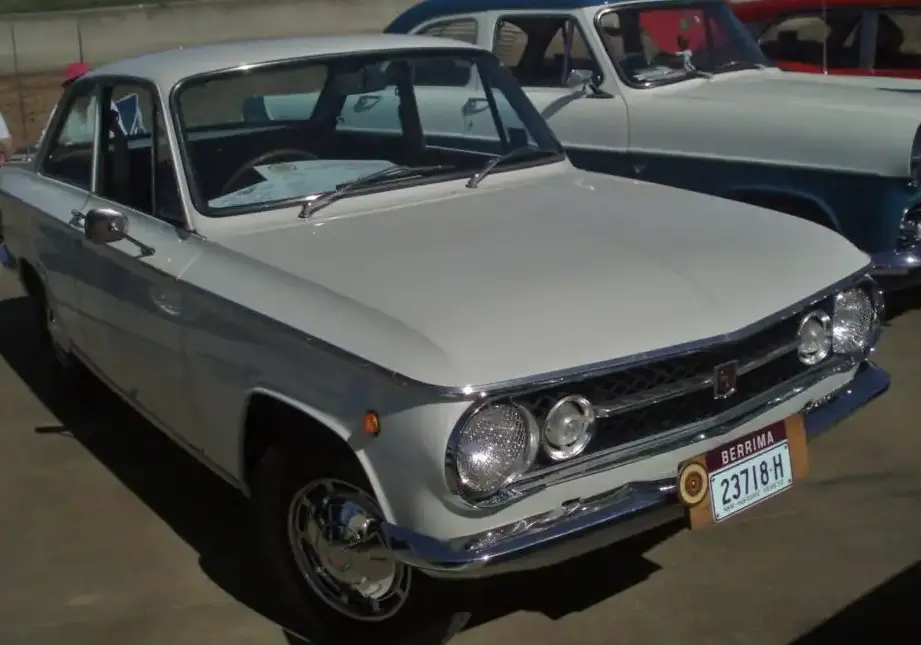
The Mazda 1000, specifically the 1.0-liter (45 hp) variant, represents Mazda’s initial foray into the compact car market, produced from 1964 to 1972. This model, designated as the first generation of the 1000 series, was crucial in establishing Mazda as an automotive manufacturer, moving beyond its roots as a cork company. The 1000 was designed to provide affordable and reliable transportation, primarily targeting the burgeoning post-war Japanese economy. While later iterations would offer more powerful engines and updated styling, the 1.0-liter version served as the entry point to the range, emphasizing fuel efficiency and basic mobility. It was a key model in Mazda’s transition from three-wheeled vehicles to four-wheeled automobiles.
Technical Specifications
| Brand | Mazda |
| Model | 1000 |
| Generation | 1000 |
| Type (Engine) | 1.0 (45 Hp) |
| Start of production | 1964 |
| End of production | 1972 |
| Powertrain Architecture | Internal Combustion engine |
| Body type | Sedan |
| Seats | 5 |
| Doors | 2 |
| Fuel Type | Petrol (Gasoline) |
| Weight-to-power ratio | 18 kg/Hp, 55.6 Hp/tonne |
| Power | 45 Hp |
| Power per litre | 45.7 Hp/l |
| Engine displacement | 985 cm3 |
| 60.11 cu. in. | |
| Number of cylinders | 4 |
| Engine configuration | Inline |
| Cylinder Bore | 70 mm |
| 2.76 in. | |
| Piston Stroke | 64 mm |
| 2.52 in. | |
| Compression ratio | 8.8:1 |
| Number of valves per cylinder | 2 |
| Fuel injection system | Carburettor |
| Engine aspiration | Naturally aspirated engine |
| Valvetrain | SOHC |
| Kerb Weight | 810 kg |
| 1785.74 lbs. | |
| Fuel tank capacity | 40 l |
| 10.57 US gal | 8.8 UK gal | |
| Length | 3855 mm |
| 151.77 in. | |
| Width | 1540 mm |
| 60.63 in. | |
| Height | 1385 mm |
| 54.53 in. | |
| Wheelbase | 2260 mm |
| 88.98 in. | |
| Front track | 1275 mm |
| 50.2 in. | |
| Rear (Back) track | 1255 mm |
| 49.41 in. | |
| Ride height (ground clearance) | 160 mm |
| 6.3 in. | |
| Minimum turning circle (turning diameter) | 8.4 m |
| 27.56 ft. | |
| Drivetrain Architecture | The Internal combustion engine (ICE) drives the rear wheels of the vehicle. |
| Drive wheel | Rear wheel drive |
| Number of gears and type of gearbox | 4 gears, manual transmission |
| Front suspension | Spring Strut, Transverse stabilizer |
| Rear suspension | Rigid axle suspension, Leaf spring |
| Front brakes | Disc |
| Rear brakes | Drum |
| Steering type | Cone worm with recirculation balls |
Powertrain & Engine Architecture
The heart of the Mazda 1000 1.0 was a 985cc (60.11 cubic inches) inline-four cylinder engine. This engine, utilizing a single overhead camshaft (SOHC) valvetrain and two valves per cylinder, produced 45 horsepower. Fuel delivery was managed by a carburetor, a common feature for vehicles of this era. The engine’s relatively low compression ratio of 8.8:1 prioritized reliability and the ability to run on the lower-octane fuels prevalent at the time. The engine was mounted longitudinally in the front of the vehicle, driving the rear wheels. The four-speed manual transmission was the only gearbox option available with this engine configuration. The engine code is not widely documented, but it represents a relatively simple and robust design, typical of early Japanese automotive engineering.
Driving Characteristics
The 1.0-liter Mazda 1000 was not designed for outright speed. With only 45 horsepower propelling a vehicle weighing approximately 810 kg (1786 lbs), acceleration was modest. However, the light weight and relatively simple mechanicals contributed to a nimble feel, particularly in urban driving conditions. The four-speed manual transmission offered a reasonable spread of gears, allowing the driver to keep the engine in its optimal power band. Compared to later, more powerful versions of the 1000, the 1.0-liter model prioritized fuel economy and ease of driving over performance. The rear-wheel-drive layout provided a traditional driving experience, but also meant that handling could be unpredictable on slippery surfaces. The gear ratios were tuned for maximizing fuel efficiency rather than quick acceleration.
Equipment & Trim Levels
The Mazda 1000 1.0 was a fairly spartan vehicle, reflecting its position as an affordable entry-level car. Standard equipment typically included basic instrumentation (speedometer, fuel gauge), simple vinyl upholstery, and minimal exterior trim. Options were limited, but could include a radio, heater, and upgraded interior trim. The interior was functional and focused on durability rather than luxury. The dashboard layout was straightforward, with easily accessible controls. The 1000 1.0 was generally offered in a limited range of solid colors, reflecting the cost-conscious nature of the vehicle.
Chassis & Braking
The Mazda 1000 1.0 featured a relatively conventional chassis design for the time. The front suspension utilized a spring strut setup with a transverse stabilizer bar, while the rear suspension employed a rigid axle with leaf springs. This configuration provided a comfortable, if somewhat basic, ride quality. Braking was accomplished via disc brakes on the front wheels and drum brakes on the rear. The steering system was a cone worm type with recirculation balls, offering reasonable precision but requiring a fair amount of effort. The relatively narrow tires and simple suspension setup were geared towards maximizing fuel efficiency and minimizing cost.
Market Reception & Comparison
The Mazda 1000 1.0 was generally well-received in its target market of Japan. It provided affordable and reliable transportation for a growing middle class. Critics praised its fuel efficiency and ease of maintenance. However, its limited power and basic features were also noted. Compared to other compact cars of the era, such as the Toyota Corolla and the Datsun 1000, the Mazda 1000 1.0 offered a similar level of practicality and affordability. The Corolla and Datsun often had a slight edge in terms of refinement and dealer network, but the Mazda 1000 carved out its own niche with its distinctive styling and reliable engine.
Legacy
The Mazda 1000 1.0 laid the foundation for Mazda’s future success in the automotive industry. While the early 1.0-liter models are relatively rare today, they are valued by collectors and enthusiasts as important pieces of Mazda history. The powertrain, while simple, proved to be remarkably durable, and many examples remain on the road today. The 1000’s success demonstrated Mazda’s ability to design and manufacture affordable, reliable automobiles, paving the way for the development of more sophisticated models in the years to come. In the used car market, surviving examples of the 1.0-liter Mazda 1000 are sought after for their originality and historical significance, often commanding a premium price among collectors.
