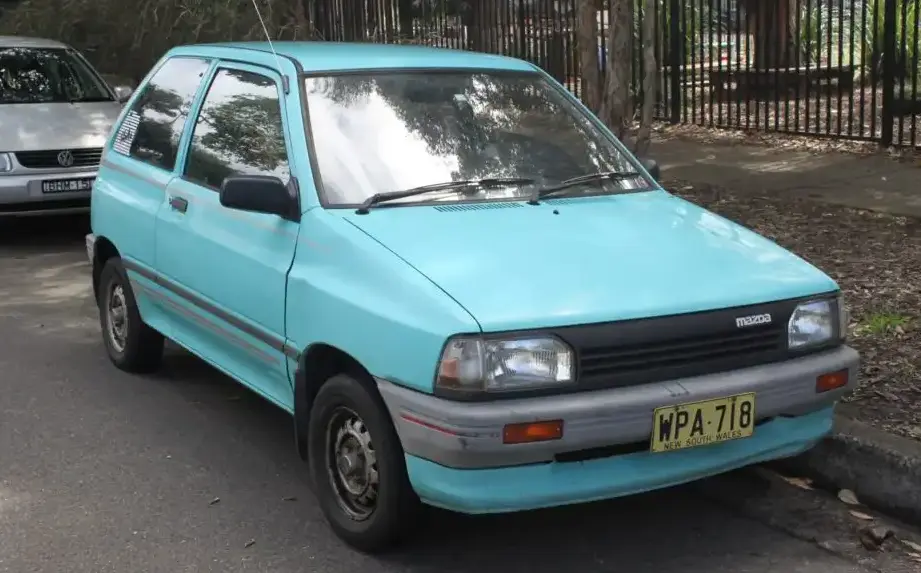
The Mazda 121, known as the Mazda 121 I (DA) in its first generation, was a supermini produced by Mazda from 1989 to 1991. This initial iteration of the 121 was significant as it represented Mazda’s entry into the burgeoning European supermini market, a segment dominated by models like the Fiat Uno, Peugeot 205, and Ford Fiesta. The 1.1-liter (54 hp) variant, equipped with a five-speed manual transmission, served as the entry point to the 121 range, targeting budget-conscious buyers seeking economical transportation. It was a key model in establishing the 121’s presence, particularly in Europe where it was often rebadged and sold under different names depending on the market.
Technical Specifications
| Brand | Mazda |
| Model | 121 |
| Generation | 121 I (DA) |
| Type (Engine) | 1.1 (54 Hp) |
| Start of production | August, 1989 |
| End of production | March, 1991 |
| Powertrain Architecture | Internal Combustion engine |
| Body type | Hatchback |
| Seats | 5 |
| Doors | 3 |
| Fuel Type | Petrol (Gasoline) |
| Acceleration 0 – 100 km/h | 13.6 sec |
| Acceleration 0 – 62 mph | 13.6 sec |
| Acceleration 0 – 60 mph | 12.9 sec |
| Maximum speed | 150 km/h (93.21 mph) |
| Weight-to-power ratio | 13.4 kg/Hp, 74.5 Hp/tonne |
| Weight-to-torque ratio | 8.5 kg/Nm, 117.2 Nm/tonne |
| Power | 54 Hp @ 5800 rpm |
| Power per litre | 47.4 Hp/l |
| Torque | 85 Nm @ 3600 rpm (62.69 lb.-ft. @ 3600 rpm) |
| Engine layout | Front, Transverse |
| Engine Model/Code | B1 |
| Engine displacement | 1139 cm3 (69.51 cu. in.) |
| Number of cylinders | 4 |
| Engine configuration | Inline |
| Cylinder Bore | 68 mm (2.68 in.) |
| Piston Stroke | 78.4 mm (3.09 in.) |
| Compression ratio | 9.4:1 |
| Number of valves per cylinder | 2 |
| Fuel injection system | Carburettor |
| Engine aspiration | Naturally aspirated engine |
| Valvetrain | SOHC |
| Engine oil capacity | 3.3 l (3.49 US qt | 2.9 UK qt) |
| Coolant | 5 l (5.28 US qt | 4.4 UK qt) |
| Kerb Weight | 725 kg (1598.35 lbs.) |
| Fuel tank capacity | 38 l (10.04 US gal | 8.36 UK gal) |
| Length | 3475 mm (136.81 in.) |
| Width | 1605 mm (63.19 in.) |
| Height | 1450 mm (57.09 in.) |
| Wheelbase | 2295 mm (90.35 in.) |
| Front track | 1400 mm (55.12 in.) |
| Rear track | 1385 mm (54.53 in.) |
| Drivetrain Architecture | The Internal combustion engine (ICE) drives the front wheels of the vehicle. |
| Drive wheel | Front wheel drive |
| Number of gears and type of gearbox | 5 gears, manual transmission |
| Front suspension | Independent, type McPherson with coil spring and anti-roll bar |
| Rear suspension | Torsion |
| Front brakes | Disc |
| Rear brakes | Drum |
| Steering type | Steering rack and pinion |
Powertrain & Engine Architecture
The heart of the 121 1.1 was the B1 engine, a 1.1-liter inline-four cylinder petrol engine. This engine utilized a single overhead camshaft (SOHC) valvetrain with two valves per cylinder. Notably, it employed a carburetor for fuel delivery, a relatively archaic system by the late 1980s, but one that contributed to its affordability. The carburetor setup, while simple, meant less precise fuel metering compared to fuel injection systems, impacting both performance and emissions. The engine produced 54 horsepower at 5800 rpm and 85 Nm (62.69 lb-ft) of torque at 3600 rpm. The five-speed manual transmission was the only gearbox option for this variant, providing a reasonable spread of gears for maximizing fuel efficiency and managing the engine’s limited power output.
Driving Characteristics
The 121 1.1 was not a performance-oriented vehicle. Its 0-60 mph time of around 12.9 seconds and top speed of 93 mph reflected its modest power output and relatively lightweight construction. The driving experience was characterized by a need to work the engine to achieve reasonable acceleration. The five-speed gearbox helped to keep the engine in its optimal power band, but overtaking maneuvers required careful planning. Compared to potential higher-spec versions (which were not widely available in all markets), the 1.1 lacked the punch needed for spirited driving. The steering was light and accurate, making it easy to maneuver in urban environments, and the suspension provided a comfortable, if somewhat basic, ride.
Equipment & Trim Levels
The 1.1-liter 121 was typically the base model, and as such, it came with a fairly minimal level of equipment. Standard features generally included cloth upholstery, basic instrumentation (speedometer, fuel gauge, temperature gauge), and a steering wheel. Power steering and central locking were often optional extras. Interior plastics were durable but utilitarian, reflecting the car’s budget-friendly positioning. The exterior trim was also basic, with steel wheels and black plastic bumpers being common features. Optional extras could include a radio, upgraded upholstery, and occasionally, a sunroof.
Chassis & Braking
The 121 I (DA) featured a front-wheel-drive layout with an independent McPherson strut suspension at the front and a torsion beam suspension at the rear. This suspension setup provided a reasonable balance between ride comfort and handling. The front brakes were disc brakes, offering adequate stopping power, while the rear brakes were drums, a cost-saving measure common in this class of vehicle. The steering was a rack and pinion system, providing precise and responsive steering feel. The relatively light curb weight of 725 kg (1598.35 lbs) helped to mitigate the limitations of the braking system and suspension.
Market Reception & Comparison
The Mazda 121 1.1 was generally well-received as an affordable and economical supermini. Critics praised its fuel efficiency and ease of driving, but noted its lack of performance and somewhat basic interior. Compared to rivals like the Fiat Uno and Peugeot 205, the 121 offered a competitive price point but lacked the stylistic flair and driving dynamics of some of its competitors. Its fuel economy was comparable to other 1.1-liter superminis of the era, and its reliability was generally considered to be good, although the carburetor-based fuel system could require occasional maintenance.
Legacy
The Mazda 121 I (DA) 1.1, while not a groundbreaking vehicle, played an important role in establishing Mazda’s presence in the European supermini market. The B1 engine, while simple, proved to be reasonably durable, and many examples are still on the road today. In the used car market, these early 121s are often sought after by enthusiasts looking for a classic, affordable, and easy-to-maintain vehicle. The 121’s successor, the second-generation model, offered significant improvements in terms of performance, refinement, and features, but the original 1.1-liter variant remains a significant piece of Mazda’s history, representing a key step in the company’s global expansion.