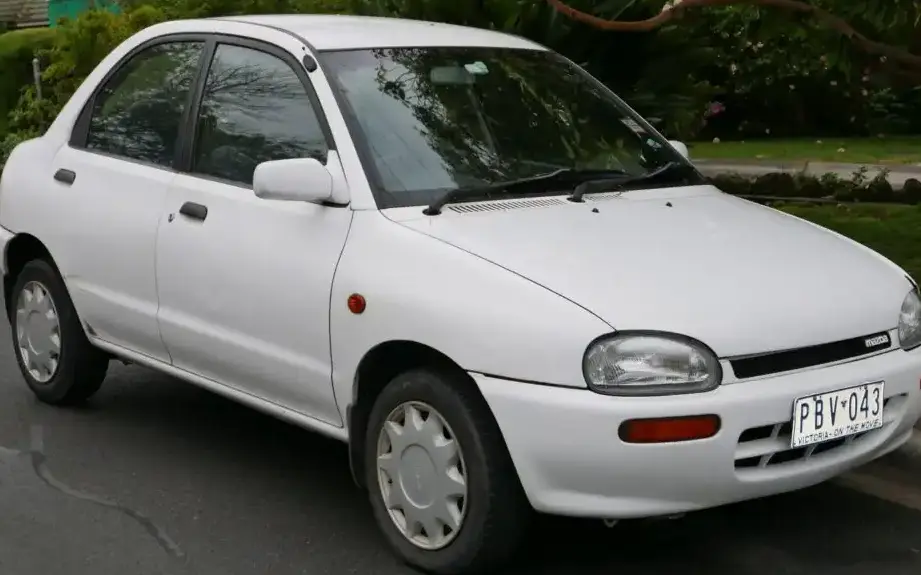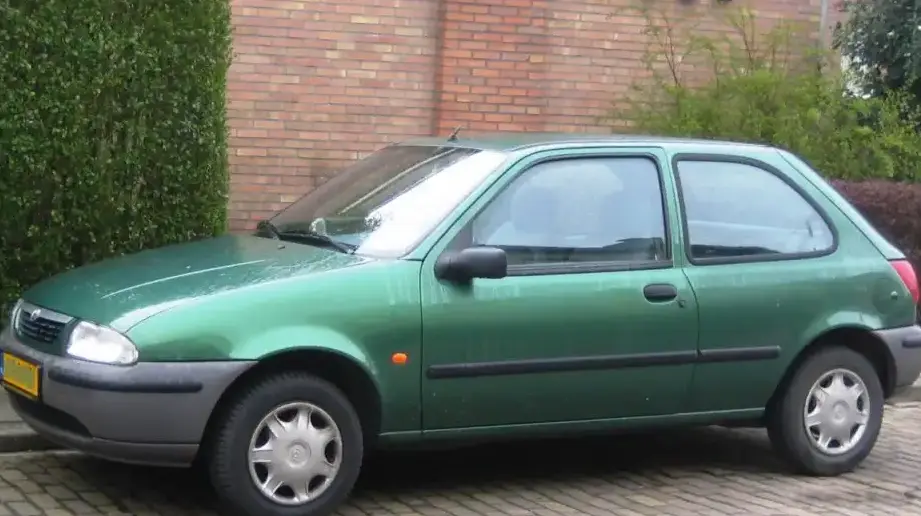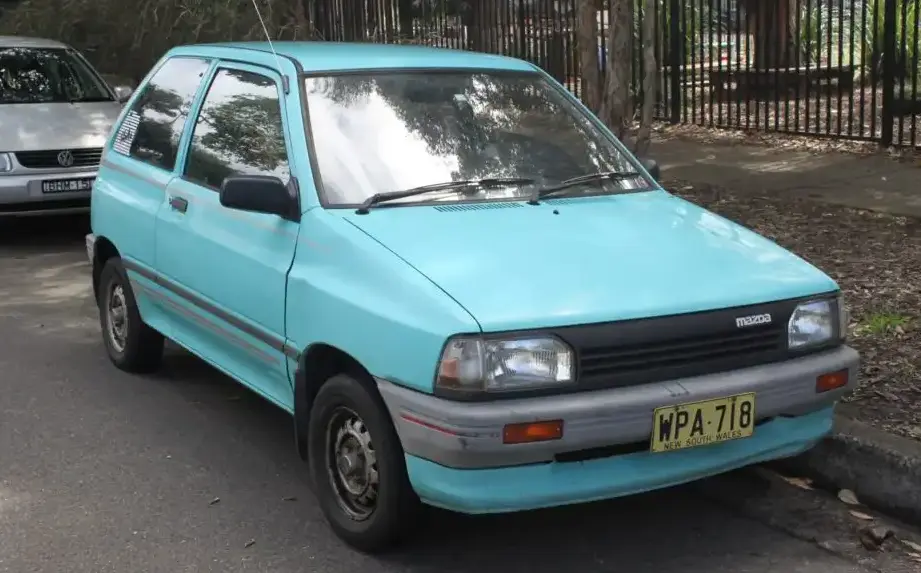
The Mazda 121, known as the Mazda 2 in some markets, represents Mazda’s entry into the supermini segment. The first generation, designated the DA series, was produced from 1987 to 1991. The 1.3-liter (65 hp) variant, introduced in 1988, served as a core model within the DA lineup, offering an affordable and economical option for buyers seeking a practical and compact hatchback. This model was primarily aimed at the European and Asian markets, where small, fuel-efficient cars were in high demand. It was positioned as the base trim level, offering a more accessible price point compared to potential future higher-specification versions.
Technical Specifications
| Brand | Mazda |
| Model | 121 |
| Generation | 121 I (DA) |
| Type (Engine) | 1.3 (65 Hp) |
| Start of production | 1988 |
| End of production | 1991 |
| Powertrain Architecture | Internal Combustion engine |
| Body type | Hatchback |
| Seats | 5 |
| Doors | 3 |
| Fuel Type | Petrol (Gasoline) |
| Acceleration 0 – 100 km/h | 11.6 sec |
| Acceleration 0 – 62 mph | 11.6 sec |
| Acceleration 0 – 60 mph | 11 sec |
| Maximum speed | 160 km/h (99.42 mph) |
| Weight-to-power ratio | 11.6 kg/Hp, 86.1 Hp/tonne |
| Weight-to-torque ratio | 7.6 kg/Nm, 132.5 Nm/tonne |
| Power | 65 Hp @ 5600 rpm |
| Power per litre | 49.1 Hp/l |
| Torque | 100 Nm @ 3600 rpm (73.76 lb.-ft. @ 3600 rpm) |
| Engine layout | Front, Transverse |
| Engine Model/Code | B3 |
| Engine displacement | 1324 cm3 (80.8 cu. in.) |
| Number of cylinders | 4 |
| Engine configuration | Inline |
| Cylinder Bore | 71 mm (2.8 in.) |
| Piston Stroke | 83.6 mm (3.29 in.) |
| Compression ratio | 9.4:1 |
| Number of valves per cylinder | 2 |
| Fuel injection system | Carburettor |
| Engine aspiration | Naturally aspirated engine |
| Valvetrain | SOHC |
| Engine oil capacity | 3.3 l (3.49 US qt | 2.9 UK qt) |
| Coolant | 5 l (5.28 US qt | 4.4 UK qt) |
| Kerb Weight | 755 kg (1664.49 lbs.) |
| Fuel tank capacity | 38 l (10.04 US gal | 8.36 UK gal) |
| Length | 3475 mm (136.81 in.) |
| Width | 1605 mm (63.19 in.) |
| Height | 1450 mm (57.09 in.) |
| Wheelbase | 2295 mm (90.35 in.) |
| Front track | 1400 mm (55.12 in.) |
| Rear track | 1385 mm (54.53 in.) |
| Drivetrain Architecture | The Internal combustion engine (ICE) drives the front wheels of the vehicle. |
| Drive wheel | Front wheel drive |
| Number of gears and type of gearbox | 5 gears, manual transmission |
| Front suspension | Independent, type McPherson with coil spring and anti-roll bar |
| Rear suspension | Torsion |
| Front brakes | Disc |
| Rear brakes | Drum |
| Steering type | Steering rack and pinion |
Powertrain & Engine Architecture
The heart of the 121 1.3 was the Mazda B3 engine, a 1.3-liter inline-four cylinder petrol engine. This engine utilized a single overhead camshaft (SOHC) valvetrain with two valves per cylinder. Notably, this engine employed a carburetor for fuel delivery, a common feature for vehicles of this era, particularly in the economy car segment. The carburetor system, while simpler and less expensive than fuel injection, offered adequate performance for the intended application. The engine produced 65 horsepower at 5,600 rpm and 74 lb-ft of torque at 3,600 rpm. The engine was transversely mounted in the front of the vehicle, driving the front wheels. The transmission was a standard five-speed manual gearbox, optimized for fuel efficiency and everyday driving.
Driving Characteristics
The 1.3-liter engine, paired with the five-speed manual transmission, provided adequate, though not exhilarating, performance. Acceleration from 0 to 60 mph took approximately 11 seconds, and the top speed was around 99 mph. The gear ratios were tuned for maximizing fuel economy, resulting in a somewhat leisurely driving experience. Compared to potential higher-output versions (which were not widely available in all markets), the 1.3 felt noticeably less powerful, particularly when fully loaded or climbing hills. However, the light weight of the vehicle (approximately 1664 lbs) helped to mitigate the lack of horsepower. The steering was light and responsive, making it easy to maneuver in urban environments.
Equipment & Trim Levels
The 121 1.3 was typically equipped with basic, yet functional, features. Standard equipment generally included cloth upholstery, a basic instrument cluster, and manual windows and door locks. Air conditioning and power steering were often optional extras, depending on the market. Interior trim was generally simple and durable, reflecting the car’s budget-oriented positioning. The exterior featured steel wheels with hubcaps, and body-colored bumpers were often an optional upgrade. The focus was on providing a practical and affordable vehicle, rather than luxury or extensive features.
Chassis & Braking
The 121 1.3 utilized a McPherson strut front suspension with coil springs and an anti-roll bar, providing a reasonable level of ride comfort and handling. The rear suspension employed a torsion beam setup, which was a cost-effective solution for maintaining a compact rear end. The braking system consisted of disc brakes on the front wheels and drum brakes on the rear. While adequate for normal driving conditions, the drum brakes on the rear offered less stopping power and fade resistance compared to disc brakes. The steering was a rack and pinion system, providing precise and responsive steering feel.
Market Reception & Comparison
The Mazda 121 1.3 was generally well-received as an affordable and reliable supermini. Critics praised its fuel efficiency and ease of driving, but noted its modest performance. Compared to competitors like the Ford Fiesta, Volkswagen Polo, and Nissan Micra, the 121 offered a competitive price point and a relatively spacious interior for its size. The carburetor-equipped engine, while economical, was considered less refined than fuel-injected alternatives offered by some competitors. Reliability was generally good, with the B3 engine proving to be durable and relatively easy to maintain.
Legacy
The Mazda 121 DA series, particularly the 1.3-liter variant, established Mazda as a player in the competitive supermini market. While not known for its performance, the 121’s affordability, fuel efficiency, and reliability made it a popular choice for budget-conscious buyers. Today, the DA series 121 is considered a classic among enthusiasts, and well-maintained examples are becoming increasingly collectible. The B3 engine, while simple in design, proved to be a robust and long-lasting powertrain, and parts availability remains relatively good. The 121 laid the groundwork for future Mazda 2 models, which have continued to build on the brand’s reputation for producing fun-to-drive and reliable small cars.