Technical Specifications
| Brand | Mazda |
| Model | 2 |
| Generation | I (DY) |
| Type (Engine) | 1.2 i 16V (75 Hp) |
| Start of production | 2003 |
| End of production | 2007 |
| Powertrain Architecture | Internal Combustion engine |
| Body type | Hatchback |
| Seats | 5 |
| Doors | 5 |
| Fuel consumption (urban) | 8.6 l/100 km (27.4 US mpg, 32.8 UK mpg, 11.6 km/l) |
| Fuel consumption (extra urban) | 5 l/100 km (47 US mpg, 56.5 UK mpg, 20 km/l) |
| Fuel consumption (combined) | 6.3 l/100 km (37.3 US mpg, 44.8 UK mpg, 15.9 km/l) |
| CO2 emissions | 149 g/km |
| Fuel Type | Petrol (Gasoline) |
| Acceleration 0 – 100 km/h | 15.1 sec |
| Acceleration 0 – 62 mph | 15.1 sec |
| Acceleration 0 – 60 mph | 14.3 sec |
| Maximum speed | 163 km/h (101.28 mph) |
| Emission standard | Euro 4 |
| Weight-to-power ratio | 14 kg/Hp, 71.4 Hp/tonne |
| Weight-to-torque ratio | 9.5 kg/Nm, 104.8 Nm/tonne |
| Power | 75 Hp @ 6000 rpm |
| Power per litre | 60.4 Hp/l |
| Torque | 110 Nm @ 4000 rpm (81.13 lb.-ft. @ 4000 rpm) |
| Engine layout | Front, Transverse |
| Engine Model/Code | FUJA |
| Engine displacement | 1242 cm3 (75.79 cu. in.) |
| Number of cylinders | 4 |
| Engine configuration | Inline |
| Cylinder Bore | 71.9 mm (2.83 in.) |
| Piston Stroke | 76.5 mm (3.01 in.) |
| Compression ratio | 10.1:1 |
| Number of valves per cylinder | 4 |
| Fuel injection system | Multi-port manifold injection |
| Engine aspiration | Naturally aspirated engine |
| Valvetrain | DOHC |
| Engine oil capacity | 3.8 l (4.02 US qt | 3.34 UK qt) |
| Coolant capacity | 5 l (5.28 US qt | 4.4 UK qt) |
| Kerb Weight | 1050 kg (2314.85 lbs.) |
| Max. weight | 1490 kg (3284.89 lbs.) |
| Max load | 440 kg (970.03 lbs.) |
| Trunk (boot) space – minimum | 267 l (9.43 cu. ft.) |
| Trunk (boot) space – maximum | 1044 l (36.87 cu. ft.) |
| Fuel tank capacity | 45 l (11.89 US gal | 9.9 UK gal) |
| Length | 3925 mm (154.53 in.) |
| Width | 1680 mm (66.14 in.) |
| Height | 1545 mm (60.83 in.) |
| Wheelbase | 2490 mm (98.03 in.) |
| Front track | 1460 mm (57.48 in.) |
| Rear track | 1435 mm (56.5 in.) |
| Drag coefficient (Cd) | 0.34 |
| Minimum turning circle | 9.8 m (32.15 ft.) |
| Drivetrain Architecture | Front wheel drive |
| Number of gears | 5 |
| Gearbox type | Manual transmission |
| Front suspension | Spring Strut |
| Rear suspension | Coil spring |
| Front brakes | Ventilated discs |
| Rear brakes | Drum |
| Assisting systems | ABS (Anti-lock braking system) |
| Steering type | Steering rack and pinion |
| Tires size | 175/65 R14 |
| Wheel rims size | 14 |
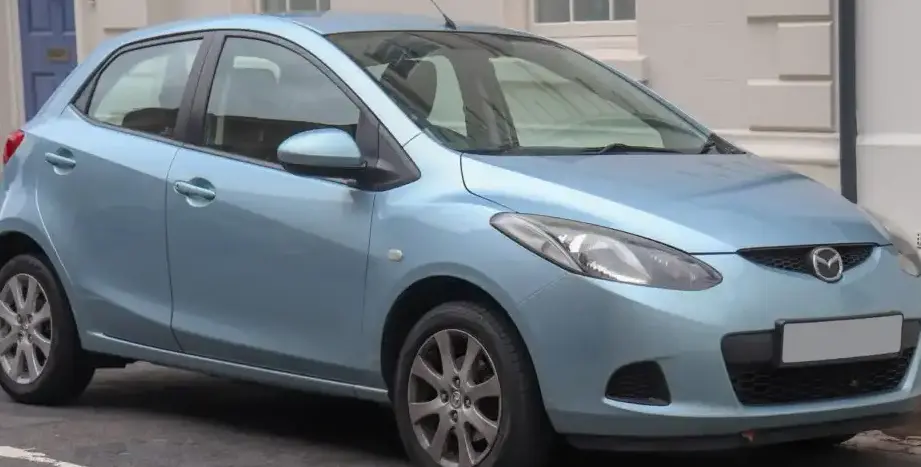
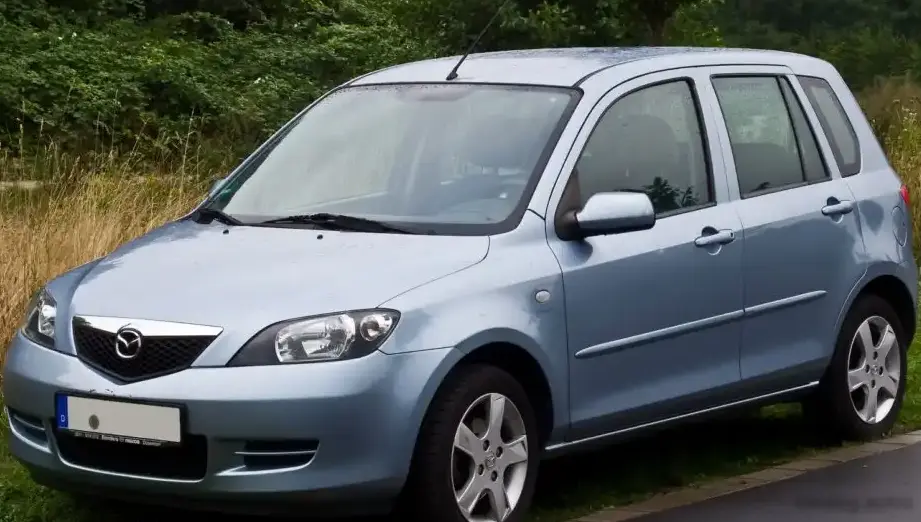
The Mazda2 I (DY) 1.2 i 16V, produced between 2003 and 2007, marked Mazda’s initial foray into the competitive European subcompact car market. Designed to rival vehicles like the Ford Fiesta, Volkswagen Polo, and Renault Clio, the DY series Mazda2 aimed to deliver a compelling combination of affordability, practicality, and Mazda’s renowned driving feel. This particular 1.2-liter variant, generating 75 horsepower, functioned as the entry-level engine option in many European countries, prioritizing fuel economy and reduced operating costs over outright performance. It was a crucial model in establishing the Mazda2 as a viable alternative in a segment dominated by established manufacturers.
Powertrain & Engine Architecture
At the core of this Mazda2 variant lies the FUJA engine, a 1.2-liter inline-four cylinder gasoline engine. This engine employs a single overhead camshaft (SOHC) design, although some later versions incorporated a dual overhead camshaft (DOHC) configuration. The FUJA engine utilizes multi-point fuel injection, delivering fuel directly to each intake port. While not as sophisticated as direct injection systems, this approach offered a good balance between efficiency and cost. The engine’s 16 valves (four per cylinder) enhance its breathing efficiency, contributing to the rated 75 horsepower at 6000 rpm and 110 Nm (81.13 lb-ft) of torque at 4000 rpm. The engine is mounted transversely at the front of the vehicle, powering the front wheels. A five-speed manual transmission was the standard offering, providing a simple and dependable method of transferring power to the road.
Driving Characteristics
The 1.2-liter Mazda2, equipped with the five-speed manual transmission, provided a driving experience centered around economy and ease of use. Acceleration was modest, requiring approximately 15.1 seconds to reach 62 mph. The engine felt somewhat stressed at higher speeds, and overtaking maneuvers demanded careful consideration. However, within city limits, the engine proved responsive enough for everyday driving. The gear ratios were optimized for fuel efficiency, with a relatively tall fifth gear designed to lower engine speed on the highway. Compared to the more powerful 1.5-liter versions, the 1.2-liter model lacked the punch for spirited driving, but it compensated with significantly improved fuel economy. The steering was light and precise, consistent with Mazda’s engineering principles, making the car easy to maneuver in confined spaces.
Equipment & Trim Levels
The base-level 1.2 i 16V trim typically included features such as power steering, central locking, electric front windows, and an AM/FM radio. Safety features included driver and passenger airbags and ABS brakes. Interior upholstery was generally a basic cloth material. Optional extras included air conditioning, alloy wheels, and a CD player. Higher trim levels, such as the ‘Sport’ or ‘TS’ models, added features like upgraded interior trim, fog lights, and a more comprehensive audio system. The overall interior design was functional and straightforward, prioritizing practicality over luxury.
Chassis & Braking
The Mazda2 I (DY) featured a MacPherson strut front suspension and a torsion beam rear suspension. This configuration provided a good compromise between ride comfort and handling. The front brakes were ventilated discs, offering adequate stopping power, while the rear brakes were drums, a cost-saving measure common in this class. The chassis was relatively lightweight, contributing to the car’s agile handling. The steering was rack and pinion, providing precise control. The 175/65 R14 tires offered a reasonable level of grip in most driving conditions.
Market Reception & Comparison
The Mazda2 1.2 i 16V was generally well-received by automotive reviewers as a practical and affordable city car. It was praised for its fuel efficiency, nimble handling, and relatively spacious interior for its size. However, some critics pointed out the engine’s lack of power, particularly when the car was fully loaded or traveling uphill. Compared to the 1.5-liter variants, the 1.2-liter model offered significantly better fuel economy (around 37.3 US mpg combined) but at the expense of performance. Reliability was generally good, with the FUJA engine proving to be a durable unit. The 1.2L model was often considered a sensible choice for drivers prioritizing economy and practicality over performance.
Legacy
The Mazda2 I (DY) 1.2 i 16V remains a relatively common sight on European roads today, a testament to its durability and affordability. The FUJA engine, while not known for its exhilarating performance, has proven to be a reliable and long-lasting unit. Used examples are typically available at very reasonable prices, making them appealing to first-time car buyers or those seeking a cheap and economical vehicle. While maintenance costs are generally low, potential buyers should be aware of the possibility of age-related issues, such as corrosion and wear on suspension components. The DY series Mazda2 played a significant role in establishing Mazda as a serious competitor in the European subcompact car market, setting the stage for the success of subsequent generations.