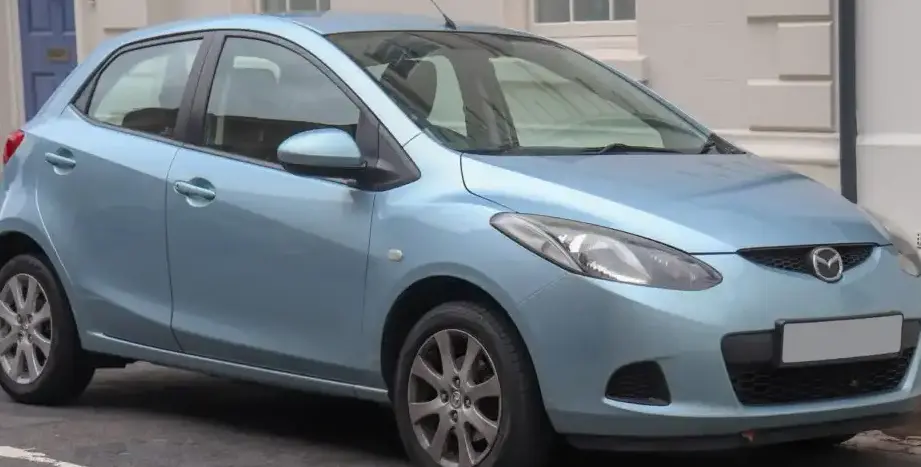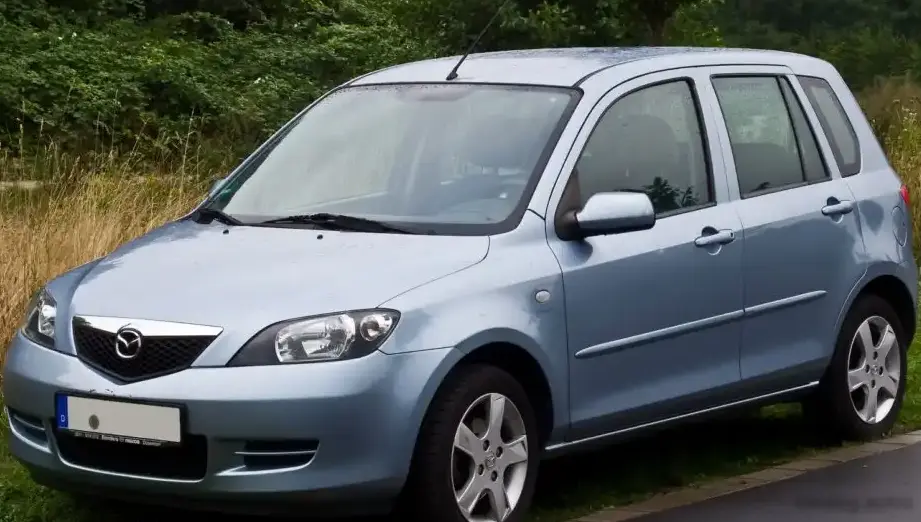
The Mazda2 I (DY) 1.4 CD Automatic, produced between 2003 and 2007, represented Mazda’s entry into the European subcompact diesel market. Part of the first generation (DY) Mazda2, this variant aimed to provide fuel efficiency and practicality for urban drivers. Positioned as a more economical option within the DY range, it sat below the 1.6-liter gasoline models in terms of performance but offered a diesel-powered alternative for those prioritizing fuel economy. The 1.4 CD Automatic was primarily sold in Europe, where diesel engines held a significant market share due to favorable taxation and fuel costs.
Technical Specifications
| Brand | Mazda |
| Model | 2 |
| Generation | I (DY) |
| Type (Engine) | 1.4 CD (68 Hp) Automatic |
| Start of production | 2003 |
| End of production | 2007 |
| Powertrain Architecture | Internal Combustion engine |
| Body type | Hatchback |
| Seats | 5 |
| Doors | 5 |
| Fuel consumption (urban) | 5.8 l/100 km (40.6 US mpg, 48.7 UK mpg, 17.2 km/l) |
| Fuel consumption (extra urban) | 4.2 l/100 km (56 US mpg, 67.3 UK mpg, 23.8 km/l) |
| Fuel consumption (combined) | 4.8 l/100 km (49 US mpg, 58.9 UK mpg, 20.8 km/l) |
| CO2 emissions | 127 g/km |
| Fuel Type | Diesel |
| Acceleration 0 – 100 km/h | 16 sec |
| Acceleration 0 – 62 mph | 16 sec |
| Acceleration 0 – 60 mph | 15.2 sec |
| Maximum speed | 160 km/h (99.42 mph) |
| Emission standard | Euro 3 |
| Weight-to-power ratio | 16.1 kg/Hp, 62.1 Hp/tonne |
| Weight-to-torque ratio | 6.8 kg/Nm, 146.1 Nm/tonne |
| Power | 68 Hp @ 4000 rpm |
| Power per litre | 48.6 Hp/l |
| Torque | 160 Nm @ 2000 rpm (118.01 lb.-ft. @ 2000 rpm) |
| Engine layout | Front, Transverse |
| Engine Model/Code | F6JA, F6JB |
| Engine displacement | 1399 cm3 (85.37 cu. in.) |
| Number of cylinders | 4 |
| Engine configuration | Inline |
| Cylinder Bore | 73.7 mm (2.9 in.) |
| Piston Stroke | 82 mm (3.23 in.) |
| Compression ratio | 18:1 |
| Number of valves per cylinder | 2 |
| Fuel injection system | Diesel Commonrail |
| Engine aspiration | Turbocharger, Intercooler |
| Valvetrain | SOHC |
| Engine oil capacity | 3.8 l (4.02 US qt | 3.34 UK qt) |
| Coolant | 5.5 l (5.81 US qt | 4.84 UK qt) |
| Kerb Weight | 1095 kg (2414.06 lbs.) |
| Max. weight | 1535 kg (3384.1 lbs.) |
| Max load | 440 kg (970.03 lbs.) |
| Trunk (boot) space – minimum | 267 l (9.43 cu. ft.) |
| Trunk (boot) space – maximum | 1044 l (36.87 cu. ft.) |
| Fuel tank capacity | 45 l (11.89 US gal | 9.9 UK gal) |
| Length | 3925 mm (154.53 in.) |
| Width | 1680 mm (66.14 in.) |
| Height | 1545 mm (60.83 in.) |
| Wheelbase | 2490 mm (98.03 in.) |
| Front track | 1470 mm (57.87 in.) |
| Rear (Back) track | 1445 mm (56.89 in.) |
| Drag coefficient (Cd) | 0.34 |
| Minimum turning circle | 9.8 m (32.15 ft.) |
| Drivetrain Architecture | ICE, Front wheel drive |
| Drive wheel | Front wheel drive |
| Number of gears | 5 |
| Gearbox type | Automatic transmission |
| Front suspension | Spring Strut |
| Rear suspension | Coil spring |
| Front brakes | Ventilated discs |
| Rear brakes | Drum |
| Assisting systems | ABS (Anti-lock braking system) |
| Steering type | Steering rack and pinion |
| Tires size | 195/50 R15 |
| Wheel rims size | 15 |
Powertrain & Engine Architecture
The Mazda2 1.4 CD Automatic was powered by the F6JA or F6JB engine, a 1.4-liter inline-four cylinder diesel engine. This engine utilized a common rail direct injection system, a technology that allowed for precise fuel delivery and improved combustion efficiency. The engine was turbocharged and intercooled, enhancing power output and reducing turbo lag. The SOHC (Single Overhead Camshaft) valvetrain operated two valves per cylinder. The automatic transmission was a conventional 5-speed unit, chosen to provide ease of use, particularly in congested urban environments. While not known for its sporty performance, the engine delivered adequate torque for everyday driving.
Driving Characteristics
The 1.4 CD Automatic offered a comfortable, if uninspiring, driving experience. With 68 horsepower and 160 Nm (118 lb-ft) of torque, acceleration was modest, taking approximately 16 seconds to reach 100 km/h (62 mph). The automatic transmission, while convenient, contributed to a slightly sluggish feel compared to the available manual transmission. Gear ratios were optimized for fuel efficiency rather than outright performance. The engine provided sufficient power for merging onto highways and overtaking, but required careful planning. The focus was clearly on economy and ease of driving, making it well-suited for city commutes.
Equipment & Trim Levels
The 1.4 CD Automatic trim level typically included features such as air conditioning, power steering, electric front windows, and a basic audio system. Interior upholstery was generally cloth, with a functional, rather than luxurious, design. Optional extras could include alloy wheels, a sunroof, and upgraded audio systems. Safety features included ABS (Anti-lock Braking System) as standard. The trim level was generally considered entry-to-mid range within the Mazda2 lineup, offering a balance of features and affordability.
Chassis & Braking
The Mazda2 I (DY) featured a front-wheel-drive layout with a MacPherson strut front suspension and a coil spring rear suspension. The front brakes were ventilated discs, providing adequate stopping power, while the rear brakes were drums, a cost-saving measure common in this segment. The chassis was tuned for comfort and ride quality, prioritizing a smooth ride over sporty handling. Stabilizer bars were present, but relatively modest in size, contributing to a slight degree of body roll during cornering.
Market Reception & Comparison
The Mazda2 1.4 CD Automatic was generally well-received by critics as a practical and economical city car. Its fuel economy of around 4.8 l/100 km (49 US mpg) was a major selling point. Compared to the 1.6-liter gasoline versions, the 1.4 CD offered significantly better fuel efficiency, but at the expense of performance. The diesel engine also produced more torque at lower RPMs, making it more drivable in urban traffic. Reliability was generally good, although diesel engines can be more expensive to maintain than gasoline engines due to the complexity of the fuel injection system and turbocharger. Compared to competitors like the Ford Fiesta and Volkswagen Polo, the Mazda2 offered a stylish design and a comfortable interior.
Legacy
The Mazda2 I (DY) 1.4 CD Automatic has proven to be a relatively reliable vehicle in the used car market. The diesel engine, while not known for blistering performance, has demonstrated good longevity when properly maintained. Common issues include wear and tear on the turbocharger and potential problems with the fuel injection system. However, these are generally manageable with regular servicing. Today, these vehicles are often sought after by buyers looking for an economical and practical city car. The DY generation Mazda2 established a reputation for reliability and value, paving the way for subsequent generations of the popular subcompact.