Technical Specifications
| Brand | Mazda |
| Model | 2 |
| Generation | IV (XP21) |
| Type (Engine) | 1.5 (116 Hp) Hybrid CVT |
| Start of production | March, 2022 |
| Powertrain Architecture | FHEV (Full Hybrid Electric Vehicle) |
| Body type | Hatchback |
| Seats | 5 |
| Doors | 5 |
| Combined fuel consumption (WLTP) | 3.8-4 l/100 km (61.9 – 58.8 US mpg, 74.3 – 70.6 UK mpg, 26.3 – 25 km/l) |
| CO2 emissions (WLTP) | 87-93 g/km |
| Fuel consumption (NEDC) | 3.2 l/100 km (73.5 US mpg, 88.3 UK mpg, 31.3 km/l) |
| CO2 emissions (NEDC) | 73 g/km |
| Fuel Type | Petrol (Gasoline) |
| Acceleration 0 – 100 km/h | 9.7 sec |
| Acceleration 0 – 62 mph | 9.7 sec |
| Acceleration 0 – 60 mph | 9.2 sec |
| Maximum speed | 175 km/h (108.74 mph) |
| Emission standard | Euro 6 AP |
| Weight-to-power ratio | 9.5 kg/Hp, 105 Hp/tonne |
| Weight-to-torque ratio | 9.2 kg/Nm, 108.6 Nm/tonne |
| Battery voltage | 177.6 V |
| Battery technology | Lithium-ion (Li-Ion) |
| Battery location | Under the rear seats |
| Electric motor power | 80 Hp |
| Electric motor Torque | 141 Nm (104 lb.-ft.) |
| Electric motor location | Integrated into the transmission |
| System power | 116 Hp |
| Engine Power | 92 Hp @ 5500 rpm |
| Engine Torque | 120 Nm @ 3600-4800 rpm (88.51 lb.-ft. @ 3600-4800 rpm) |
| Engine layout | Front, Transverse |
| Engine Model/Code | M15A-FXE |
| Engine displacement | 1490 cm3 (90.93 cu. in.) |
| Number of cylinders | 3 |
| Engine configuration | Inline |
| Cylinder Bore | 80.5 mm (3.17 in.) |
| Piston Stroke | 97.6 mm (3.84 in.) |
| Compression ratio | 14:1 |
| Number of valves per cylinder | 4 |
| Fuel injection system | Direct injection |
| Engine oil capacity | 3.6 l (3.8 US qt | 3.17 UK qt) |
| Coolant capacity | 5.1 l (5.39 US qt | 4.49 UK qt) |
| Kerb Weight | 1105-1125 kg (2436.11 – 2480.2 lbs.) |
| Trunk (boot) space – minimum | 286 l (10.1 cu. ft.) |
| Fuel tank capacity | 36 l (9.51 US gal | 7.92 UK gal) |
| Length | 3940 mm (155.12 in.) |
| Width | 1745 mm (68.7 in.) |
| Width including mirrors | 2020 mm (79.53 in.) |
| Height | 1500 mm (59.06 in.) |
| Wheelbase | 2560 mm (100.79 in.) |
| Front track | 1531 mm (60.28 in.) |
| Rear track | 1528 mm (60.16 in.) |
| Ride height (ground clearance) | 135 mm (5.31 in.) |
| Minimum turning circle | 10.4-11 m (34.12 – 36.09 ft.) |
| Front suspension | Independent type McPherson |
| Rear suspension | Torsion |
| Front brakes | Ventilated discs, 282 mm |
| Rear brakes | Disc, 282 mm |
| Tires size | 185/65 R15; 195/55 R16 |
| Wheel rims size | 5.5J x 15; 5.5J x 16 |
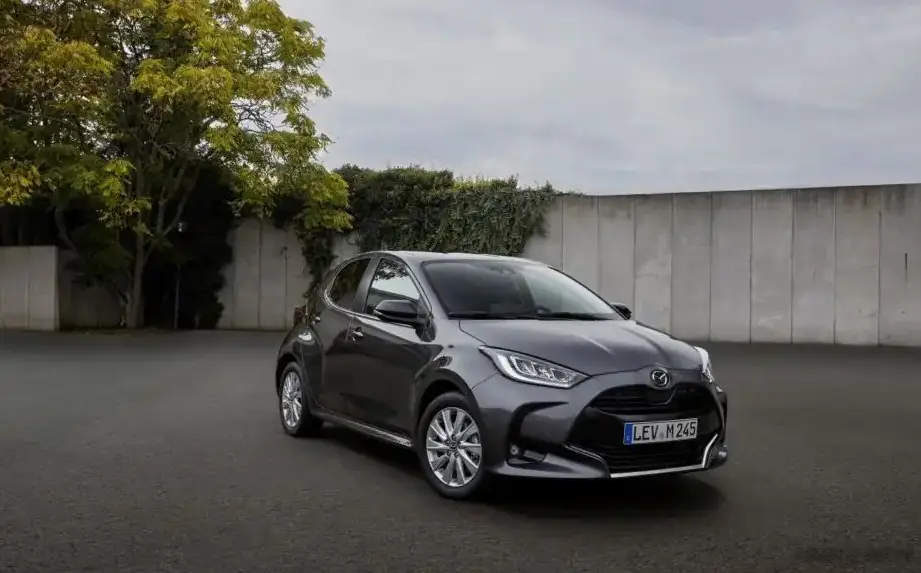
The Mazda 2 IV (XP21) 1.5 Hybrid CVT, launched in March 2022, marks Mazda’s entry into the subcompact hybrid market, primarily aimed at consumers in Europe and Asia seeking fuel efficiency and practicality for city driving. This variant is part of the fourth generation (XP21) Mazda 2, a model already recognized for its surprisingly engaging driving dynamics despite its small size. The 1.5 Hybrid CVT is positioned as the core offering in the lineup, bridging the gap between more basic trims and potentially sportier, non-hybrid versions depending on regional availability. It features a full hybrid electric vehicle (FHEV) powertrain, combining a small gasoline engine with an electric motor to maximize fuel economy and minimize emissions.
Powertrain & Engine Architecture
The Mazda 2 Hybrid’s powertrain centers around the M15A-FXE 1.5-liter inline-three cylinder engine. This engine utilizes the Atkinson cycle, a design choice prioritizing efficiency, though it typically results in reduced low-end torque. Mazda addresses this by integrating a robust electric motor into the powertrain. The engine incorporates direct fuel injection and a relatively high compression ratio of 14:1, further enhancing thermal efficiency. The electric motor, integrated within the transmission housing, provides supplementary power and enables short periods of all-electric operation. The combined system output is 116 horsepower. The continuously variable transmission (CVT) is specifically calibrated for hybrid operation, emphasizing smooth acceleration and fuel economy over a sporty driving feel. The battery, a lithium-ion unit, is strategically located under the rear seats to preserve passenger space.
Driving Characteristics
The 1.5 Hybrid CVT delivers a smooth and refined driving experience, particularly well-suited for urban environments. Acceleration is adequate, achieving a 0-60 mph time of approximately 9.2 seconds, but it doesn’t match the responsiveness of higher-powered Mazda 2 variants. The CVT effectively manages the engine’s power delivery, minimizing harshness and maximizing fuel efficiency. The electric motor provides instant torque at low speeds, enhancing city driving and reducing reliance on the gasoline engine. While the Atkinson cycle engine can feel somewhat lacking in low-end power, the electric motor assistance effectively compensates for this. Compared to a manual transmission version (if available in the same market), the CVT prioritizes ease of use and fuel economy over driver engagement.
Equipment & Trim Levels
The Mazda 2 IV 1.5 Hybrid CVT generally comes well-equipped, reflecting its position as a mainstream offering. Standard features typically include air conditioning, a touchscreen infotainment system with smartphone integration (Apple CarPlay and Android Auto), Bluetooth connectivity, and a comprehensive suite of safety features such as lane departure warning, automatic emergency braking, and adaptive cruise control. Interior upholstery is usually cloth, with higher trims potentially offering partial leather options. Optional extras can include a sunroof, an upgraded audio system, and parking sensors. The dashboard layout is clean and modern, prioritizing usability and a minimalist aesthetic.
Chassis & Braking
The Mazda 2 Hybrid employs a McPherson strut front suspension and a torsion beam rear suspension. This configuration strikes a good balance between ride comfort and handling. The front brakes are ventilated discs, while the rear brakes are solid discs, providing sufficient stopping power for the vehicle’s weight and performance. Electric power steering offers light and precise steering feel. The chassis is tuned to prioritize comfort and stability, rather than outright sportiness. Stabilizer bars are incorporated on both axles to minimize body roll during cornering.
Market Reception & Comparison
The Mazda 2 Hybrid has been generally well-received by automotive critics for its fuel efficiency and refined driving experience. It competes with other subcompact hybrids such as the Toyota Yaris Hybrid and Renault Clio E-Tech. Compared to the non-hybrid Mazda 2 variants, the Hybrid offers significantly improved fuel economy but slightly reduced performance. Reliability is anticipated to be strong, building on Mazda’s established reputation for build quality. The hybrid system introduces added complexity, but Mazda has a proven track record of producing reliable hybrid powertrains.
Legacy
The Mazda 2 IV 1.5 Hybrid CVT represents Mazda’s commitment to electrification and fuel efficiency. While it’s still relatively early in its lifecycle, the powertrain is expected to prove durable and reliable. As the used car market matures, this variant is likely to be attractive to buyers prioritizing fuel economy and low running costs. The integration of hybrid technology into the Mazda 2 platform demonstrates Mazda’s ability to adapt to evolving market demands and increasingly stringent regulatory requirements.