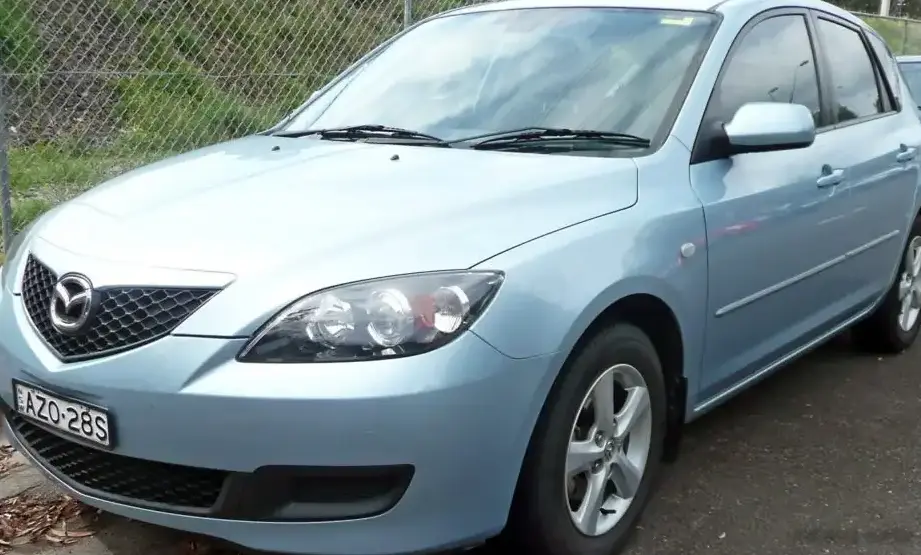
The Mazda 3 first generation (BK) 1.6 CD hatchback, produced from 2004 to 2006, represented Mazda’s entry into the increasingly competitive compact hatchback segment in Europe. This variant, powered by a 1.6-liter diesel engine producing 109 horsepower, was positioned as an economical and practical option within the broader BK Mazda 3 lineup. It aimed to appeal to buyers prioritizing fuel efficiency and lower running costs over outright performance. The BK generation was significant for Mazda as it marked a shift towards more sophisticated design and engineering, moving away from the more utilitarian image of previous models.
Technical Specifications
| Brand | Mazda |
| Model | 3 |
| Generation | I Hatchback (BK) |
| Type (Engine) | 1.6 CD (109 Hp) |
| Start of production | 2004 |
| End of production | 2006 |
| Powertrain Architecture | Internal Combustion engine |
| Body type | Hatchback |
| Seats | 5 |
| Doors | 5 |
| Fuel consumption (urban) | 6.2 l/100 km (37.9 US mpg, 45.6 UK mpg, 16.1 km/l) |
| Fuel consumption (extra urban) | 4.3 l/100 km (54.7 US mpg, 65.7 UK mpg, 23.3 km/l) |
| Fuel consumption (combined) | 5 l/100 km (47 US mpg, 56.5 UK mpg, 20 km/l) |
| CO2 emissions | 138 g/km |
| Fuel Type | Diesel |
| Acceleration 0 – 100 km/h | 11.5 sec |
| Acceleration 0 – 62 mph | 11.5 sec |
| Acceleration 0 – 60 mph | 10.9 sec |
| Maximum speed | 182 km/h (113.09 mph) |
| Emission standard | Euro 3 |
| Weight-to-power ratio | 11.7 kg/Hp, 85.5 Hp/tonne |
| Weight-to-torque ratio | 5.3 kg/Nm, 188.2 Nm/tonne |
| Power | 109 Hp @ 4000 rpm |
| Power per litre | 69.9 Hp/l |
| Torque | 240 Nm @ 1750 rpm (177.01 lb.-ft. @ 1750 rpm) |
| Engine layout | Front, Transverse |
| Engine Model/Code | Y6 |
| Engine displacement | 1560 cm3 (95.2 cu. in.) |
| Number of cylinders | 4 |
| Engine configuration | Inline |
| Cylinder Bore | 75 mm (2.95 in.) |
| Piston Stroke | 88.3 mm (3.48 in.) |
| Compression ratio | 18.3:1 |
| Number of valves per cylinder | 4 |
| Fuel injection system | Diesel Commonrail |
| Engine aspiration | Turbocharger, Intercooler |
| Valvetrain | DOHC |
| Engine oil capacity | 3.8 l (4.02 US qt | 3.34 UK qt) |
| Coolant | 8.5 l (8.98 US qt | 7.48 UK qt) |
| Kerb Weight | 1275 kg (2810.89 lbs.) |
| Max. weight | 1785 kg (3935.25 lbs.) |
| Max load | 510 kg (1124.36 lbs.) |
| Trunk (boot) space – minimum | 300 l (10.59 cu. ft.) |
| Trunk (boot) space – maximum | 635 l (22.42 cu. ft.) |
| Fuel tank capacity | 55 l (14.53 US gal | 12.1 UK gal) |
| Permitted trailer load with brakes (12%) | 1300 kg (2866.01 lbs.) |
| Permitted trailer load without brakes | 600 kg (1322.77 lbs.) |
| Length | 4420 mm (174.02 in.) |
| Width | 1755 mm (69.09 in.) |
| Height | 1465 mm (57.68 in.) |
| Wheelbase | 2640 mm (103.94 in.) |
| Front track | 1530 mm (60.24 in.) |
| Rear (Back) track | 1515 mm (59.65 in.) |
| Drag coefficient (Cd) | 0.35 |
| Minimum turning circle (turning diameter) | 10.3 m (33.79 ft.) |
| Drivetrain Architecture | The Internal combustion engine (ICE) drives the front wheels of the vehicle. |
| Drive wheel | Front wheel drive |
| Number of gears and type of gearbox | 5 gears, manual transmission |
| Front suspension | Coil spring |
| Rear suspension | Coil spring |
| Front brakes | Ventilated discs |
| Rear brakes | Disc |
| Assisting systems | ABS (Anti-lock braking system) |
| Steering type | Steering rack and pinion |
| Power steering | Electric Steering |
| Tires size | 205/55 R16 |
| Wheel rims size | 16 |
Powertrain & Engine Architecture
The heart of the Mazda 3 1.6 CD was the Y6 diesel engine, a 1.6-liter inline-four cylinder unit. This engine utilized a common rail direct injection system, a technology that allowed for precise fuel delivery and improved combustion efficiency. The Y6 engine was turbocharged and intercooled, boosting power output to 109 horsepower and 240 Nm (177 lb-ft) of torque. The engine featured a double overhead camshaft (DOHC) valvetrain with four valves per cylinder, contributing to its relatively high specific output for a small-displacement diesel. The engine’s 18.3:1 compression ratio was typical for diesel engines of the era, maximizing efficiency. The 1.6 CD was exclusively offered with a five-speed manual transmission in most European markets. This transmission was chosen for its simplicity and cost-effectiveness, aligning with the variant’s focus on affordability.
Driving Characteristics
The 1.6 CD variant of the Mazda 3 offered a practical and economical driving experience. Acceleration was modest, taking around 11.5 seconds to reach 62 mph (100 km/h). However, the engine’s 240 Nm of torque, available from a low 1750 rpm, provided adequate pulling power for everyday driving situations. The five-speed manual transmission was well-matched to the engine’s characteristics, offering smooth gear changes. Compared to higher-output versions of the Mazda 3, such as the 2.0-liter petrol models, the 1.6 CD lacked the same level of outright performance. However, it excelled in fuel economy, achieving combined fuel consumption figures of around 5 liters per 100 kilometers (47 US mpg). The suspension setup provided a comfortable ride, although it wasn’t as sporty or engaging as the suspension found in some of the higher-spec Mazda 3 models.
Equipment & Trim Levels
The 1.6 CD trim level typically represented the entry point into the Mazda 3 range. Standard equipment generally included air conditioning, power steering, electric front windows, and a basic audio system. Safety features such as ABS and front airbags were also standard. Interior upholstery was typically cloth, and the dashboard featured a functional but relatively simple design. Optional extras included alloy wheels, rear electric windows, and an upgraded audio system. The overall interior ambiance was geared towards practicality and durability rather than luxury.
Chassis & Braking
The Mazda 3 BK utilized a front-engine, front-wheel-drive layout. The suspension consisted of coil springs and dampers all around. The front suspension employed MacPherson struts, while the rear suspension utilized a multi-link setup. This configuration provided a good balance between ride comfort and handling. The braking system featured ventilated discs on the front wheels and solid discs on the rear wheels. ABS (Anti-lock Braking System) was standard, enhancing braking performance and stability. The 1.6 CD variant typically came equipped with 205/55 R16 tires, providing adequate grip for everyday driving conditions.
Market Reception & Comparison
The Mazda 3 1.6 CD was generally well-received by automotive critics as a practical and economical choice. It was praised for its fuel efficiency, comfortable ride, and reasonable price point. However, some critics noted its lack of outright performance compared to rival models. Compared to other diesel-powered hatchbacks in its class, such as the Volkswagen Golf 1.9 TDI and the Ford Focus 1.6 TDCi, the Mazda 3 1.6 CD offered a competitive level of fuel economy and equipment. However, the Volkswagen and Ford models often boasted slightly more refined engines and a more established reputation for reliability.
Legacy
The Mazda 3 BK 1.6 CD has proven to be a relatively reliable vehicle in the used car market. The Y6 diesel engine, while not known for being particularly powerful, is generally durable and capable of high mileage with proper maintenance. Common issues include wear and tear on the turbocharger and potential problems with the fuel injection system. However, these issues are typically manageable with regular servicing. Today, the 1.6 CD variant represents an affordable and economical option for buyers seeking a practical and reliable compact hatchback. Its fuel efficiency and relatively low running costs continue to make it an attractive proposition in the used car market.