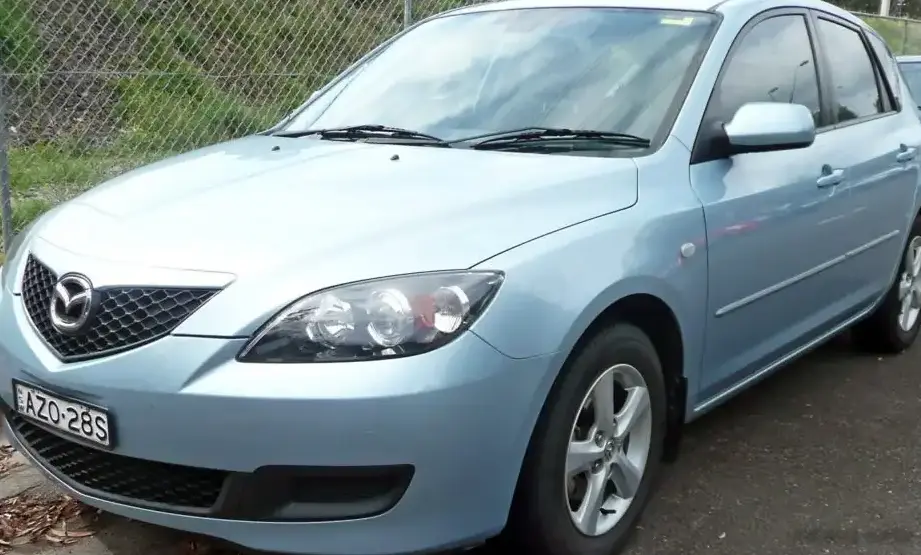
The Mazda 3 first generation (BK) 1.6i Automatic, produced between 2003 and 2006, represented Mazda’s entry into the increasingly competitive compact hatchback segment. Positioned as a more affordable and accessible option within the BK range, it offered a blend of practicality, fuel efficiency, and Mazda’s signature sporty handling. This variant was primarily aimed at buyers seeking a comfortable and reliable daily driver, prioritizing ease of use over outright performance. It played a significant role in establishing the Mazda 3 as a popular choice in the European and Asian markets, where compact hatchbacks are highly favored. The 1.6i Automatic served as the base model for many buyers, offering a stepping stone into the Mazda brand.
Technical Specifications
| Brand | Mazda |
| Model | 3 |
| Generation | I Hatchback (BK) |
| Type (Engine) | 1.6i (105 Hp) Automatic |
| Start of production | 2003 |
| End of production | 2006 |
| Powertrain Architecture | Internal Combustion engine |
| Body type | Hatchback |
| Seats | 5 |
| Doors | 5 |
| Fuel consumption (urban) | 10.1 l/100 km (23.3 US mpg, 28 UK mpg, 9.9 km/l) |
| Fuel consumption (extra urban) | 6.8 l/100 km (34.6 US mpg, 41.5 UK mpg, 14.7 km/l) |
| Fuel consumption (combined) | 8 l/100 km (29.4 US mpg, 35.3 UK mpg, 12.5 km/l) |
| CO2 emissions | 191 g/km |
| Fuel Type | Petrol (Gasoline) |
| Acceleration 0 – 100 km/h | 12.4 sec |
| Acceleration 0 – 62 mph | 12.4 sec |
| Acceleration 0 – 60 mph | 11.8 sec |
| Maximum speed | 174 km/h (108.12 mph) |
| Emission standard | Euro 4 |
| Weight-to-power ratio | 11.5 kg/Hp, 86.8 Hp/tonne |
| Weight-to-torque ratio | 8.3 kg/Nm, 119.8 Nm/tonne |
| Power | 105 Hp @ 6000 rpm |
| Power per litre | 65.7 Hp/l |
| Torque | 145 Nm @ 4000 rpm (106.95 lb.-ft. @ 4000 rpm) |
| Engine layout | Front, Transverse |
| Engine Model/Code | Z601, Z627 |
| Engine displacement | 1598 cm3 (97.52 cu. in.) |
| Number of cylinders | 4 |
| Engine configuration | Inline |
| Cylinder Bore | 78 mm (3.07 in.) |
| Piston Stroke | 83.6 mm (3.29 in.) |
| Compression ratio | 10:1 |
| Number of valves per cylinder | 4 |
| Fuel injection system | Multi-port manifold injection |
| Engine aspiration | Naturally aspirated engine |
| Valvetrain | DOHC |
| Engine oil capacity | 3.9 l (4.12 US qt | 3.43 UK qt) |
| Coolant | 6 l (6.34 US qt | 5.28 UK qt) |
| Kerb Weight | 1210 kg (2667.59 lbs.) |
| Max. weight | 1720 kg (3791.95 lbs.) |
| Max load | 510 kg (1124.36 lbs.) |
| Trunk (boot) space – minimum | 300 l (10.59 cu. ft.) |
| Trunk (boot) space – maximum | 635 l (22.42 cu. ft.) |
| Fuel tank capacity | 55 l (14.53 US gal | 12.1 UK gal) |
| Permitted trailer load with brakes (12%) | 1200 kg (2645.55 lbs.) |
| Permitted trailer load without brakes | 550 kg (1212.54 lbs.) |
| Length | 4420 mm (174.02 in.) |
| Width | 1755 mm (69.09 in.) |
| Height | 1465 mm (57.68 in.) |
| Wheelbase | 2640 mm (103.94 in.) |
| Front track | 1530 mm (60.24 in.) |
| Rear (Back) track | 1515 mm (59.65 in.) |
| Drag coefficient (Cd) | 0.34 |
| Minimum turning circle (turning diameter) | 10.3 m (33.79 ft.) |
| Drivetrain Architecture | The Internal combustion engine (ICE) drives the front wheels of the vehicle. |
| Drive wheel | Front wheel drive |
| Number of gears and type of gearbox | 4 gears, automatic transmission |
| Front suspension | Coil spring |
| Rear suspension | Coil spring |
| Front brakes | Ventilated discs |
| Rear brakes | Disc |
| Assisting systems | ABS (Anti-lock braking system) |
| Steering type | Steering rack and pinion |
| Power steering | Electric Steering |
| Tires size | 205/55 R16 |
| Wheel rims size | 16 |
Powertrain & Engine Architecture
The heart of the 1.6i Automatic is the Mazda Z6 engine family, specifically the Z601 or Z627 code depending on the specific market and year. This 1.6-liter inline-four cylinder engine utilizes a naturally aspirated configuration, producing 105 horsepower at 6000 rpm and 145 Nm (106.95 lb-ft) of torque at 4000 rpm. The engine features a double overhead camshaft (DOHC) valvetrain with four valves per cylinder, contributing to its relatively efficient operation. Fuel delivery is managed by a multi-port fuel injection system. The engine’s design prioritized fuel economy and smooth operation over outright power. Paired with this engine is a four-speed automatic transmission. This transmission, while providing convenience, was a relatively conventional design for the era, lacking the efficiency and responsiveness of more modern automatic gearboxes.
Driving Characteristics
The 1.6i Automatic offered a comfortable, if not particularly exhilarating, driving experience. Acceleration from 0-60 mph took approximately 11.8 seconds, and top speed was limited to 174 km/h (108.12 mph). The four-speed automatic transmission, while smooth, resulted in noticeable gear changes and a tendency to hold onto gears longer to maximize fuel efficiency. Compared to the five-speed manual version of the 1.6i, the automatic suffered a slight performance penalty. Higher-output variants, such as the 2.0-liter and 2.3-liter models, offered significantly more power and a sportier driving experience, but at a higher price point. The automatic transmission was geared towards providing a relaxed and easy driving experience, making it well-suited for urban commuting and long highway journeys.
Equipment & Trim Levels
The 1.6i Automatic typically came equipped with a reasonable level of standard features. These included power windows, central locking, air conditioning, and an integrated audio system. Interior upholstery was typically cloth, with a relatively simple dashboard layout. Optional extras included alloy wheels, a sunroof, and upgraded audio systems. The trim level was generally considered the base model, offering essential features without the luxury appointments found in higher-spec variants. Safety features included ABS (Anti-lock Braking System) as standard, but airbags were often limited to the driver and front passenger.
Chassis & Braking
The Mazda 3 BK utilized a front-wheel-drive platform with coil spring suspension on both the front and rear axles. The front suspension featured MacPherson struts, while the rear employed a multi-link setup. Braking duties were handled by ventilated discs on the front wheels and solid discs on the rear. The suspension tuning was geared towards providing a comfortable ride, with a focus on absorbing bumps and minimizing body roll. The 1.6i Automatic, being the entry-level model, typically featured smaller wheels and tires (205/55 R16) compared to higher-spec variants.
Market Reception & Comparison
The Mazda 3 1.6i Automatic received generally positive reviews for its practicality, fuel efficiency, and comfortable ride. Critics noted that the engine lacked significant power, particularly when paired with the automatic transmission. However, it was praised for its responsive steering and well-balanced handling. Compared to rivals like the Ford Focus and Volkswagen Golf, the Mazda 3 offered a more engaging driving experience. Fuel economy was competitive, averaging around 8 l/100 km (29.4 US mpg). Reliability was generally good, although some owners reported minor issues with the automatic transmission over time.
Legacy
The Mazda 3 BK 1.6i Automatic remains a relatively common sight on used car markets today. The Z6 engine is known for its durability and relatively low maintenance costs. While the four-speed automatic transmission is not as refined as more modern units, it has proven to be reasonably reliable. These cars represent an affordable and practical entry point into Mazda ownership, offering a blend of comfort, reliability, and Mazda’s signature driving dynamics. However, potential buyers should be aware of the engine’s modest power output and the potential for age-related wear and tear on the transmission.