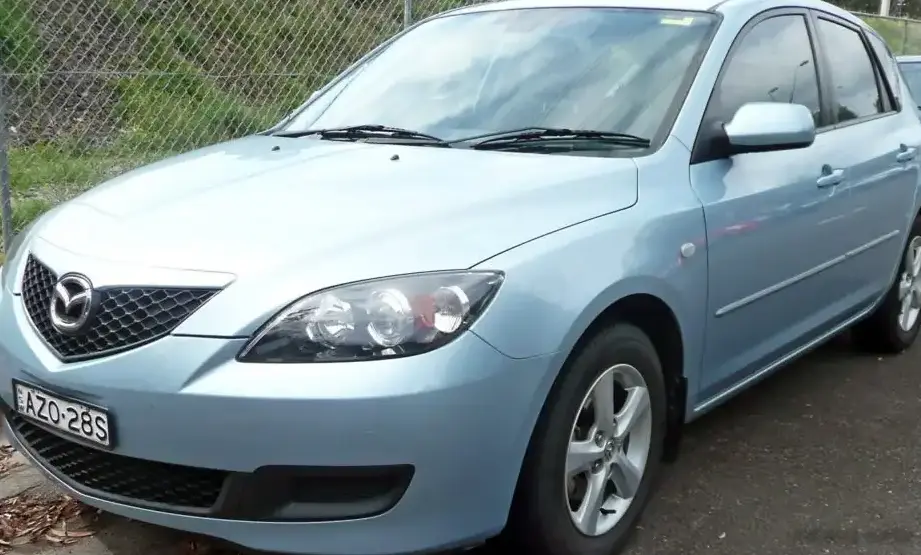
The Mazda 3 first generation (BK) facelift, produced from 2006 to 2009, represented a significant step forward for Mazda in the competitive compact segment. The 1.6 CD variant, powered by a 90 horsepower diesel engine and typically paired with a five-speed manual transmission (though an automatic was available in some markets), was positioned as an entry-level offering, prioritizing fuel efficiency and affordability. This model aimed to attract buyers seeking a practical and economical hatchback, particularly in European markets where diesel engines were highly favored. The facelift brought revised styling, improved interior materials, and refinements to the chassis compared to the original BK model launched in 2003.
Technical Specifications
| Brand | Mazda |
| Model | 3 |
| Generation | I Hatchback (BK, facelift 2006) |
| Type (Engine) | 1.6 CD (90 Hp) |
| Start of production | 2006 |
| End of production | 2009 |
| Powertrain Architecture | Internal Combustion engine |
| Body type | Hatchback |
| Seats | 5 |
| Doors | 5 |
| Fuel consumption (urban) | 6 l/100 km (39.2 US mpg, 47.1 UK mpg, 16.7 km/l) |
| Fuel consumption (extra urban) | 4 l/100 km (58.8 US mpg, 70.6 UK mpg, 25 km/l) |
| Fuel consumption (combined) | 4.7 l/100 km (50 US mpg, 60.1 UK mpg, 21.3 km/l) |
| CO2 emissions | 125 g/km |
| Fuel Type | Diesel |
| Acceleration 0 – 100 km/h | 12.2 sec |
| Acceleration 0 – 62 mph | 12.2 sec |
| Acceleration 0 – 60 mph | 11.6 sec |
| Maximum speed | 174 km/h (108.12 mph) |
| Emission standard | Euro 4 |
| Weight-to-power ratio | 14.1 kg/Hp, 70.9 Hp/tonne |
| Weight-to-torque ratio | 5.9 kg/Nm, 169.3 Nm/tonne |
| Power | 90 Hp @ 4000 rpm |
| Power per litre | 57.7 Hp/l |
| Torque | 215 Nm @ 1750 rpm (158.58 lb.-ft. @ 1750 rpm) |
| Engine layout | Front, Transverse |
| Engine Model/Code | Y406 |
| Engine displacement | 1560 cm3 (95.2 cu. in.) |
| Number of cylinders | 4 |
| Engine configuration | Inline |
| Cylinder Bore | 75 mm (2.95 in.) |
| Piston Stroke | 88.3 mm (3.48 in.) |
| Compression ratio | 18.3:1 |
| Number of valves per cylinder | 4 |
| Fuel injection system | Diesel Commonrail |
| Engine aspiration | Turbocharger, Intercooler |
| Valvetrain | DOHC |
| Engine oil capacity | 3.8 l (4.02 US qt | 3.34 UK qt) |
| Coolant | 8.5 l (8.98 US qt | 7.48 UK qt) |
| Kerb Weight | 1270 kg (2799.87 lbs.) |
| Max. weight | 1800 kg (3968.32 lbs.) |
| Max load | 530 kg (1168.45 lbs.) |
| Trunk (boot) space – minimum | 300 l (10.59 cu. ft.) |
| Trunk (boot) space – maximum | 635 l (22.42 cu. ft.) |
| Fuel tank capacity | 55 l (14.53 US gal | 12.1 UK gal) |
| Permitted trailer load with brakes (12%) | 1300 kg (2866.01 lbs.) |
| Permitted trailer load without brakes | 600 kg (1322.77 lbs.) |
| Length | 4415 mm (173.82 in.) |
| Width | 1755 mm (69.09 in.) |
| Width including mirrors | 1935 mm (76.18 in.) |
| Height | 1465 mm (57.68 in.) |
| Wheelbase | 2640 mm (103.94 in.) |
| Front track | 1530 mm (60.24 in.) |
| Rear (Back) track | 1515 mm (59.65 in.) |
| Ride height (ground clearance) | 160 mm (6.3 in.) |
| Drag coefficient (Cd) | 0.30 |
| Minimum turning circle (turning diameter) | 10.4 m (34.12 ft.) |
| Drivetrain Architecture | The Internal combustion engine (ICE) drives the front wheels of the vehicle. |
| Drive wheel | Front wheel drive |
| Number of gears and type of gearbox | 5 gears, manual transmission |
| Front suspension | Independent, type McPherson with coil spring and anti-roll bar |
| Rear suspension | Independent multi-link spring suspension with stabilizer |
| Front brakes | Ventilated discs |
| Rear brakes | Disc |
| Assisting systems | ABS (Anti-lock braking system) |
| Steering type | Steering rack and pinion |
| Power steering | Electric Steering |
| Tires size | 195/65 R15 |
| Wheel rims size | 15 |
Powertrain & Engine Architecture
The heart of the 1.6 CD variant was the Y406 engine, a 1.6-liter inline-four cylinder diesel. This engine utilized a common rail direct injection system, delivering fuel directly into the combustion chamber at extremely high pressure. This technology, coupled with a turbocharger and intercooler, allowed for a reasonable 90 horsepower and 215 Nm (158.58 lb-ft) of torque. The engine featured a double overhead camshaft (DOHC) valvetrain with four valves per cylinder, optimizing gas flow for improved efficiency and power. The compression ratio was relatively high at 18.3:1, typical for diesel engines. The five-speed manual transmission was the most common pairing, offering a balance between fuel economy and drivability. An automatic transmission was offered in some markets, but it was less common and generally considered less responsive.
Driving Characteristics
The 1.6 CD with the manual transmission provided adequate, though not exhilarating, performance. Acceleration from 0-60 mph took around 11.6 to 12.2 seconds, and top speed was around 108 mph. The engine’s torque peak at 1750 rpm meant that it felt relatively responsive in everyday driving situations, particularly for overtaking. However, it lacked the punch of higher-powered variants like the 2.0-liter gasoline engines. The automatic transmission, when equipped, further dulled the performance, with noticeable delays in shifting and a less engaging driving experience. The gear ratios were tuned for fuel economy rather than outright speed.
Equipment & Trim Levels
The 1.6 CD typically represented the base trim level of the Mazda 3 range. Standard equipment generally included air conditioning, power steering, electric front windows, and a basic audio system. Safety features such as ABS and front airbags were also standard. Higher trim levels added features like alloy wheels, rear electric windows, a more sophisticated audio system, and climate control. Optional extras included metallic paint, a sunroof, and upgraded interior trim.
Chassis & Braking
The Mazda 3 BK facelift featured an independent suspension setup at all four corners. The front utilized a McPherson strut design with a coil spring and anti-roll bar, while the rear employed a multi-link system, also with a stabilizer bar. This setup provided a good balance between ride comfort and handling. Brakes were ventilated discs at the front and solid discs at the rear, providing adequate stopping power for the vehicle’s weight and performance. The electric power steering offered a light and easy driving experience.
Market Reception & Comparison
The 1.6 CD variant was well-received in Europe, where fuel economy and low running costs were highly valued. Critics praised its efficiency and practicality, but noted its lack of outright performance compared to gasoline-powered models. Compared to the 2.0-liter gasoline variants, the 1.6 CD offered significantly better fuel economy but considerably less power. The 2.0-liter diesel offered a compromise, providing more power with still-respectable fuel economy. Reliability was generally good, although the diesel particulate filter (DPF) could be a potential issue if the vehicle was primarily used for short trips.
Legacy
The Mazda 3 BK facelift 1.6 CD remains a popular choice in the used car market, particularly for buyers seeking an affordable and economical hatchback. The Y406 engine, while not known for its blistering performance, is generally considered reliable if properly maintained. Common issues include DPF clogging and potential problems with the fuel injection system. However, with regular servicing and careful driving, these engines can provide many years of reliable service. The 1.6 CD variant represents a practical and sensible option within the first-generation Mazda 3 lineup, offering a compelling blend of fuel efficiency, affordability, and everyday usability.