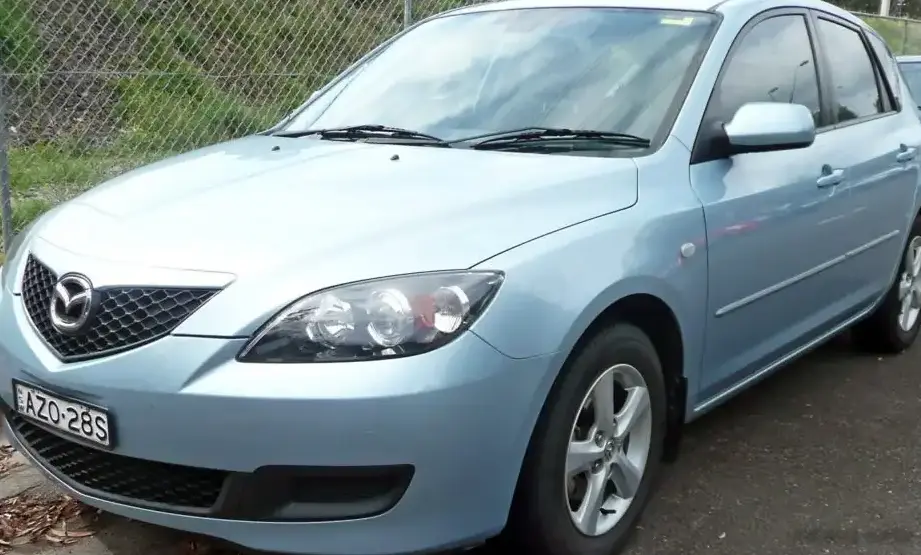
The Mazda 3 first generation (BK) 1.6i Automatic, produced between 2003 and 2006, represented Mazda’s entry into the increasingly competitive compact sedan market. Positioned as the base model within the BK range, it offered a more affordable and fuel-efficient alternative to the higher-spec 2.0L and 2.3L variants. This model was primarily aimed at buyers seeking a practical, reliable, and economical daily driver, particularly in markets where manual transmissions weren’t as popular. The BK generation Mazda 3 was a significant departure from its predecessor, the Mazda Familia/Protegé, offering a more modern design and improved driving dynamics.
Technical Specifications
| Brand | Mazda |
| Model | 3 |
| Generation | I Sedan (BK) |
| Type (Engine) | 1.6i (105 Hp) Automatic |
| Start of production | 2003 |
| End of production | 2006 |
| Powertrain Architecture | Internal Combustion engine |
| Body type | Sedan |
| Seats | 5 |
| Doors | 4 |
| Fuel consumption (urban) | 10.2 l/100 km (23.1 US mpg, 27.7 UK mpg, 9.8 km/l) |
| Fuel consumption (extra urban) | 6.4 l/100 km (36.8 US mpg, 44.1 UK mpg, 15.6 km/l) |
| Fuel consumption (combined) | 7.8 l/100 km (30.2 US mpg, 36.2 UK mpg, 12.8 km/l) |
| CO2 emissions | 186 g/km |
| Fuel Type | Petrol (Gasoline) |
| Acceleration 0 – 100 km/h | 12.4 sec |
| Acceleration 0 – 62 mph | 12.4 sec |
| Acceleration 0 – 60 mph | 11.8 sec |
| Maximum speed | 177 km/h (109.98 mph) |
| Emission standard | Euro 4 |
| Weight-to-power ratio | 11.3 kg/Hp, 88.2 Hp/tonne |
| Weight-to-torque ratio | 8.2 kg/Nm, 121.8 Nm/tonne |
| Power | 105 Hp @ 6000 rpm |
| Power per litre | 65.7 Hp/l |
| Torque | 145 Nm @ 4000 rpm (106.95 lb.-ft. @ 4000 rpm) |
| Engine layout | Front, Transverse |
| Engine Model/Code | Z601, Z627 |
| Engine displacement | 1598 cm3 (97.52 cu. in.) |
| Number of cylinders | 4 |
| Engine configuration | Inline |
| Cylinder Bore | 78 mm (3.07 in.) |
| Piston Stroke | 83.6 mm (3.29 in.) |
| Compression ratio | 10:1 |
| Number of valves per cylinder | 4 |
| Fuel injection system | Multi-port manifold injection |
| Engine aspiration | Naturally aspirated engine |
| Valvetrain | DOHC |
| Engine oil capacity | 3.9 l (4.12 US qt | 3.43 UK qt) |
| Coolant | 6 l (6.34 US qt | 5.28 UK qt) |
| Kerb Weight | 1190 kg (2623.5 lbs.) |
| Max. weight | 1700 kg (3747.86 lbs.) |
| Max load | 510 kg (1124.36 lbs.) |
| Trunk (boot) space – minimum | 413 l (14.58 cu. ft.) |
| Trunk (boot) space – maximum | 675 l (23.84 cu. ft.) |
| Fuel tank capacity | 55 l (14.53 US gal | 12.1 UK gal) |
| Permitted trailer load with brakes (12%) | 1200 kg (2645.55 lbs.) |
| Permitted trailer load without brakes | 550 kg (1212.54 lbs.) |
| Length | 4490 mm (176.77 in.) |
| Width | 1755 mm (69.09 in.) |
| Height | 1465 mm (57.68 in.) |
| Wheelbase | 2640 mm (103.94 in.) |
| Front track | 1530 mm (60.24 in.) |
| Rear (Back) track | 1515 mm (59.65 in.) |
| Drag coefficient (Cd) | 0.33 |
| Minimum turning circle (turning diameter) | 10.3 m (33.79 ft.) |
| Drivetrain Architecture | The Internal combustion engine (ICE) drives the front wheels of the vehicle. |
| Drive wheel | Front wheel drive |
| Number of gears and type of gearbox | 4 gears, automatic transmission |
| Front suspension | Coil spring |
| Rear suspension | Coil spring |
| Front brakes | Ventilated discs |
| Rear brakes | Disc |
| Assisting systems | ABS (Anti-lock braking system) |
| Steering type | Steering rack and pinion |
| Tires size | 195/65 R15 |
| Wheel rims size | 6J x 15 |
Powertrain & Engine Architecture
The 1.6i variant utilized Mazda’s Z6 engine family, specifically the Z601 or Z627 code depending on the specific market and year. This was a naturally aspirated, 1.6-liter (1598cc) inline-four cylinder engine. It featured a double overhead camshaft (DOHC) valvetrain with four valves per cylinder, and multi-port fuel injection. The engine produced 105 horsepower at 6000 rpm and 145 Nm (106.95 lb-ft) of torque at 4000 rpm. The automatic transmission was a conventional four-speed unit, designed for smooth operation rather than outright performance. This transmission was chosen to appeal to drivers prioritizing comfort and ease of use over sporty driving dynamics.
Driving Characteristics
The 1.6i Automatic offered a comfortable, but not particularly exciting, driving experience. Acceleration was adequate for everyday driving, with a 0-60 mph time of around 11.8 seconds. The four-speed automatic transmission, while smooth, lacked the responsiveness of a manual gearbox or a more modern automatic with additional gears. The gear ratios were optimized for fuel efficiency rather than performance, resulting in a noticeable delay during overtaking maneuvers. Compared to the 2.0L and 2.3L models, the 1.6i felt noticeably slower and less refined. However, it provided a more relaxed and forgiving driving experience, particularly in urban environments.
Equipment & Trim Levels
The 1.6i Automatic typically came with a fairly basic level of equipment. Standard features generally included air conditioning, power windows, power door locks, and a basic audio system. Interior upholstery was typically cloth. Optional extras included alloy wheels, a sunroof, and upgraded audio systems. The trim level was generally considered the entry-level offering, focusing on providing essential features at an affordable price point. It was often marketed towards first-time car buyers or those seeking a reliable and economical commuter vehicle.
Chassis & Braking
The Mazda 3 BK utilized a front-engine, front-wheel-drive layout. Suspension consisted of coil springs all around. The front brakes were ventilated discs, providing adequate stopping power, while the rear brakes were solid discs. Anti-lock Braking System (ABS) was standard. The chassis was designed to provide a balance between comfort and handling. The suspension tuning was relatively soft, prioritizing ride comfort over sporty handling. The weight distribution was fairly balanced, contributing to predictable handling characteristics.
Market Reception & Comparison
The 1.6i Automatic was generally well-received as a practical and affordable option within the Mazda 3 lineup. Critics praised its fuel efficiency and comfortable ride, but noted its lack of performance compared to the higher-spec models. Fuel economy was a strong point, achieving around 30.2 US mpg in combined driving. Reliability was generally good, with the Z6 engine proving to be a durable and dependable unit. Compared to competitors like the Honda Civic and Toyota Corolla, the Mazda 3 offered a more engaging driving experience, but the 1.6i variant lagged behind in terms of outright performance.
Legacy
The 1.6i Automatic version of the Mazda 3 BK has proven to be a relatively reliable and long-lasting vehicle. The Z6 engine is known for its durability, and the four-speed automatic transmission, while not the most advanced, is generally robust. In the used car market, these models are often sought after by buyers looking for an affordable and dependable compact sedan. While not a performance standout, the 1.6i Automatic remains a viable option for those prioritizing fuel efficiency, comfort, and reliability.