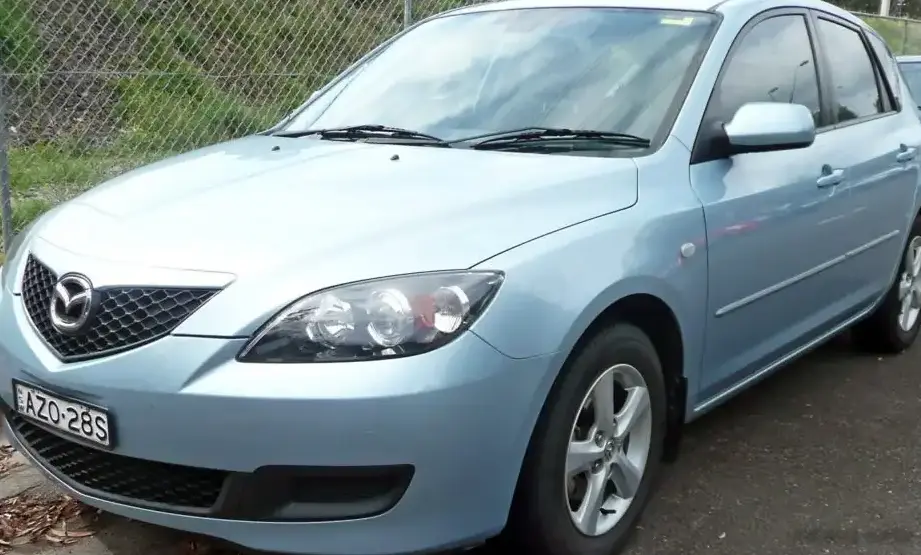
The Mazda 3 II Hatchback, specifically the 2.0 DISI variant producing 151 horsepower, was a key model in Mazda’s lineup from 2009 to 2011. Representing the second generation of the Mazda 3 (BL platform), this hatchback aimed to blend sporty handling with practical everyday usability. Positioned as a mid-range offering, it slotted between the base 1.6-liter models and the more performance-focused MazdaSpeed3. The 2.0 DISI offered a compelling balance of power and fuel efficiency, making it a popular choice in the compact hatchback segment, particularly in European and Asian markets where the hatchback body style is favored.
Technical Specifications
| Brand | Mazda |
| Model | 3 |
| Generation | II Hatchback (BL) |
| Type (Engine) | 2.0 DISI (151 Hp) |
| Start of production | 2009 |
| End of production | 2011 |
| Powertrain Architecture | Internal Combustion engine |
| Body type | Hatchback |
| Seats | 5 |
| Doors | 5 |
| Fuel consumption (urban) | 9.3 l/100 km (25.3 US mpg) |
| Fuel consumption (extra urban) | 5.4 l/100 km (43.6 US mpg) |
| Fuel consumption (combined) | 6.8 l/100 km (34.6 US mpg) |
| CO2 emissions | 159 g/km |
| Fuel Type | Petrol (Gasoline) |
| Acceleration 0 – 100 km/h | 10.4 sec |
| Acceleration 0 – 62 mph | 10.4 sec |
| Acceleration 0 – 60 mph | 9.9 sec |
| Maximum speed | 206 km/h (128 mph) |
| Emission standard | Euro 5 |
| Weight-to-power ratio | 8.4 kg/Hp |
| Weight-to-torque ratio | 6.6 kg/Nm |
| Power | 151 Hp @ 6200 rpm |
| Torque | 191 Nm @ 4500 rpm (140.87 lb.-ft. @ 4500 rpm) |
| Engine layout | Front, Transverse |
| Engine Model/Code | LFZ2 |
| Engine displacement | 1999 cm3 (121.99 cu. in.) |
| Number of cylinders | 4 |
| Engine configuration | Inline |
| Cylinder Bore | 87.5 mm (3.44 in.) |
| Piston Stroke | 83.1 mm (3.27 in.) |
| Compression ratio | 11.2:1 |
| Number of valves per cylinder | 4 |
| Fuel injection system | Direct injection |
| Engine aspiration | Naturally aspirated engine |
| Valvetrain | DOHC |
| Engine oil capacity | 4.3 l (4.54 US qt | 3.78 UK qt) |
| Coolant capacity | 7.5 l (7.93 US qt | 6.6 UK qt) |
| Kerb Weight | 1270 kg (2799.87 lbs.) |
| Max. weight | 1835 kg (4045.48 lbs.) |
| Max load | 565 kg (1245.61 lbs.) |
| Trunk (boot) space – minimum | 340 l (12.01 cu. ft.) |
| Trunk (boot) space – maximum | 1360 l (48.03 cu. ft.) |
| Fuel tank capacity | 55 l (14.53 US gal | 12.1 UK gal) |
| Permitted trailer load with brakes (12%) | 1000 kg (2204.62 lbs.) |
| Permitted trailer load without brakes | 550 kg (1212.54 lbs.) |
| Length | 4460 mm (175.59 in.) |
| Width | 1755 mm (69.09 in.) |
| Width including mirrors | 2002 mm (78.82 in.) |
| Height | 1470 mm (57.87 in.) |
| Wheelbase | 2640 mm (103.94 in.) |
| Front track | 1520 mm (59.84 in.) |
| Rear (Back) track | 1515 mm (59.65 in.) |
| Ride height (ground clearance) | 155 mm (6.1 in.) |
| Drag coefficient (Cd) | 0.30 |
| Minimum turning circle (turning diameter) | 10.4 m (34.12 ft.) |
| Drivetrain Architecture | Front wheel drive |
| Drive wheel | Front wheel drive |
| Number of gears and type of gearbox | 6 gears, manual transmission |
| Front brakes | Ventilated discs |
| Rear brakes | Disc |
| Assisting systems | ABS (Anti-lock braking system) |
| Steering type | Steering rack and pinion |
| Power steering | Electric Steering |
| Tires size | 205/50 R17 |
| Wheel rims size | 17 |
Powertrain & Engine Architecture
The heart of the Mazda 3 2.0 DISI was the LFZ2 engine, a 1999cc inline-four cylinder powerplant. “DISI” stands for Direct Injection Spark Ignition, highlighting the engine’s key technology. This direct injection system, combined with a high 11.2:1 compression ratio, allowed for increased power and efficiency compared to traditional port fuel injection. The engine utilized a double overhead camshaft (DOHC) valvetrain with four valves per cylinder, further enhancing its breathing and performance. The 2.0 DISI produced 151 horsepower at 6200 rpm and 191 Nm (140.87 lb-ft) of torque at 4500 rpm. This engine was paired with a six-speed manual transmission as standard, offering precise gear changes and a more engaging driving experience. While an automatic transmission was available in some markets, it wasn’t as commonly equipped as the manual.
Driving Characteristics
The 2.0 DISI-equipped Mazda 3 offered a noticeably more spirited driving experience than the base 1.6-liter models. Acceleration from 0-60 mph took approximately 9.9 seconds, and it could reach a top speed of 128 mph. The direct injection system provided a responsive throttle and a relatively flat torque curve, making it easy to drive in various conditions. Compared to the higher-performance MazdaSpeed3, the 2.0 DISI lacked the turbocharged punch, but it offered a more linear and predictable power delivery. The six-speed manual transmission allowed drivers to keep the engine in its optimal power band, while the well-tuned suspension provided a comfortable yet controlled ride. The steering was precise and communicative, contributing to the car’s overall sporty feel.
Equipment & Trim Levels
The 2.0 DISI trim typically included features such as air conditioning, power windows and locks, a CD player with auxiliary input, and alloy wheels. Higher trim levels added options like a sunroof, leather upholstery, a premium sound system, and automatic climate control. Safety features included ABS brakes, front and side airbags, and stability control. Interior materials were generally of good quality for the price point, and the dashboard layout was functional and user-friendly. The hatchback body style offered excellent cargo versatility, with 12.01 cu. ft. of space behind the rear seats and up to 48.03 cu. ft. with the rear seats folded down.
Chassis & Braking
The Mazda 3 II Hatchback utilized a MacPherson strut front suspension and a multi-link rear suspension, providing a good balance of ride comfort and handling precision. The front brakes were ventilated discs, while the rear brakes were solid discs. ABS (Anti-lock Braking System) was standard, enhancing braking performance and safety. The electric power steering provided a light and responsive feel, making it easy to maneuver in tight spaces. The car’s relatively lightweight construction (1270 kg / 2799.87 lbs) contributed to its agile handling characteristics.
Market Reception & Comparison
The Mazda 3 2.0 DISI was generally well-received by automotive critics. It was praised for its sporty handling, responsive engine, and attractive styling. Fuel economy was also considered competitive for its class, with combined fuel consumption of 34.6 US mpg. Compared to other compact hatchbacks, such as the Volkswagen Golf and the Ford Focus, the Mazda 3 offered a more engaging driving experience and a more stylish design. However, some critics noted that the interior could be a bit noisy at highway speeds. The 1.6-liter Mazda 3 offered better fuel economy but lacked the performance of the 2.0 DISI, while the MazdaSpeed3 provided significantly more power but came with a higher price tag and a firmer ride.
Legacy
The LFZ2 engine, while not without its minor quirks, proved to be a relatively reliable powerplant. Common issues included occasional oil consumption and, in some cases, problems with the fuel injectors. However, with proper maintenance, these engines could provide many years of trouble-free service. Today, the Mazda 3 II Hatchback 2.0 DISI remains a popular choice in the used car market, particularly among enthusiasts who appreciate its sporty handling and engaging driving experience. Its combination of practicality, performance, and affordability makes it a compelling option for those seeking a fun-to-drive compact hatchback.