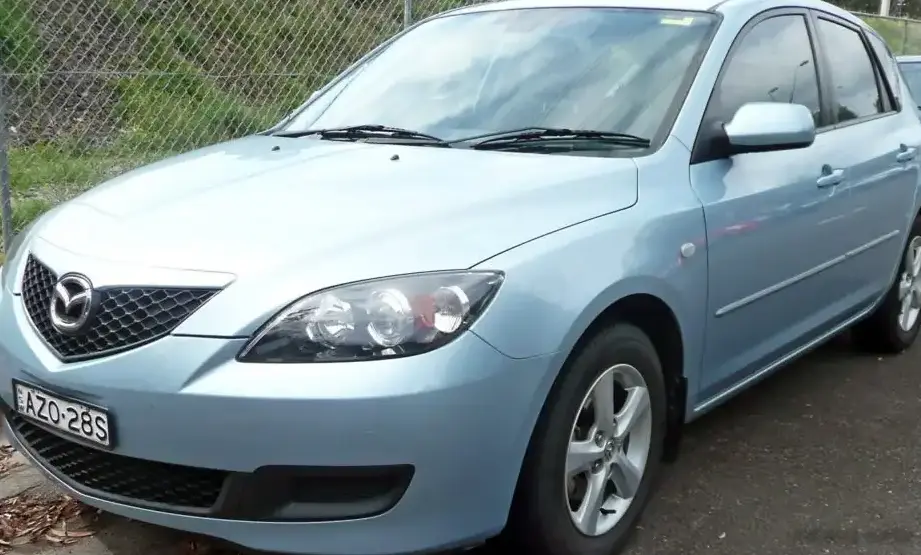
The Mazda 3 II Hatchback, specifically the 2.2 CD variant producing 150 horsepower, was a key offering in Mazda’s lineup from 2011 to 2013. This model represents the facelifted version of the second-generation Mazda 3 (BL platform), introducing styling updates and refined engine options. Positioned as a practical and efficient choice, the 2.2 CD aimed to appeal to buyers seeking a balance between fuel economy, performance, and everyday usability. It served as a diesel alternative within a range that also included gasoline-powered engines, offering a more torque-focused driving experience.
Technical Specifications
| Brand | Mazda |
| Model | 3 |
| Generation | II Hatchback (BL, facelift 2011) |
| Type (Engine) | 2.2 CD (150 Hp) |
| Start of production | 2011 |
| End of production | 2013 |
| Powertrain Architecture | Internal Combustion engine |
| Body type | Hatchback |
| Seats | 5 |
| Doors | 5 |
| Fuel consumption (urban) | 6.6 l/100 km (35.6 US mpg, 42.8 UK mpg, 15.2 km/l) |
| Fuel consumption (extra urban) | 4.4 l/100 km (53.5 US mpg, 64.2 UK mpg, 22.7 km/l) |
| Fuel consumption (combined) | 5.2 l/100 km (45.2 US mpg, 54.3 UK mpg, 19.2 km/l) |
| CO2 emissions | 139 g/km |
| Fuel Type | Diesel |
| Acceleration 0 – 100 km/h | 9.2 sec |
| Acceleration 0 – 62 mph | 9.2 sec |
| Acceleration 0 – 60 mph | 8.7 sec |
| Maximum speed | 205 km/h (127.38 mph) |
| Emission standard | Euro 5 |
| Weight-to-power ratio | 9.3 kg/Hp, 107.9 Hp/tonne |
| Weight-to-torque ratio | 3.9 kg/Nm, 259 Nm/tonne |
| Power | 150 Hp @ 3500 rpm |
| Torque | 360 Nm @ 1800-2600 rpm (265.52 lb.-ft. @ 1800-2600 rpm) |
| Engine layout | Front, Transverse |
| Engine Model/Code | R2AA |
| Engine displacement | 2184 cm3 (133.28 cu. in.) |
| Number of cylinders | 4 |
| Engine configuration | Inline |
| Cylinder Bore | 86 mm (3.39 in.) |
| Piston Stroke | 94 mm (3.7 in.) |
| Compression ratio | 16.7:1 |
| Number of valves per cylinder | 4 |
| Fuel injection system | Diesel Commonrail |
| Engine aspiration | Turbocharger, Intercooler |
| Valvetrain | DOHC |
| Engine oil capacity | 4.7 l (4.97 US qt | 4.14 UK qt) |
| Coolant | 7.5 l (7.93 US qt | 6.6 UK qt) |
| Kerb Weight | 1390 kg (3064.43 lbs.) |
| Max. weight | 1965 kg (4332.08 lbs.) |
| Max load | 575 kg (1267.66 lbs.) |
| Trunk (boot) space – minimum | 340 l (12.01 cu. ft.) |
| Trunk (boot) space – maximum | 1360 l (48.03 cu. ft.) |
| Fuel tank capacity | 55 l (14.53 US gal | 12.1 UK gal) |
| Permitted trailer load with brakes (12%) | 1500 kg (3306.93 lbs.) |
| Permitted trailer load without brakes | 600 kg (1322.77 lbs.) |
| Length | 4460 mm (175.59 in.) |
| Width | 1755 mm (69.09 in.) |
| Width including mirrors | 2002 mm (78.82 in.) |
| Height | 1470 mm (57.87 in.) |
| Wheelbase | 2640 mm (103.94 in.) |
| Front track | 1520 mm (59.84 in.) |
| Rear (Back) track | 1515 mm (59.65 in.) |
| Ride height (ground clearance) | 150 mm (5.91 in.) |
| Drag coefficient (Cd) | 0.29 |
| Minimum turning circle (turning diameter) | 10.4 m (34.12 ft.) |
| Drivetrain Architecture | The Internal combustion engine (ICE) drives the front wheels of the vehicle. |
| Drive wheel | Front wheel drive |
| Number of gears and type of gearbox | 6 gears, manual transmission |
| Front suspension | Independent, type McPherson with coil spring and anti-roll bar |
| Rear suspension | Independent multi-link suspension |
| Front brakes | Ventilated discs |
| Rear brakes | Disc |
| Assisting systems | ABS (Anti-lock braking system) |
| Steering type | Steering rack and pinion |
| Power steering | Electric Steering |
| Tires size | 205/50 R17 |
| Wheel rims size | 17 |
INTRODUCTION
The Mazda 3 II Hatchback 2.2 CD (150 Hp), produced from 2011 to 2013, was a significant iteration of Mazda’s popular compact car. This facelifted version of the BL platform brought with it revised styling cues, improved interior materials, and updated engine options. The 2.2-liter diesel engine, designated as the R2AA, was a key component of this update, offering a compelling blend of fuel efficiency and usable performance. Within the Mazda 3 lineup, this variant occupied a middle ground, appealing to drivers who prioritized economy and torque over outright horsepower, and who preferred the convenience of a hatchback body style.
Powertrain & Engine Architecture
The heart of this Mazda 3 variant is the R2AA 2.2-liter inline-four cylinder diesel engine. This engine utilizes a common-rail direct injection system, delivering fuel directly into the combustion chamber at extremely high pressure for optimized combustion. The engine features a turbocharger with an intercooler, boosting power output and improving throttle response. The valvetrain employs a Double Overhead Camshaft (DOHC) configuration, contributing to efficient valve control. The engine produces 150 horsepower at 3500 rpm and a substantial 360 Nm (265.52 lb.-ft.) of torque between 1800 and 2600 rpm. This torque curve provides strong pulling power at lower engine speeds, making it well-suited for everyday driving and highway cruising. The engine also incorporates a diesel particulate filter (DPF) to reduce harmful emissions, meeting Euro 5 standards. The engine is transversely mounted at the front of the vehicle. The 6-speed manual transmission was standard, providing precise gear changes and contributing to the car’s overall efficiency.
Driving Characteristics
The 2.2 CD variant of the Mazda 3 offered a distinctly different driving experience compared to its gasoline-powered counterparts. The high torque output meant strong acceleration from low speeds, making it easy to navigate city traffic and execute overtaking maneuvers. While not as rev-happy as the gasoline engines, the diesel provided a relaxed and confident feel, particularly on the highway. The 6-speed manual transmission was well-matched to the engine’s characteristics, allowing drivers to keep the engine in its optimal power band. Compared to the higher-output gasoline versions, the 2.2 CD prioritized fuel economy and usability over outright performance. The gear ratios were tuned for efficiency, contributing to the impressive combined fuel consumption figures.
Equipment & Trim Levels
The 2.2 CD trim level typically included a good level of standard equipment. Features commonly found in this variant included air conditioning, power windows, power mirrors, a CD/MP3 stereo system, and alloy wheels. Safety features such as ABS, electronic brakeforce distribution (EBD), and multiple airbags were also standard. Higher trim levels offered optional extras such as a sunroof, leather upholstery, automatic climate control, and a navigation system. Interior upholstery was typically cloth, with a focus on durability and practicality. The dashboard layout was functional and driver-focused, with clear instrumentation and intuitive controls.
Chassis & Braking
The Mazda 3 II Hatchback utilized an independent suspension system on both the front and rear axles. The front suspension employed a McPherson strut design with coil springs and an anti-roll bar, while the rear suspension featured a multi-link setup. This configuration provided a good balance between ride comfort and handling precision. The braking system consisted of ventilated discs on the front wheels and solid discs on the rear. ABS (Anti-lock Braking System) was standard, enhancing braking performance and stability, especially in adverse conditions. The chassis was designed to provide a stable and predictable driving experience, with a focus on minimizing body roll and maximizing grip.
Market Reception & Comparison
The Mazda 3 II Hatchback 2.2 CD was generally well-received by automotive critics. It was praised for its fuel efficiency, strong torque output, and comfortable ride. However, some reviewers noted that the diesel engine was slightly noisier than the gasoline alternatives. Compared to the 1.6-liter gasoline engine, the 2.2 CD offered significantly more torque and better fuel economy, but at a slightly higher purchase price. Compared to other diesel-powered hatchbacks in its class, the Mazda 3 2.2 CD was considered a competitive offering, providing a good balance of performance, economy, and value.
Legacy
The R2AA 2.2-liter diesel engine proved to be a relatively reliable powertrain when properly maintained. Common issues, like with many modern diesels, revolved around the diesel particulate filter (DPF) requiring periodic regeneration or, in some cases, replacement. The 6-speed manual transmission is also known for its durability. On the used car market, the Mazda 3 II Hatchback 2.2 CD remains a popular choice for buyers seeking a fuel-efficient and practical compact car. Its reputation for reliability and low running costs continues to make it an attractive option, particularly for those who prioritize economy and torque over outright performance.