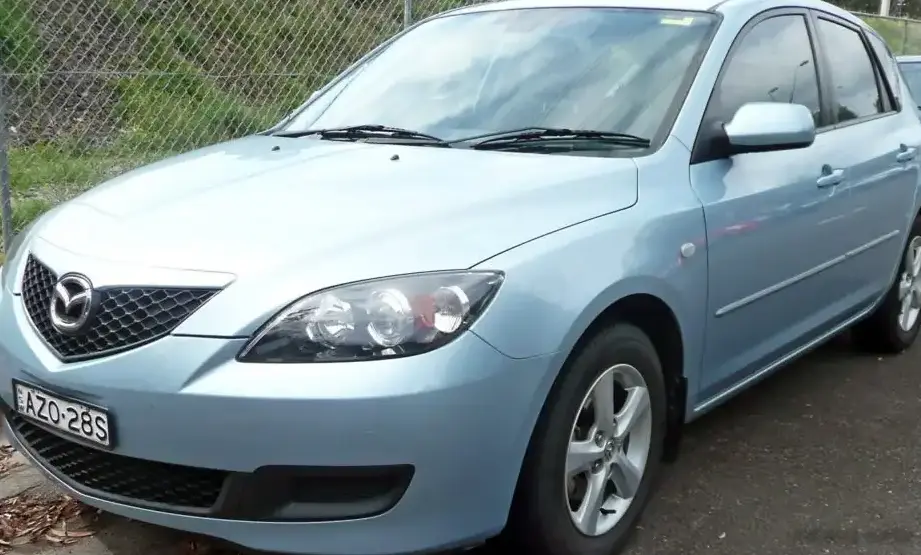
The Mazda 3 II Sedan (BL) 2.0i with the automatic transmission, produced between 2009 and 2011, represented a key offering in Mazda’s compact car lineup. Positioned as a mid-range trim, it bridged the gap between the base 1.6-liter models and the more performance-oriented 2.3-liter variants. This generation of the Mazda 3, built on the BL platform, aimed to deliver a more refined and mature driving experience compared to its predecessor, focusing on improved interior quality, ride comfort, and fuel efficiency while retaining Mazda’s signature sporty handling characteristics. The 2.0i Automatic was particularly aimed at buyers seeking a balance of practicality, comfort, and reasonable performance for daily commuting and family use.
Technical Specifications
| Brand | Mazda |
| Model | 3 |
| Generation | II Sedan (BL) |
| Type (Engine) | 2.0i (150 Hp) Automatic |
| Start of production | 2009 |
| End of production | 2011 |
| Powertrain Architecture | Internal Combustion engine |
| Body type | Sedan |
| Seats | 5 |
| Doors | 4 |
| Fuel consumption (urban) | 10.7 l/100 km (22 US mpg, 26.4 UK mpg, 9.3 km/l) |
| Fuel consumption (extra urban) | 5.9 l/100 km (39.9 US mpg, 47.9 UK mpg, 16.9 km/l) |
| Fuel consumption (combined) | 7.7 l/100 km (30.5 US mpg, 36.7 UK mpg, 13 km/l) |
| CO2 emissions | 183 g/km |
| Fuel Type | Petrol (Gasoline) |
| Acceleration 0 – 100 km/h | 10.6 sec |
| Acceleration 0 – 62 mph | 10.6 sec |
| Acceleration 0 – 60 mph | 10.1 sec |
| Maximum speed | 210 km/h (130.49 mph) |
| Emission standard | Euro 5 |
| Weight-to-power ratio | 8.4 kg/Hp, 119 Hp/tonne |
| Weight-to-torque ratio | 6.7 kg/Nm, 148.4 Nm/tonne |
| Power | 150 Hp @ 6500 rpm |
| Power per litre | 75 Hp/l |
| Torque | 187 Nm @ 4000 rpm (137.92 lb.-ft. @ 4000 rpm) |
| Engine layout | Front, Transverse |
| Engine Model/Code | LF5H, LF5W |
| Engine displacement | 1999 cm3 (121.99 cu. in.) |
| Number of cylinders | 4 |
| Engine configuration | Inline |
| Cylinder Bore | 87.5 mm (3.44 in.) |
| Piston Stroke | 83.1 mm (3.27 in.) |
| Compression ratio | 10:1 |
| Number of valves per cylinder | 4 |
| Fuel injection system | Multi-port manifold injection |
| Engine aspiration | Naturally aspirated engine |
| Valvetrain | DOHC |
| Engine oil capacity | 4.3 l (4.54 US qt | 3.78 UK qt) |
| Coolant | 7.5 l (7.93 US qt | 6.6 UK qt) |
| Kerb Weight | 1260 kg (2777.82 lbs.) |
| Max. weight | 1820 kg (4012.41 lbs.) |
| Max load | 560 kg (1234.59 lbs.) |
| Trunk (boot) space – minimum | 430 l (15.19 cu. ft.) |
| Fuel tank capacity | 55 l (14.53 US gal | 12.1 UK gal) |
| Permitted trailer load with brakes (12%) | 1300 kg (2866.01 lbs.) |
| Permitted trailer load without brakes | 550 kg (1212.54 lbs.) |
| Length | 4580 mm (180.31 in.) |
| Width | 1755 mm (69.09 in.) |
| Width including mirrors | 2002 mm (78.82 in.) |
| Height | 1470 mm (57.87 in.) |
| Wheelbase | 2640 mm (103.94 in.) |
| Front track | 1520 mm (59.84 in.) |
| Rear (Back) track | 1515 mm (59.65 in.) |
| Ride height (ground clearance) | 155 mm (6.1 in.) |
| Drag coefficient (Cd) | 0.28 |
| Minimum turning circle (turning diameter) | 10.4 m (34.12 ft.) |
| Drivetrain Architecture | The Internal combustion engine (ICE) drives the front wheels of the vehicle. |
| Drive wheel | Front wheel drive |
| Number of gears and type of gearbox | 5 gears, automatic transmission |
| Front brakes | Ventilated discs |
| Rear brakes | Disc |
| Assisting systems | ABS (Anti-lock braking system) |
| Steering type | Steering rack and pinion |
| Power steering | Electric Steering |
| Tires size | 205/50 R17 |
| Wheel rims size | 17 |
Powertrain & Engine Architecture
The heart of the 2.0i Automatic was the LF5H or LF5W engine, a 1999cc inline-four cylinder gasoline engine. This engine utilized a naturally aspirated configuration with multi-port fuel injection and a double overhead camshaft (DOHC) valvetrain. The 10:1 compression ratio was typical for the era, balancing performance and fuel efficiency. The engine produced 150 horsepower at 6500 rpm and 187 Nm (137.92 lb-ft) of torque at 4000 rpm. The automatic transmission was a conventional 5-speed unit, chosen for its ease of use and comfort. While not offering the quickest shifts, it was reliable and well-suited to the engine’s characteristics. The transmission was geared towards providing smooth acceleration and maintaining reasonable fuel economy.
Driving Characteristics
The 2.0i Automatic offered a comfortable and predictable driving experience. Acceleration from 0-60 mph took around 10.1 seconds, which was adequate for everyday driving but noticeably slower than the manual transmission or the higher-output 2.3-liter models. The automatic transmission, while smooth, did result in some power loss compared to the manual. The gear ratios were optimized for fuel economy and cruising, meaning the engine could feel somewhat strained during aggressive acceleration. Handling was typical of the Mazda 3, with responsive steering and a well-tuned suspension. However, the added weight of the automatic transmission and its associated components did slightly diminish the car’s agility compared to its manual counterparts.
Equipment & Trim Levels
The 2.0i Automatic trim typically included standard features such as air conditioning, power windows and locks, a CD player with auxiliary input, and basic safety equipment like ABS and airbags. Interior upholstery was usually cloth, with options for upgraded materials available. Common optional extras included a sunroof, alloy wheels, and a more advanced audio system. The dashboard layout was functional and straightforward, prioritizing ease of use over flashy design. The 2.0i trim aimed to provide a good balance of features and affordability, making it an attractive option for a wide range of buyers.
Chassis & Braking
The Mazda 3 II Sedan featured a MacPherson strut front suspension and a multi-link rear suspension, providing a comfortable ride and good handling characteristics. The 2.0i Automatic model typically came equipped with ventilated front disc brakes and solid rear disc brakes. The ABS system provided enhanced braking control, particularly in emergency situations. The electric power steering offered a light and responsive feel, making it easy to maneuver in urban environments. Stabilizer bars were fitted to both the front and rear axles to reduce body roll during cornering.
Market Reception & Comparison
The Mazda 3 II Sedan 2.0i Automatic was generally well-received by automotive critics. It was praised for its comfortable ride, refined interior, and good fuel economy. However, some reviewers noted that the automatic transmission dulled the driving experience compared to the manual version. Compared to the 1.6-liter models, the 2.0i offered a noticeable performance boost. Against the 2.3-liter variants, it represented a more affordable and fuel-efficient option, albeit with less power. Reliability was generally good, with the LF engine proving to be durable and relatively trouble-free. Fuel economy figures of around 30.5 US mpg combined were competitive for the segment.
Legacy
The Mazda 3 II Sedan 2.0i Automatic has proven to be a reliable and durable vehicle in the used car market. The LF engine is known for its longevity, and the automatic transmission, while not the most exciting, is generally dependable. These cars are still relatively common on the road today, a testament to their build quality and reliability. While not a performance icon, the 2.0i Automatic remains a practical and affordable option for buyers seeking a comfortable and well-equipped compact sedan. Maintenance costs are generally reasonable, and parts availability is good, making it a sensible choice for those looking for a dependable used car.