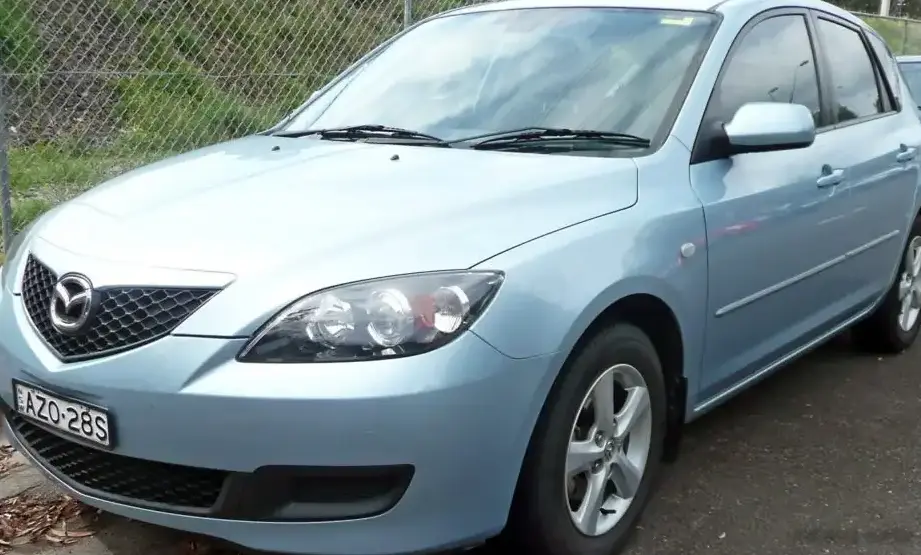
The Mazda 3 II Sedan, specifically the 1.6i variant with an automatic transmission, was a key offering in Mazda’s lineup from 2011 to 2013. This model, designated as part of the BL series after a 2011 facelift, represented Mazda’s attempt to balance affordability, fuel efficiency, and practicality within the competitive compact sedan segment. Positioned as an entry-level to mid-range trim, it provided a more accessible price point compared to higher-powered engine options like the 2.0L or 2.5L variants, while still offering the stylish design and generally reliable mechanics that characterized the second-generation Mazda 3. It was primarily marketed towards buyers seeking a comfortable and economical daily driver.
Technical Specifications
| Brand | Mazda |
| Model | 3 |
| Generation | II Sedan (BL, facelift 2011) |
| Type (Engine) | 1.6i (105 Hp) Automatic |
| Start of production | 2011 |
| End of production | 2013 |
| Powertrain Architecture | Internal Combustion engine |
| Body type | Sedan |
| Seats | 5 |
| Doors | 4 |
| Fuel consumption (urban) | 9.9 l/100 km (23.8 US mpg) |
| Fuel consumption (extra urban) | 6 l/100 km (39.2 US mpg) |
| Fuel consumption (combined) | 7.4 l/100 km (31.8 US mpg) |
| CO2 emissions | 171 g/km |
| Fuel Type | Petrol (Gasoline) |
| Acceleration 0 – 100 km/h | 13.1 sec |
| Acceleration 0 – 62 mph | 13.1 sec |
| Acceleration 0 – 60 mph | 12.4 sec |
| Maximum speed | 177 km/h (109.98 mph) |
| Emission standard | Euro 5 |
| Weight-to-power ratio | 11.4 kg/Hp |
| Weight-to-torque ratio | 8.2 kg/Nm |
| Power | 105 Hp @ 6000 rpm |
| Torque | 145 Nm @ 4000 rpm (106.95 lb.-ft. @ 4000 rpm) |
| Engine layout | Front, Transverse |
| Engine Model/Code | Z668, Z682 |
| Engine displacement | 1598 cm3 (97.52 cu. in.) |
| Number of cylinders | 4 |
| Engine configuration | Inline |
| Cylinder Bore | 78 mm (3.07 in.) |
| Piston Stroke | 83.6 mm (3.29 in.) |
| Compression ratio | 10:1 |
| Number of valves per cylinder | 4 |
| Fuel injection system | Multi-port manifold injection |
| Engine aspiration | Naturally aspirated engine |
| Valvetrain | DOHC |
| Engine oil capacity | 3.9 l (4.12 US qt | 3.43 UK qt) |
| Coolant capacity | 6 l (6.34 US qt | 5.28 UK qt) |
| Kerb Weight | 1195 kg (2634.52 lbs.) |
| Max. weight | 1770 kg (3902.18 lbs.) |
| Max load | 575 kg (1267.66 lbs.) |
| Trunk (boot) space – minimum | 430 l (15.19 cu. ft.) |
| Fuel tank capacity | 55 l (14.53 US gal | 12.1 UK gal) |
| Permitted trailer load without brakes | 550 kg (1212.54 lbs.) |
| Length | 4580 mm (180.31 in.) |
| Width | 1755 mm (69.09 in.) |
| Width including mirrors | 2002 mm (78.82 in.) |
| Height | 1470 mm (57.87 in.) |
| Wheelbase | 2640 mm (103.94 in.) |
| Front track | 1535 mm (60.43 in.) |
| Rear (Back) track | 1530 mm (60.24 in.) |
| Ride height (ground clearance) | 155 mm (6.1 in.) |
| Drag coefficient (Cd) | 0.27 |
| Minimum turning circle | 10.4 m (34.12 ft.) |
| Drivetrain Architecture | Front wheel drive |
| Drive wheel | Front wheel drive |
| Number of gears and type of gearbox | 4 gears, automatic transmission |
| Front suspension | Independent, type McPherson with coil spring and anti-roll bar |
| Rear suspension | Independent multi-link suspension |
| Front brakes | Ventilated discs |
| Rear brakes | Disc |
| Assisting systems | ABS (Anti-lock braking system) |
| Steering type | Steering rack and pinion |
| Power steering | Electric Steering |
| Tires size | 205/55 R16 |
| Wheel rims size | 16 |
Powertrain & Engine Architecture
The heart of the 1.6i Automatic Mazda 3 was the Z668 or Z682 engine, a 1.6-liter inline-four cylinder gasoline engine. This engine featured a double overhead camshaft (DOHC) valvetrain with four valves per cylinder, contributing to reasonable breathing for its displacement. Fuel delivery was handled by a multi-port fuel injection system, a common setup for the time, providing adequate atomization for efficient combustion. The engine produced 105 horsepower at 6000 rpm and 145 Nm (106.95 lb-ft) of torque at 4000 rpm. The automatic transmission was a conventional four-speed unit. While not particularly advanced, it was known for its reliability. The transmission’s gear ratios were tuned for fuel economy and smooth operation rather than outright performance.
Driving Characteristics
The 1.6L engine paired with the four-speed automatic resulted in a driving experience focused on comfort and economy. Acceleration was modest, with a 0-60 mph time of around 12.4 seconds. The automatic transmission, while smooth, lacked the responsiveness of a manual gearbox or more modern automatic transmissions with more gears. Upshifts were noticeable, and downshifts could sometimes feel hesitant, especially during overtaking maneuvers. The relatively tall gear ratios prioritized fuel efficiency, but at the expense of spirited driving. Compared to the 2.0L or 2.5L Mazda 3 models, the 1.6i Automatic felt noticeably slower and less engaging.
Equipment & Trim Levels
The 1.6i Automatic trim typically included standard features such as air conditioning, power windows and locks, a basic audio system (often with CD player and auxiliary input), and ABS brakes. Interior upholstery was usually cloth, and the dashboard featured a straightforward design with easy-to-use controls. Optional extras could include alloy wheels, a sunroof, and upgraded audio systems. The trim level generally sat below the more performance-oriented trims, focusing on providing essential features at a competitive price point.
Chassis & Braking
The Mazda 3 II Sedan utilized an independent suspension setup, with a McPherson strut configuration at the front and a multi-link system at the rear. This provided a comfortable ride quality, absorbing bumps and imperfections in the road reasonably well. Front brakes were ventilated discs, offering adequate stopping power, while rear brakes were solid discs. The steering was rack and pinion with electric power assistance, providing a light and easy steering feel. Stabilizer bars were included both front and rear to reduce body roll during cornering, though the overall handling was geared more towards comfort than sporty dynamics.
Market Reception & Comparison
The 1.6i Automatic Mazda 3 was generally well-received as a practical and affordable compact sedan. Critics praised its comfortable ride, fuel efficiency, and stylish design. However, the engine’s lack of power and the transmission’s somewhat dated technology were common criticisms. Compared to other trims in the Mazda 3 lineup, the 1.6i Automatic offered the best fuel economy but the slowest acceleration. It competed with other entry-level compact sedans like the Toyota Corolla, Honda Civic, and Hyundai Elantra, often offering a more engaging driving experience than some of its rivals.
Legacy
The 1.6L engine and four-speed automatic transmission combination in the Mazda 3 II Sedan proved to be relatively reliable, with many examples still on the road today. While not known for exceptional performance, the powertrain offered a good balance of durability and affordability. In the used car market, these models are often sought after by buyers looking for a dependable and economical daily driver. Maintenance costs are generally reasonable, and parts availability is good. However, potential buyers should be aware of the age-related wear and tear common to older vehicles, such as suspension components and potential oil leaks.