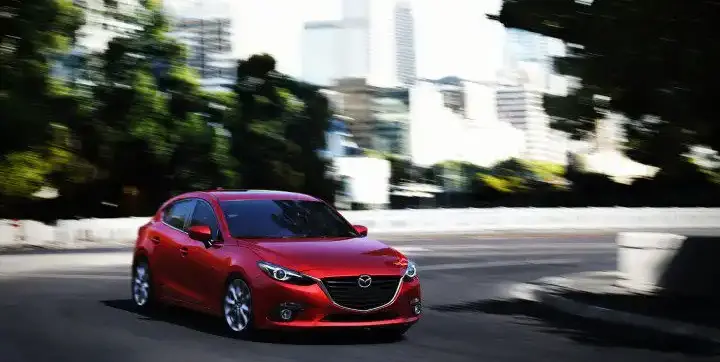
The Mazda 3 III Hatchback (BM) 1.5 Skyactiv-D, producing 105 horsepower, was a key variant in Mazda’s European and Asian lineup from 2016. Positioned as an entry-level diesel option, it aimed to deliver fuel efficiency and reasonable performance for everyday commuting and family use. This model represented Mazda’s continued commitment to diesel technology, particularly their Skyactiv-D engine family, known for its high compression ratios and focus on efficiency. The BM generation Mazda 3, launched in 2013, was a significant step forward in Mazda’s design and engineering, offering a more refined driving experience and improved interior quality compared to its predecessors.
Technical Specifications
| Brand | Mazda |
| Model | 3 |
| Generation | 3 III Hatchback (BM) |
| Type (Engine) | 1.5 Skyactiv-D (105 Hp) |
| Start of production | 2016 |
| End of production | 2016 |
| Powertrain Architecture | Internal Combustion engine |
| Body type | Hatchback |
| Seats | 5 |
| Doors | 5 |
| Fuel consumption (urban) | 4.3 l/100 km (54.7 US mpg, 65.7 UK mpg, 23.3 km/l) |
| Fuel consumption (extra urban) | 3.5 l/100 km (67.2 US mpg, 80.7 UK mpg, 28.6 km/l) |
| Fuel consumption (combined) | 3.8 l/100 km (61.9 US mpg, 74.3 UK mpg, 26.3 km/l) |
| CO2 emissions | 99 g/km |
| Fuel Type | Diesel |
| Acceleration 0 – 100 km/h | 11 sec |
| Acceleration 0 – 62 mph | 11 sec |
| Acceleration 0 – 60 mph | 10.5 sec |
| Maximum speed | 185 km/h (114.95 mph) |
| Emission standard | Euro 6 |
| Weight-to-power ratio | 12.1 kg/Hp, 82.7 Hp/tonne |
| Weight-to-torque ratio | 4.7 kg/Nm, 212.6 Nm/tonne |
| Power | 105 Hp @ 4000 rpm |
| Power per litre | 70.1 Hp/l |
| Torque | 270 Nm @ 1600-2500 rpm (199.14 lb.-ft. @ 1600-2500 rpm) |
| Engine layout | Front, Transverse |
| Engine Model/Code | S5-DPTS, S5-DPTR |
| Engine displacement | 1498 cm3 (91.41 cu. in.) |
| Number of cylinders | 4 |
| Engine configuration | Inline |
| Cylinder Bore | 76 mm (2.99 in.) |
| Piston Stroke | 82.6 mm (3.25 in.) |
| Compression ratio | 14.8:1 |
| Number of valves per cylinder | 4 |
| Fuel injection system | Diesel Commonrail |
| Engine aspiration | Turbocharger, Intercooler |
| Valvetrain | DOHC |
| Engine oil capacity | 5.1 l (5.39 US qt | 4.49 UK qt) |
| Coolant | 7 l (7.4 US qt | 6.16 UK qt) |
| Kerb Weight | 1270 kg (2799.87 lbs.) |
| Max. weight | 1870 kg (4122.64 lbs.) |
| Max load | 600 kg (1322.77 lbs.) |
| Trunk (boot) space – minimum | 364 l (12.85 cu. ft.) |
| Trunk (boot) space – maximum | 1263 l (44.6 cu. ft.) |
| Fuel tank capacity | 51 l (13.47 US gal | 11.22 UK gal) |
| Max. roof load | 75 kg (165.35 lbs.) |
| Permitted trailer load with brakes (8%) | 1300 kg (2866.01 lbs.) |
| Permitted trailer load with brakes (12%) | 1300 kg (2866.01 lbs.) |
| Permitted trailer load without brakes | 600 kg (1322.77 lbs.) |
| Permitted towbar download | 75 kg (165.35 lbs.) |
| Length | 4460 mm (175.59 in.) |
| Width | 1795 mm (70.67 in.) |
| Width including mirrors | 2053 mm (80.83 in.) |
| Height | 1450 mm (57.09 in.) |
| Wheelbase | 2700 mm (106.3 in.) |
| Front track | 1555 mm (61.22 in.) |
| Rear (Back) track | 1560 mm (61.42 in.) |
| Ride height (ground clearance) | 155 mm (6.1 in.) |
| Drag coefficient (Cd) | 0.28 |
| Minimum turning circle (turning diameter) | 10.6 m (34.78 ft.) |
| Drivetrain Architecture | The Internal combustion engine (ICE) drives the front wheels of the vehicle. |
| Drive wheel | Front wheel drive |
| Number of gears and type of gearbox | 6 gears, manual transmission |
| Front brakes | Ventilated discs |
| Rear brakes | Disc |
| Assisting systems | ABS (Anti-lock braking system) |
| Steering type | Steering rack and pinion |
| Power steering | Electric Steering |
| Tires size | 205/60 R16 |
| Wheel rims size | 16 |
Powertrain & Engine Architecture
The heart of this Mazda 3 variant is the 1.5-liter Skyactiv-D diesel engine, specifically the S5-DPTS or S5-DPTR engine code depending on the specific market. This engine is a four-cylinder, inline configuration, boasting a relatively high compression ratio of 14.8:1, a hallmark of the Skyactiv-D technology. This high compression, combined with a low-pressure turbocharger and direct injection, contributes to both fuel efficiency and a surprisingly responsive power delivery. The engine utilizes a common-rail direct injection system, ensuring precise fuel metering and optimized combustion. The DOHC (Double Overhead Camshaft) valvetrain further enhances engine breathing and performance. A particulate filter is included to meet stringent Euro 6 emission standards. The engine is transversely mounted in the front of the vehicle. The 6-speed manual transmission was standard, designed to complement the engine’s torque curve and provide a reasonably engaging driving experience.
Driving Characteristics
The 105 horsepower and 270 Nm (199 lb-ft) of torque offered by the 1.5 Skyactiv-D engine provided adequate, though not exhilarating, performance. Acceleration from 0 to 60 mph took around 10.5 seconds, and top speed was limited to 115 mph. The engine’s torque peak, available from 1600-2500 rpm, meant that everyday driving felt effortless, with sufficient power for overtaking and navigating hills. Compared to the more powerful 2.2-liter Skyactiv-D variants, this 1.5L engine felt less strained at higher speeds, but lacked the outright punch for more spirited driving. The manual transmission’s gear ratios were well-matched to the engine’s characteristics, allowing for smooth and efficient gear changes. While not a sports car, the 1.5 Skyactiv-D offered a comfortable and refined driving experience, prioritizing fuel economy and usability.
Equipment & Trim Levels
The 1.5 Skyactiv-D typically represented an entry to mid-level trim within the Mazda 3 range. Standard equipment generally included air conditioning, power windows, power mirrors, a basic audio system with USB connectivity, and ABS brakes. Higher trim levels added features like alloy wheels, a touchscreen infotainment system, rear parking sensors, and climate control. Interior upholstery was typically cloth, with a functional and durable design. Optional extras included a sunroof, navigation system, and advanced safety features like lane departure warning and automatic emergency braking.
Chassis & Braking
The Mazda 3 BM utilized a front-wheel-drive chassis with independent suspension at the front (typically MacPherson strut) and a torsion beam setup at the rear. The suspension was tuned for a balance between comfort and handling, providing a stable and predictable ride. Braking consisted of ventilated discs at the front and solid discs at the rear. ABS (Anti-lock Braking System) was standard. The chassis was designed to be lightweight, contributing to the car’s overall fuel efficiency and agility. Stabilizer bars were fitted to both the front and rear axles to reduce body roll during cornering.
Market Reception & Comparison
The Mazda 3 1.5 Skyactiv-D was generally well-received by automotive critics for its fuel efficiency and refined driving experience. It was often praised for its comfortable ride and well-equipped interior, especially considering its price point. Compared to other diesel hatchbacks in its class, such as the Volkswagen Golf and Ford Focus, the Mazda 3 offered a more engaging driving experience and a more stylish interior. However, some critics noted that the engine lacked the outright power of its rivals. Fuel economy was a major selling point, with combined figures around 62 mpg making it an attractive option for cost-conscious buyers. Reliability was generally good, with the Skyactiv-D engine proving to be a durable and dependable unit.
Legacy
The 1.5 Skyactiv-D engine, while not as common as the larger 2.2-liter variant, has proven to be a reliable and efficient powertrain. In the used car market, Mazda 3 models equipped with this engine are often sought after by buyers looking for a fuel-efficient and dependable hatchback. Regular maintenance, including oil changes and filter replacements, is crucial for ensuring the long-term health of the engine. The Skyactiv-D technology, as a whole, helped establish Mazda as a leader in diesel engine development, and the 1.5-liter variant remains a viable option for those seeking a practical and economical vehicle.