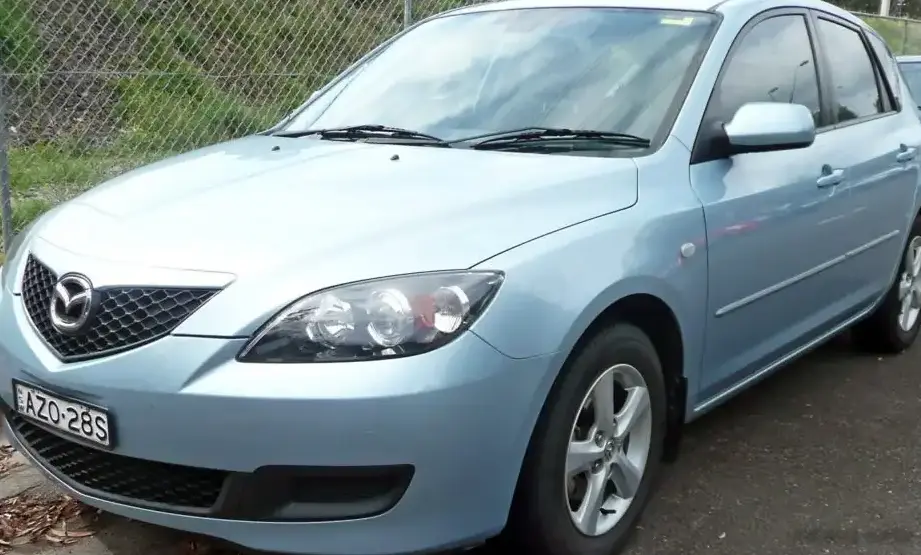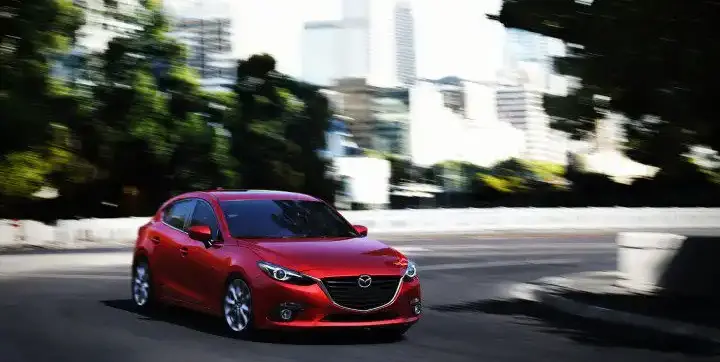
The Mazda 3 III Hatchback (BM) 1.5 Skyactiv-D (105 hp) Skyactiv-Drive, produced primarily for the European market during the 2016 model year, represented an entry-level diesel option within the third generation (BM/BN) Mazda 3 lineup. This variant combined a small-displacement diesel engine with Mazda’s proprietary Skyactiv-Drive automatic transmission, aiming to deliver fuel efficiency and reasonable performance in a practical hatchback package. It occupied the lower end of the performance spectrum for the third-generation Mazda 3, positioned below the more powerful 2.0-liter gasoline and diesel variants.
Technical Specifications
| Brand | Mazda |
| Model | 3 |
| Generation | 3 III Hatchback (BM) |
| Type (Engine) | 1.5 Skyactiv-D (105 Hp) Skyactiv-Drive |
| Start of production | 2016 |
| End of production | 2016 |
| Powertrain Architecture | Internal Combustion engine |
| Body type | Hatchback |
| Seats | 5 |
| Doors | 5 |
| Fuel consumption (urban) | 4.9 l/100 km (48 US mpg, 57.6 UK mpg, 20.4 km/l) |
| Fuel consumption (extra urban) | 4.1 l/100 km (57.4 US mpg, 68.9 UK mpg, 24.4 km/l) |
| Fuel consumption (combined) | 4.4 l/100 km (53.5 US mpg, 64.2 UK mpg, 22.7 km/l) |
| CO2 emissions | 114 g/km |
| Fuel Type | Diesel |
| Acceleration 0 – 100 km/h | 11.6 sec |
| Acceleration 0 – 62 mph | 11.6 sec |
| Acceleration 0 – 60 mph | 11 sec |
| Maximum speed | 181 km/h (112.47 mph) |
| Emission standard | Euro 6 |
| Weight-to-power ratio | 12.3 kg/Hp, 81.1 Hp/tonne |
| Weight-to-torque ratio | 4.8 kg/Nm, 208.5 Nm/tonne |
| Power | 105 Hp @ 4000 rpm |
| Power per litre | 70.1 Hp/l |
| Torque | 270 Nm @ 1600-2500 rpm (199.14 lb.-ft. @ 1600-2500 rpm) |
| Engine layout | Front, Transverse |
| Engine Model/Code | S5-DPTS, S5-DPTR |
| Engine displacement | 1498 cm3 (91.41 cu. in.) |
| Number of cylinders | 4 |
| Engine configuration | Inline |
| Cylinder Bore | 76 mm (2.99 in.) |
| Piston Stroke | 82.6 mm (3.25 in.) |
| Compression ratio | 14.8:1 |
| Number of valves per cylinder | 4 |
| Fuel injection system | Diesel Commonrail |
| Engine aspiration | Turbocharger, Intercooler |
| Valvetrain | DOHC |
| Engine oil capacity | 5.1 l (5.39 US qt | 4.49 UK qt) |
| Coolant | 7.1 l (7.5 US qt | 6.25 UK qt) |
| Kerb Weight | 1295 kg (2854.99 lbs.) |
| Max. weight | 1900 kg (4188.78 lbs.) |
| Max load | 605 kg (1333.8 lbs.) |
| Trunk (boot) space – minimum | 364 l (12.85 cu. ft.) |
| Trunk (boot) space – maximum | 1263 l (44.6 cu. ft.) |
| Fuel tank capacity | 51 l (13.47 US gal | 11.22 UK gal) |
| Max. roof load | 75 kg (165.35 lbs.) |
| Permitted trailer load with brakes (8%) | 1300 kg (2866.01 lbs.) |
| Permitted trailer load with brakes (12%) | 1300 kg (2866.01 lbs.) |
| Permitted trailer load without brakes | 600 kg (1322.77 lbs.) |
| Permitted towbar download | 75 kg (165.35 lbs.) |
| Length | 4460 mm (175.59 in.) |
| Width | 1795 mm (70.67 in.) |
| Width including mirrors | 2053 mm (80.83 in.) |
| Height | 1450 mm (57.09 in.) |
| Wheelbase | 2700 mm (106.3 in.) |
| Front track | 1555 mm (61.22 in.) |
| Rear (Back) track | 1560 mm (61.42 in.) |
| Ride height (ground clearance) | 155 mm (6.1 in.) |
| Drag coefficient (Cd) | 0.28 |
| Minimum turning circle (turning diameter) | 10.6 m (34.78 ft.) |
| Drivetrain Architecture | The Internal combustion engine (ICE) drives the front wheels of the vehicle. |
| Drive wheel | Front wheel drive |
| Number of gears and type of gearbox | 6 gears, automatic transmission |
| Front brakes | Ventilated discs |
| Rear brakes | Disc |
| Assisting systems | ABS (Anti-lock braking system) |
| Steering type | Steering rack and pinion |
| Power steering | Electric Steering |
| Tires size | 205/60 R16 |
| Wheel rims size | 16 |
INTRODUCTION
The Mazda 3 III (BM) series, launched in 2013, represented a significant step forward in Mazda’s design and engineering philosophy, embracing the “KODO – Soul of Motion” design language and the Skyactiv technology suite. The 1.5 Skyactiv-D 105 hp variant, introduced in 2016, was specifically tailored for European markets where diesel engines held a strong preference. This model aimed to provide a balance between fuel economy, practicality, and Mazda’s signature driving dynamics. It was positioned as the entry point into the Mazda 3 diesel range, appealing to buyers prioritizing efficiency and lower running costs.
Powertrain & Engine Architecture
At the heart of this variant lies the S5-DPTS or S5-DPTR 1.5-liter Skyactiv-D diesel engine. This engine is a four-cylinder, inline configuration featuring a high compression ratio of 14.8:1, a key element of the Skyactiv technology. The engine utilizes a common-rail direct injection system, delivering fuel at extremely high pressures for optimized combustion. A turbocharger with an intercooler is employed to boost power output and improve torque across a wider rev range. The engine’s valvetrain utilizes a Dual Overhead Camshaft (DOHC) design with four valves per cylinder, enhancing breathing and overall efficiency. The Skyactiv-Drive automatic transmission is a six-speed torque converter automatic, uniquely designed by Aisin in collaboration with Mazda. It prioritizes fuel efficiency through a wider range of gear ratios and a quicker lock-up clutch, minimizing slippage.
Driving Characteristics
The 105 hp output and 270 Nm of torque, available from 1600-2500 rpm, provided adequate, though not exhilarating, performance. Acceleration from 0-100 km/h took approximately 11.6 seconds. The Skyactiv-Drive transmission, while prioritizing efficiency, sometimes felt less responsive than traditional automatic gearboxes or manual transmissions. Gear changes were smooth but could be hesitant during quick acceleration. The relatively low power output meant that overtaking maneuvers required careful planning. Compared to the 2.0-liter gasoline and diesel variants, this 1.5L model offered a more relaxed driving experience, focusing on fuel economy rather than outright speed. The gear ratios were tuned for maximizing fuel efficiency at cruising speeds, making it a comfortable long-distance companion.
Equipment & Trim Levels
The 1.5 Skyactiv-D 105 hp variant typically came with a reasonable level of standard equipment. This included air conditioning, power windows, power mirrors, a basic audio system with USB connectivity, and stability control. Interior upholstery was generally cloth, with a functional, if not luxurious, dashboard layout. Optional extras included alloy wheels, a touchscreen infotainment system with navigation, rear parking sensors, and climate control. Trim levels varied slightly depending on the specific European market, but generally followed a progressive structure with increasing levels of equipment and features.
Chassis & Braking
The Mazda 3 III Hatchback utilized a front-wheel-drive platform with a MacPherson strut suspension setup at the front and a multi-link suspension at the rear. The suspension was tuned to provide a balance between comfort and handling, characteristic of Mazda’s engineering approach. Braking systems consisted of ventilated discs at the front and solid discs at the rear. Anti-lock Braking System (ABS) was standard. Stabilizer bars were fitted to both the front and rear axles to reduce body roll during cornering. The chassis was designed to be relatively lightweight, contributing to improved fuel efficiency and handling.
Market Reception & Comparison
The 1.5 Skyactiv-D 105 hp variant was generally well-received by European automotive critics as a practical and economical option. It was praised for its fuel efficiency, achieving combined fuel consumption figures of around 4.4 l/100 km. However, some reviewers noted the engine’s lack of outright power and the sometimes-sluggish response of the Skyactiv-Drive transmission. Compared to the 2.0-liter diesel variants, this model offered lower running costs but sacrificed performance. Against competitors like the Volkswagen Golf and Ford Focus, the Mazda 3 offered a more engaging driving experience, but the 1.5L diesel was often seen as less powerful than comparable engines offered by those brands.
Legacy
The 1.5 Skyactiv-D engine proved to be a relatively reliable unit, with few widespread mechanical issues reported. The Skyactiv-Drive transmission, while sometimes criticized for its responsiveness, also demonstrated good long-term durability. In the used car market, these models are often sought after by buyers prioritizing fuel economy and low running costs. However, potential buyers should be aware of the importance of regular maintenance, particularly regarding the diesel particulate filter (DPF), which can be prone to clogging if the vehicle is primarily used for short journeys. Overall, the Mazda 3 III 1.5 Skyactiv-D 105 hp Skyactiv-Drive remains a viable and economical option for those seeking a practical and well-built hatchback.