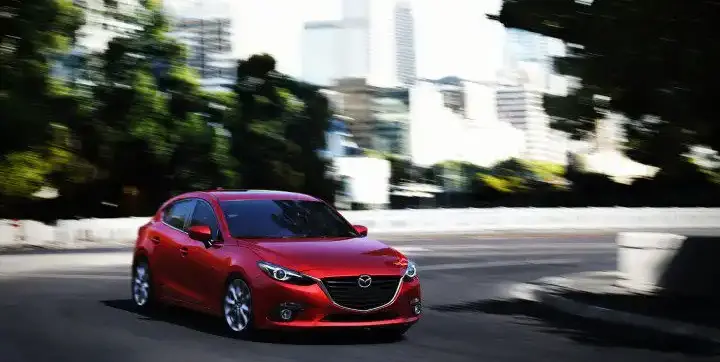
The Mazda 3 (BM) series, launched in 2013, represented a significant advancement for Mazda, embodying the company’s “KODO – Soul of Motion” design language and integrating the innovative SkyActiv technologies. The 2.0-liter SkyActiv-G engine paired with the SkyActiv-Drive automatic transmission was a crucial element of this strategy, delivering a balance between performance, fuel efficiency, and driving pleasure. This combination targeted a broad audience seeking a refined and modern compact hatchback. The SkyActiv technologies were designed to maximize combustion efficiency and reduce weight, contributing to improved fuel economy and handling.
Technical Specifications
| Brand | Mazda |
| Model | 3 |
| Generation | 3 III Hatchback (BM) |
| Type (Engine) | 2.0 SkyActiv-G (155 Hp) Skyactiv-Drive |
| Start of production | July, 2013 |
| End of production | 2016 |
| Powertrain Architecture | Internal Combustion engine |
| Body type | Hatchback |
| Seats | 5 |
| Doors | 5 |
| Fuel consumption (urban) | 7.8 l/100 km (30.2 US mpg) |
| Fuel consumption (extra urban) | 5.9 l/100 km (39.9 US mpg) |
| Fuel consumption (combined) | 7.1 l/100 km (33.1 US mpg) |
| Fuel Type | Petrol (Gasoline) |
| Maximum speed | 210 km/h (130.49 mph) |
| Emission standard | PZEV |
| Weight-to-power ratio | 8.5 kg/Hp |
| Weight-to-torque ratio | 6.5 kg/Nm |
| Power | 155 Hp @ 6000 rpm |
| Torque | 203 Nm @ 4000 rpm (149.73 lb.-ft. @ 4000 rpm) |
| Maximum engine speed | 6800 rpm |
| Engine layout | Front, Transverse |
| Engine Model/Code | PE-VPS |
| Engine displacement | 1998 cm3 (121.93 cu. in.) |
| Number of cylinders | 4 |
| Engine configuration | Inline |
| Cylinder Bore | 83.5 mm (3.29 in.) |
| Piston Stroke | 91.2 mm (3.59 in.) |
| Compression ratio | 13:1 |
| Number of valves per cylinder | 4 |
| Fuel injection system | Direct injection |
| Engine aspiration | Naturally aspirated engine |
| Valvetrain | DOHC, VVT |
| Engine oil capacity | 4.2 l (4.44 US qt | 3.7 UK qt) |
| Coolant capacity | 6.5 l (6.87 US qt | 5.72 UK qt) |
| Kerb Weight | 1324-1329 kg (2918.92 – 2929.94 lbs.) |
| Trunk (boot) space (min) | 572 l (20.2 cu. ft.) |
| Trunk (boot) space (max) | 1334 l (47.11 cu. ft.) |
| Fuel tank capacity | 50 l (13.21 US gal | 11 UK gal) |
| Length | 4460 mm (175.59 in.) |
| Width | 1795 mm (70.67 in.) |
| Height | 1455 mm (57.28 in.) |
| Wheelbase | 2700 mm (106.3 in.) |
| Front track | 1555 mm (61.22 in.) |
| Rear track | 1560 mm (61.42 in.) |
| Ride height (ground clearance) | 155 mm (6.1 in.) |
| Drag coefficient (Cd) | 0.28 |
| Minimum turning circle | 11.3 m (37.07 ft.) |
| Drivetrain | Front wheel drive |
| Number of gears | 6 |
| Gearbox type | Automatic transmission Skyactiv-Drive |
| Front suspension | Independent, McPherson with coil spring and anti-roll bar |
| Rear suspension | Independent multi-link with stabilizer |
| Front brakes | Ventilated discs, 280 mm |
| Rear brakes | Disc, 265 mm |
| Tires size | 205/60 R16 |
| Wheel rims size | 6.5J x 16 |
Powertrain & Engine Architecture
The PE-VPS 2.0-liter SkyActiv-G inline-four cylinder engine forms the core of this variant. A defining characteristic is its high 13:1 compression ratio, achieved through advanced engineering and optimized combustion chamber design. Direct fuel injection is employed, enhancing fuel atomization and enabling precise combustion control. The engine also features a dual overhead camshaft (DOHC) valvetrain with variable valve timing (VVT) on both intake and exhaust valves, optimizing performance and efficiency throughout the engine’s operating range. The SkyActiv-Drive six-speed automatic transmission is engineered for smooth, responsive shifts. Unlike conventional torque-converter automatics, it utilizes a torque converter with an extended lock-up range, minimizing energy loss and improving fuel economy. The transmission’s control logic is calibrated for both fuel efficiency and driver engagement.
Driving Characteristics
Producing 155 horsepower and 149.73 lb-ft of torque, the 2.0-liter SkyActiv-G engine delivers sufficient performance for everyday driving. While not as potent as the 2.5-liter variant, it provides adequate power for highway merging and overtaking maneuvers. The SkyActiv-Drive automatic transmission contributes to a smooth and refined driving experience. Gear ratios are optimized for both fuel economy and responsiveness, with quick downshifts available when needed. Compared to the manual transmission versions, the automatic offers increased convenience, especially in congested urban environments. However, it does slightly reduce the level of driver engagement. The overall driving experience is characterized by a comfortable ride and predictable handling, making it well-suited for daily commutes and longer trips.
Equipment & Trim Levels
The 2.0-liter SkyActiv-G automatic variant typically included a solid set of standard features. These generally encompassed air conditioning, power windows and locks, a basic audio system with USB connectivity, and stability control. Higher trim levels added features like alloy wheels, a touchscreen infotainment system, Bluetooth connectivity, and a rearview camera. Interior upholstery was typically cloth, with optional leather seats available on higher trims. The dashboard layout was clean and modern, prioritizing ergonomics and ease of use.
Chassis & Braking
The Mazda 3 BM utilized a front-wheel-drive platform with an independent suspension system. The front suspension employed a McPherson strut design with coil springs and an anti-roll bar, while the rear suspension featured a multi-link setup with a stabilizer bar. This suspension configuration provided a good balance between ride comfort and handling precision. The braking system consisted of ventilated discs at the front and solid discs at the rear. An anti-lock braking system (ABS) was standard, enhancing safety and control during emergency braking situations.
Market Reception & Comparison
The Mazda 3 BM, including the 2.0-liter SkyActiv-G automatic variant, received largely positive reviews from automotive critics. It was praised for its stylish design, refined interior, and engaging driving dynamics. The SkyActiv technologies were also recognized for their contribution to fuel efficiency. Compared to other compact hatchbacks in its class, the Mazda 3 offered a more premium feel and a more enjoyable driving experience. The 2.0-liter automatic variant was often considered a sensible choice for buyers prioritizing fuel economy and convenience over outright performance. Some critics noted that the automatic transmission could occasionally feel hesitant, and the engine lacked the power of the larger 2.5-liter option.
Legacy
The 2.0-liter SkyActiv-G engine and SkyActiv-Drive transmission have proven to be relatively reliable powertrains. While some minor issues, such as occasional oil consumption and transmission software glitches, have been reported, these are not widespread. In the used car market, the Mazda 3 BM 2.0-liter automatic remains a popular choice, offering a good balance of value, reliability, and driving enjoyment. Its fuel efficiency and relatively low maintenance costs make it an appealing option for budget-conscious buyers. The SkyActiv technologies introduced in this generation continue to influence Mazda’s engineering philosophy, solidifying the Mazda 3’s position as a significant milestone in the company’s history.