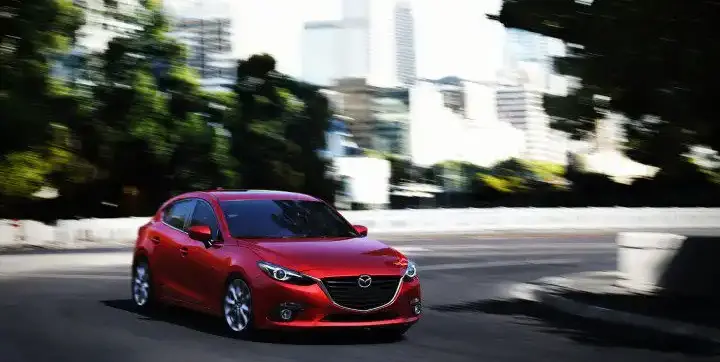
The Mazda 3 III Hatchback (BM) 2.2 SkyActiv-D, producing 150 horsepower, was a key variant in Mazda’s third-generation Mazda 3 lineup, produced from 2013 to 2016. This model represented Mazda’s commitment to diesel technology, particularly within the European market, where diesel engines held a significant share. Positioned as a mid-range offering, it bridged the gap between the lower-powered petrol engines and the more expensive, higher-output diesel options. The BM generation Mazda 3 aimed to elevate the compact car segment with a focus on driving dynamics, fuel efficiency, and stylish design, and the 2.2 SkyActiv-D played a crucial role in achieving these goals.
Technical Specifications
| Brand | Mazda |
| Model | 3 |
| Generation | 3 III Hatchback (BM) |
| Type (Engine) | 2.2 SkyActiv-D (150 Hp) |
| Start of production | 2013 |
| End of production | 2016 |
| Powertrain Architecture | Internal Combustion engine |
| Body type | Hatchback |
| Seats | 5 |
| Doors | 5 |
| Fuel consumption (urban) | 4.9 l/100 km (48 US mpg, 57.6 UK mpg, 20.4 km/l) |
| Fuel consumption (extra urban) | 3.6 l/100 km (65.3 US mpg, 78.5 UK mpg, 27.8 km/l) |
| Fuel consumption (combined) | 4.1 l/100 km (57.4 US mpg, 68.9 UK mpg, 24.4 km/l) |
| CO2 emissions | 107 g/km |
| Fuel Type | Diesel |
| Acceleration 0 – 100 km/h | 8.1 sec |
| Acceleration 0 – 62 mph | 8.1 sec |
| Acceleration 0 – 60 mph | 7.7 sec |
| Maximum speed | 210 km/h (130.49 mph) |
| Emission standard | Euro 6 |
| Weight-to-power ratio | 8.8 kg/Hp, 113.6 Hp/tonne |
| Weight-to-torque ratio | 3.5 kg/Nm, 287.9 Nm/tonne |
| Power | 150 Hp @ 4500 rpm |
| Power per litre | 68.5 Hp/l |
| Torque | 380 Nm @ 1800 rpm (280.27 lb.-ft. @ 1800 rpm) |
| Engine layout | Front, Transverse |
| Engine Model/Code | SH-VTPS |
| Engine displacement | 2191 cm3 (133.7 cu. in.) |
| Number of cylinders | 4 |
| Engine configuration | Inline |
| Cylinder Bore | 86 mm (3.39 in.) |
| Piston Stroke | 94.2 mm (3.71 in.) |
| Compression ratio | 14:1 |
| Number of valves per cylinder | 4 |
| Fuel injection system | Diesel Commonrail |
| Engine aspiration | BiTurbo, Intercooler |
| Valvetrain | DOHC |
| Engine oil capacity | 5.1 l (5.39 US qt | 4.49 UK qt) |
| Coolant | 8.5 l (8.98 US qt | 7.48 UK qt) |
| Kerb Weight | 1320 kg (2910.1 lbs.) |
| Max. weight | 1910 kg (4210.83 lbs.) |
| Max load | 590 kg (1300.73 lbs.) |
| Trunk (boot) space – minimum | 364 l (12.85 cu. ft.) |
| Trunk (boot) space – maximum | 1263 l (44.6 cu. ft.) |
| Fuel tank capacity | 51 l (13.47 US gal | 11.22 UK gal) |
| Permitted trailer load with brakes (12%) | 1800 kg (3968.32 lbs.) |
| Permitted trailer load without brakes | 650 kg (1433 lbs.) |
| Length | 4460 mm (175.59 in.) |
| Width | 1795 mm (70.67 in.) |
| Width including mirrors | 2053 mm (80.83 in.) |
| Height | 1450 mm (57.09 in.) |
| Wheelbase | 2700 mm (106.3 in.) |
| Front track | 1555 mm (61.22 in.) |
| Rear (Back) track | 1560 mm (61.42 in.) |
| Ride height (ground clearance) | 155 mm (6.1 in.) |
| Drag coefficient (Cd) | 0.28 |
| Minimum turning circle (turning diameter) | 10.6 m (34.78 ft.) |
| Drivetrain Architecture | The Internal combustion engine (ICE) drives the front wheels of the vehicle. |
| Drive wheel | Front wheel drive |
| Number of gears and type of gearbox | 6 gears, manual transmission |
| Front brakes | Ventilated discs |
| Rear brakes | Disc |
| Assisting systems | ABS (Anti-lock braking system) |
| Steering type | Steering rack and pinion |
| Power steering | Electric Steering |
| Tires size | 205/60 R16 |
| Wheel rims size | 16 |
Powertrain & Engine Architecture
The heart of this Mazda 3 variant is the 2.2-liter SkyActiv-D diesel engine, designated with the SH-VTPS engine code. This engine is a four-cylinder, inline configuration, boasting a high compression ratio of 14:1, contributing to its thermal efficiency. The SkyActiv-D technology focuses on maximizing combustion efficiency through a combination of direct injection, optimized piston design, and a unique swirl intake system. The engine utilizes a common-rail direct injection system, delivering fuel at extremely high pressures for finer atomization and more complete combustion. Crucially, this version features a twin-turbocharger setup (bi-turbo) with an intercooler. The smaller turbocharger provides quick response at low engine speeds, minimizing turbo lag, while the larger turbocharger delivers increased power at higher RPMs. This configuration results in a broad torque curve, peaking at 380 Nm (280 lb-ft) at just 1800 rpm. The engine is paired with a six-speed manual transmission, delivering power to the front wheels.
Driving Characteristics
The 150 hp SkyActiv-D engine in the Mazda 3 offered a compelling blend of performance and fuel economy. While not as overtly sporty as the petrol-powered versions, it provided ample torque for everyday driving and confident overtaking. The twin-turbo setup minimized turbo lag, providing a responsive feel even at lower speeds. The six-speed manual transmission was well-matched to the engine’s characteristics, offering precise shifts and allowing drivers to make the most of the available power. Acceleration from 0-100 km/h (0-62 mph) took approximately 8.1 seconds, which was respectable for a diesel-powered hatchback of this class. The emphasis was on usability and efficiency rather than outright speed. Compared to the higher-output 175 hp SkyActiv-D, this variant felt less urgent, but it offered superior fuel economy and a more relaxed driving experience.
Equipment & Trim Levels
The 150 hp SkyActiv-D typically came in mid-range trim levels, often designated as ‘Sport’ or ‘Touring’ depending on the specific market. Standard equipment generally included air conditioning, power windows, power mirrors, a multi-function steering wheel, and a basic audio system with USB connectivity. Higher trim levels added features such as alloy wheels, fog lights, a touchscreen infotainment system, Bluetooth connectivity, and automatic climate control. Optional extras included a sunroof, leather upholstery, and a premium sound system. Interior upholstery was typically cloth, with higher trims offering partial leather options. The dashboard layout was functional and driver-focused, with a clear instrument cluster and logically arranged controls.
Chassis & Braking
The Mazda 3 BM utilized a front-wheel-drive platform with a MacPherson strut suspension at the front and a multi-link suspension at the rear. This setup provided a good balance between ride comfort and handling precision. The 150 hp diesel variant typically featured ventilated front disc brakes and solid rear disc brakes. Anti-lock Braking System (ABS) was standard. Stabilizer bars were fitted to both the front and rear axles to reduce body roll during cornering. The suspension was tuned to provide a comfortable ride without sacrificing handling agility, making it a pleasant car to drive on both city streets and winding roads.
Market Reception & Comparison
The Mazda 3 2.2 SkyActiv-D (150 hp) was generally well-received by automotive critics. It was praised for its fuel efficiency, refined engine, and engaging driving dynamics. However, some reviewers noted that the engine lacked the outright punch of its higher-powered counterparts. Compared to the petrol-powered Mazda 3 variants, the diesel offered significantly better fuel economy, making it an attractive option for drivers who covered long distances. Compared to other diesel hatchbacks in its class, such as the Volkswagen Golf TDI, the Mazda 3 was often lauded for its more engaging driving experience and stylish design. Reliability reports generally indicated good long-term dependability, although diesel particulate filter (DPF) maintenance was a consideration for owners.
Legacy
The 2.2 SkyActiv-D engine proved to be a robust and reliable powertrain. While Mazda has since moved towards more advanced engine technologies, including SkyActiv-X petrol engines, the SkyActiv-D remains a respected engine in the used car market. The 150 hp variant, in particular, offers a good balance of performance, fuel economy, and affordability. Well-maintained examples continue to be sought after by drivers looking for a practical and efficient hatchback with a touch of driving flair. The engine’s longevity and relatively low maintenance costs contribute to its enduring appeal.