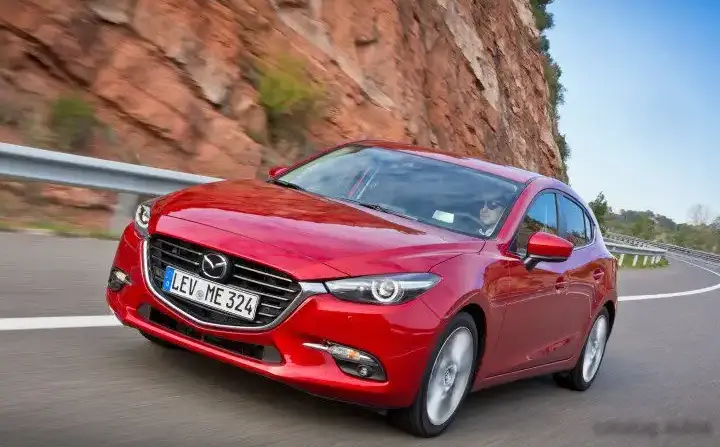
The Mazda 3 III Hatchback, specifically the facelift model introduced in 2017, represented a significant evolution of Mazda’s popular compact car. The 1.5 SkyActiv-D variant, producing 105 horsepower, was offered between 2017 and 2018. This model occupied a key position in the Mazda 3 lineup, aimed at buyers prioritizing fuel efficiency and lower running costs without sacrificing the brand’s renowned driving dynamics. It was positioned as an entry-level diesel option, slotting below the more powerful 2.2-liter SkyActiv-D engines and gasoline variants.
Technical Specifications
| Brand | Mazda |
| Model | 3 |
| Generation | 3 III Hatchback (BM, facelift 2017) |
| Type (Engine) | 1.5 SkyActiv-D (105 Hp) |
| Start of production | 2017 |
| End of production | 2018 |
| Powertrain Architecture | Internal Combustion engine |
| Body type | Hatchback |
| Seats | 5 |
| Doors | 5 |
| Fuel consumption (urban) | 4.3 l/100 km (54.7 US mpg, 65.7 UK mpg, 23.3 km/l) |
| Fuel consumption (extra urban) | 3.5 l/100 km (67.2 US mpg, 80.7 UK mpg, 28.6 km/l) |
| Fuel consumption (combined) | 3.8 l/100 km (61.9 US mpg, 74.3 UK mpg, 26.3 km/l) |
| CO2 emissions | 99 g/km |
| Fuel Type | Diesel |
| Acceleration 0 – 100 km/h | 11 sec |
| Acceleration 0 – 62 mph | 11 sec |
| Acceleration 0 – 60 mph | 10.5 sec |
| Maximum speed | 185 km/h (114.95 mph) |
| Emission standard | Euro 6 |
| Weight-to-power ratio | 12 kg/Hp, 83.3 Hp/tonne |
| Weight-to-torque ratio | 4.7 kg/Nm, 214.3 Nm/tonne |
| Power | 105 Hp @ 4000 rpm |
| Power per litre | 70 Hp/l |
| Torque | 270 Nm @ 1600-2500 rpm (199.14 lb.-ft. @ 1600-2500 rpm) |
| Engine layout | Front, Transverse |
| Engine Model/Code | S5-DPTS, S5-DPTR |
| Engine displacement | 1499 cm3 (91.47 cu. in.) |
| Number of cylinders | 4 |
| Engine configuration | Inline |
| Cylinder Bore | 76 mm (2.99 in.) |
| Piston Stroke | 82.6 mm (3.25 in.) |
| Compression ratio | 14.8:1 |
| Number of valves per cylinder | 4 |
| Fuel injection system | Diesel Commonrail |
| Engine aspiration | Turbocharger, Intercooler |
| Engine oil capacity | 5.1 l (5.39 US qt | 4.49 UK qt) |
| Coolant | 7 l (7.4 US qt | 6.16 UK qt) |
| Kerb Weight | 1260-1343 kg (2777.82 – 2960.81 lbs.) |
| Max. weight | 1870 kg (4122.64 lbs.) |
| Max load | 527-610 kg (1161.84 – 1344.82 lbs.) |
| Trunk (boot) space – minimum | 364 l (12.85 cu. ft.) |
| Trunk (boot) space – maximum | 1263 l (44.6 cu. ft.) |
| Fuel tank capacity | 51 l (13.47 US gal | 11.22 UK gal) |
| Max. roof load | 75 kg (165.35 lbs.) |
| Permitted trailer load with brakes (8%) | 1300 kg (2866.01 lbs.) |
| Permitted trailer load with brakes (12%) | 1300 kg (2866.01 lbs.) |
| Permitted trailer load without brakes | 600 kg (1322.77 lbs.) |
| Permitted towbar download | 75 kg (165.35 lbs.) |
| Length | 4470 mm (175.98 in.) |
| Width | 1795 mm (70.67 in.) |
| Width including mirrors | 2053 mm (80.83 in.) |
| Height | 1465 mm (57.68 in.) |
| Wheelbase | 2700 mm (106.3 in.) |
| Ride height (ground clearance) | 155 mm (6.1 in.) |
| Minimum turning circle | 10.6 m (34.78 ft.) |
| Drivetrain Architecture | The Internal combustion engine (ICE) drives the front wheels of the vehicle. |
| Drive wheel | Front wheel drive |
| Number of gears and type of gearbox | 6 gears, manual transmission |
| Front suspension | Independent, type McPherson with coil spring and anti-roll bar |
| Rear suspension | Independent multi-link suspension |
| Front brakes | Ventilated discs |
| Rear brakes | Disc |
| Assisting systems | ABS (Anti-lock braking system) |
| Steering type | Steering rack and pinion |
| Power steering | Electric Steering |
| Tires size | 205/60 R16; 215/45 R18 |
| Wheel rims size | 16; 18 |
INTRODUCTION
The Mazda 3 III, launched in 2014 and receiving a facelift in 2017, continued Mazda’s commitment to stylish design and engaging driving dynamics in the compact segment. The 1.5 SkyActiv-D 105 hp variant, introduced with the facelift, was specifically tailored for European markets and other regions prioritizing fuel economy and lower emissions. It utilized Mazda’s SkyActiv technology, a holistic approach to engine design focusing on efficiency and responsiveness. This particular engine and trim level aimed to provide a balance between affordability, practicality, and the Mazda brand’s signature driving experience.
Powertrain & Engine Architecture
The heart of this Mazda 3 is the S5-DPTS or S5-DPTR 1.5-liter four-cylinder diesel engine. This engine is a key component of Mazda’s SkyActiv-D technology, characterized by a very high compression ratio of 14.8:1. This is achieved through a unique combustion process and lightweight engine components. The engine utilizes a common-rail direct injection system, delivering fuel at extremely high pressure for optimized combustion. A small turbocharger with an intercooler further enhances performance and efficiency. The engine produces 105 horsepower at 4000 rpm and 270 Nm (199 lb-ft) of torque between 1600 and 2500 rpm. The engine is transversely mounted at the front of the vehicle. The 6-speed manual transmission was standard, designed to work in harmony with the engine’s torque curve, providing smooth and efficient gear changes.
Driving Characteristics
The 1.5 SkyActiv-D 105 hp variant offered a comfortable and refined driving experience, prioritizing fuel efficiency over outright performance. Acceleration from 0-60 mph took around 10.5 seconds, and top speed was limited to 115 mph. While not particularly quick, the engine provided ample torque for everyday driving situations, making it easy to navigate city streets and maintain comfortable cruising speeds on the highway. The 6-speed manual transmission allowed drivers to effectively utilize the engine’s torque band, and the gear ratios were well-matched for both fuel economy and responsiveness. Compared to the more powerful 2.2-liter SkyActiv-D models, this variant felt less urgent, but it offered a more relaxed and economical driving experience. The manual transmission also provided a more engaging driving experience than an automatic would have.
Equipment & Trim Levels
The 1.5 SkyActiv-D 105 hp model typically came equipped with a reasonable level of standard features. These included air conditioning, power windows, power mirrors, a basic audio system with USB connectivity, and alloy wheels. Safety features such as ABS, stability control, and multiple airbags were also standard. Higher trim levels offered additional features such as a touchscreen infotainment system, navigation, automatic climate control, and parking sensors. Interior upholstery was typically cloth, with options for upgraded materials on higher trims. The dashboard layout was clean and modern, with a focus on ergonomics and ease of use.
Chassis & Braking
The Mazda 3 III utilized a McPherson strut front suspension and a multi-link rear suspension, providing a good balance between ride comfort and handling precision. The suspension was tuned to deliver a responsive and engaging driving experience, while still absorbing bumps and imperfections in the road. Front brakes were ventilated discs, while rear brakes were solid discs. ABS (Anti-lock Braking System) was standard, enhancing braking performance and safety. The chassis was designed to be lightweight and rigid, contributing to the car’s overall handling characteristics. Stabilizer bars were fitted to both the front and rear axles to reduce body roll during cornering.
Market Reception & Comparison
The 1.5 SkyActiv-D 105 hp variant was generally well-received by automotive critics, who praised its fuel efficiency, refined engine, and engaging driving dynamics. It was seen as a practical and economical choice for buyers who prioritized fuel costs and low emissions. Compared to other diesel engines in the same class, the Mazda 3’s 1.5-liter engine offered a good balance between performance and efficiency. The 2.2-liter SkyActiv-D models offered more power but came at a higher price and with slightly lower fuel economy. Gasoline-powered Mazda 3 models provided a more responsive driving experience but typically consumed more fuel.
Legacy
The 1.5 SkyActiv-D engine proved to be a reliable and durable powertrain. While diesel engines, in general, have faced increased scrutiny regarding emissions, the SkyActiv-D technology was designed to minimize particulate matter and NOx emissions. On the used car market, these models are often sought after for their fuel efficiency and relatively low running costs. Proper maintenance, including regular oil changes and filter replacements, is crucial for ensuring the long-term reliability of this engine. The Mazda 3 III, in general, has established a reputation for reliability and build quality, making it a popular choice among used car buyers.