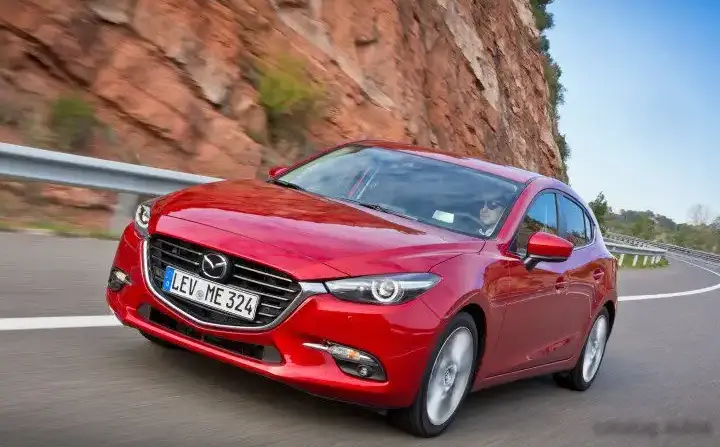
The Mazda 3 III Hatchback, specifically the facelifted version introduced in 2017, represented a significant evolution of Mazda’s compact offering. The 2.0 SkyActiv-G variant, producing 155 horsepower, was a key component of the lineup, primarily sold during the 2018 model year. This model sat within the broader BM series, utilizing the company’s SkyActiv technology suite aimed at improving fuel efficiency and driving dynamics. It was positioned as a mid-range option, offering a balance between performance and affordability within the Mazda 3 range.
Technical Specifications
| Brand | Mazda |
| Model | 3 |
| Generation | 3 III Hatchback (BM, facelift 2017) |
| Type (Engine) | 2.0 SkyActiv-G (155 Hp) |
| Start of production | 2018 |
| End of production | 2018 |
| Powertrain Architecture | Internal Combustion engine |
| Body type | Hatchback |
| Seats | 5 |
| Doors | 5 |
| Fuel consumption (urban) | 8.7 l/100 km (27 US mpg, 32.5 UK mpg, 11.5 km/l) |
| Fuel consumption (extra urban) | 6.4 l/100 km (36.8 US mpg, 44.1 UK mpg, 15.6 km/l) |
| Fuel consumption (combined) | 7.6 l/100 km (30.9 US mpg, 37.2 UK mpg, 13.2 km/l) |
| Fuel Type | Petrol (Gasoline) |
| Weight-to-power ratio | 8.4 kg/Hp, 118.9 Hp/tonne |
| Weight-to-torque ratio | 6.4 kg/Nm, 155.7 Nm/tonne |
| Power | 155 Hp @ 6000 rpm |
| Power per litre | 77.6 Hp/l |
| Torque | 203 Nm @ 4000 rpm (149.73 lb.-ft. @ 4000 rpm) |
| Maximum engine speed | 6800 rpm |
| Engine layout | Front, Transverse |
| Engine Model/Code | PE-VPS |
| Engine displacement | 1998 cm3 (121.93 cu. in.) |
| Number of cylinders | 4 |
| Engine configuration | Inline |
| Cylinder Bore | 83.5 mm (3.29 in.) |
| Piston Stroke | 91.2 mm (3.59 in.) |
| Compression ratio | 13:1 |
| Number of valves per cylinder | 4 |
| Fuel injection system | Direct injection |
| Engine aspiration | Naturally aspirated engine |
| Valvetrain | DOHC-VVT |
| Engine oil capacity | 4.2 l (4.44 US qt | 3.7 UK qt) |
| Coolant | 6.2 l (6.55 US qt | 5.46 UK qt) |
| Kerb Weight | 1304 kg (2874.83 lbs.) |
| Trunk (boot) space – minimum | 572 l (20.2 cu. ft.) |
| Trunk (boot) space – maximum | 1334 l (47.11 cu. ft.) |
| Fuel tank capacity | 50 l (13.21 US gal | 11 UK gal) |
| Length | 4460 mm (175.59 in.) |
| Width | 1796 mm (70.71 in.) |
| Height | 1455 mm (57.28 in.) |
| Wheelbase | 2700 mm (106.3 in.) |
| Front track | 1554 mm (61.18 in.) |
| Rear (Back) track | 1560 mm (61.42 in.) |
| Ride height (ground clearance) | 155 mm (6.1 in.) |
| Minimum turning circle (turning diameter) | 10.6 m (34.78 ft.) |
| Drivetrain Architecture | The Internal combustion engine (ICE) drives the front wheels of the vehicle. |
| Drive wheel | Front wheel drive |
| Number of gears and type of gearbox | 6 gears, manual transmission |
| Front suspension | Independent, type McPherson with coil spring and anti-roll bar |
| Rear suspension | Independent multi-link spring suspension with stabilizer |
| Front brakes | Ventilated discs |
| Rear brakes | Disc |
| Assisting systems | ABS (Anti-lock braking system) |
| Steering type | Steering rack and pinion |
| Power steering | Electric Steering |
| Tires size | 205/60 R16 |
| Wheel rims size | 6.5J x 16 |
Powertrain & Engine Architecture
The heart of this Mazda 3 variant is the PE-VPS 2.0-liter SkyActiv-G inline-four cylinder engine. This engine is a cornerstone of Mazda’s efficiency-focused SkyActiv technology. It boasts a high compression ratio of 13:1, achieved through careful engineering and optimized combustion chamber design. This high compression, combined with direct fuel injection, contributes to improved thermal efficiency and power output. The engine utilizes a double overhead camshaft (DOHC) valvetrain with variable valve timing (VVT) on both intake and exhaust camshafts, further optimizing performance across the rev range. The 6-speed manual transmission was standard, providing drivers with a direct connection to the engine and allowing for precise control. The transmission’s gear ratios were tuned to balance acceleration and fuel economy, prioritizing responsiveness in typical driving situations.
Driving Characteristics
The 155 hp and 149.73 lb-ft of torque delivered by the 2.0-liter SkyActiv-G engine, coupled with the 6-speed manual transmission, provided a reasonably engaging driving experience. While not overtly sporty, the engine offered sufficient power for everyday driving and highway cruising. Acceleration was adequate, though noticeably slower than the higher-output variants. The manual transmission’s precise shift action and well-chosen gear ratios enhanced the driving experience, allowing drivers to extract the most from the engine’s powerband. Compared to the more powerful 2.5-liter engine option, this variant prioritized fuel efficiency over outright performance. The lower power output also resulted in a slightly lighter front end, contributing to more balanced handling characteristics.
Equipment & Trim Levels
The 2.0 SkyActiv-G variant typically came equipped with a solid set of standard features. These generally included power windows and locks, air conditioning, a basic infotainment system with Bluetooth connectivity, and a rearview camera. Interior upholstery was typically cloth, with a focus on durability and comfort. Higher trim levels offered options such as leather upholstery, a premium sound system, a sunroof, and advanced safety features like blind-spot monitoring and lane departure warning. The specific trim level determined the availability of these optional extras.
Chassis & Braking
The Mazda 3 III Hatchback utilized a McPherson strut front suspension and a multi-link rear suspension, providing a comfortable and controlled ride. The suspension was tuned to balance handling and ride quality, offering a good compromise for everyday driving. Front brakes were ventilated discs, providing ample stopping power, while rear brakes were solid discs. The inclusion of ABS (Anti-lock Braking System) was standard, enhancing safety in emergency braking situations. Stabilizer bars were fitted to both the front and rear suspension, reducing body roll during cornering.
Market Reception & Comparison
The 2.0 SkyActiv-G variant of the Mazda 3 was generally well-received by automotive critics. It was praised for its fuel efficiency, comfortable ride, and engaging driving dynamics. However, some reviewers noted that the engine’s performance was adequate but not exceptional, particularly when compared to the more powerful 2.5-liter option. Fuel economy figures of around 30.9 US mpg combined were competitive within the compact hatchback segment. Reliability was generally considered good, with the SkyActiv engine proving to be durable and long-lasting. Compared to diesel variants, this gasoline engine offered a smoother and quieter driving experience, but typically at the expense of fuel economy.
Legacy
The 2.0 SkyActiv-G engine has proven to be a reliable and durable powertrain. In the used car market, these Mazda 3 models are generally sought after for their fuel efficiency, practicality, and overall build quality. Maintenance costs are typically reasonable, and parts availability is good. While not the most powerful option in the Mazda 3 lineup, the 2.0-liter engine provides a good balance of performance, efficiency, and reliability, making it a popular choice for drivers seeking a well-rounded compact hatchback.