Technical Specifications
| Brand | Mazda |
| Model | 3 |
| Generation | 3 III Hatchback (BM, facelift 2017) |
| Type (Engine) | 2.0 SkyActiv-G (155 Hp) Skyactiv-Drive |
| Start of production | 2018 |
| End of production | 2018 |
| Powertrain Architecture | Internal Combustion engine |
| Body type | Hatchback |
| Seats | 5 |
| Doors | 5 |
| Fuel consumption (urban) | 8.4 l/100 km (28 US mpg, 33.6 UK mpg, 11.9 km/l) |
| Fuel consumption (extra urban) | 6.4 l/100 km (36.8 US mpg, 44.1 UK mpg, 15.6 km/l) |
| Fuel consumption (combined) | 7.4 l/100 km (31.8 US mpg, 38.2 UK mpg, 13.5 km/l) |
| Fuel Type | Petrol (Gasoline) |
| Weight-to-power ratio | 8.6 kg/Hp, 116.2 Hp/tonne |
| Weight-to-torque ratio | 6.6 kg/Nm, 152.2 Nm/tonne |
| Power | 155 Hp @ 6000 rpm |
| Power per litre | 77.6 Hp/l |
| Torque | 203 Nm @ 4000 rpm (149.73 lb.-ft. @ 4000 rpm) |
| Maximum engine speed | 6800 rpm |
| Engine layout | Front, Transverse |
| Engine Model/Code | PE-VPS |
| Engine displacement | 1998 cm3 (121.93 cu. in.) |
| Number of cylinders | 4 |
| Engine configuration | Inline |
| Cylinder Bore | 83.5 mm (3.29 in.) |
| Piston Stroke | 91.2 mm (3.59 in.) |
| Compression ratio | 13:1 |
| Number of valves per cylinder | 4 |
| Fuel injection system | Direct injection |
| Engine aspiration | Naturally aspirated engine |
| Valvetrain | DOHC-VVT |
| Engine oil capacity | 4.2 l (4.44 US qt | 3.7 UK qt) |
| Coolant | 6.3 l (6.66 US qt | 5.54 UK qt) |
| Kerb Weight | 1334 kg (2940.97 lbs.) |
| Trunk (boot) space – minimum | 572 l (20.2 cu. ft.) |
| Trunk (boot) space – maximum | 1334 l (47.11 cu. ft.) |
| Fuel tank capacity | 50 l (13.21 US gal | 11 UK gal) |
| Length | 4460 mm (175.59 in.) |
| Width | 1796 mm (70.71 in.) |
| Height | 1455 mm (57.28 in.) |
| Wheelbase | 2700 mm (106.3 in.) |
| Front track | 1554 mm (61.18 in.) |
| Rear (Back) track | 1560 mm (61.42 in.) |
| Ride height (ground clearance) | 155 mm (6.1 in.) |
| Minimum turning circle (turning diameter) | 10.6 m (34.78 ft.) |
| Drivetrain Architecture | The Internal combustion engine (ICE) drives the front wheels of the vehicle. |
| Drive wheel | Front wheel drive |
| Number of gears and type of gearbox | 6 gears, automatic transmission |
| Front suspension | Independent, type McPherson with coil spring and anti-roll bar |
| Rear suspension | Independent multi-link spring suspension with stabilizer |
| Front brakes | Ventilated discs |
| Rear brakes | Disc |
| Assisting systems | ABS (Anti-lock braking system) |
| Steering type | Steering rack and pinion |
| Power steering | Electric Steering |
| Tires size | 205/60 R16 |
| Wheel rims size | 6.5J x 16 |
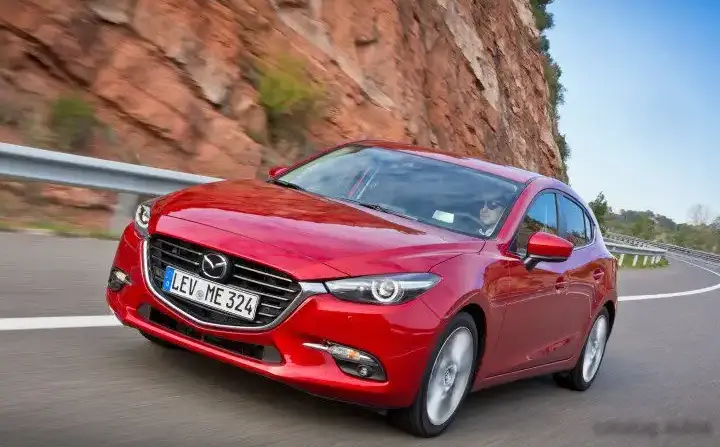
The Mazda 3 III Hatchback, specifically the facelift model released in 2017, represented a significant evolution of Mazda’s popular compact car. The 2.0 SkyActiv-G (155 Hp) variant paired with the SkyActiv-Drive automatic transmission, produced from 2018, occupied a middle ground within the third-generation (BM) lineup. This configuration aimed to balance fuel efficiency with adequate performance, appealing to buyers seeking a comfortable and practical daily driver. It was positioned above the base 2.0-liter manual models and below the more performance-oriented options, offering a refined driving experience without the higher price tag of the top-tier trims.
Powertrain & Engine Architecture
At the heart of this Mazda 3 variant lies the PE-VPS 2.0-liter SkyActiv-G inline-four engine. This engine is a cornerstone of Mazda’s SkyActiv technology, designed to maximize combustion efficiency. Key features include a high compression ratio of 13:1, achieved through careful engine design and precise fuel injection. The engine utilizes direct injection, delivering fuel directly into the combustion chamber for improved fuel atomization and more complete combustion. The valvetrain employs a Dual Overhead Camshaft (DOHC) configuration with Variable Valve Timing (VVT) on both intake and exhaust valves, optimizing engine performance across the rev range. The SkyActiv-Drive automatic transmission is a six-speed unit with a torque converter. Unlike traditional automatic transmissions, the SkyActiv-Drive prioritizes quick, smooth shifts and a more direct driving feel. It achieves this through a combination of optimized shift logic and a wider range of gear ratios.
Driving Characteristics
The 155 hp and 203 Nm (149.73 lb-ft) of torque produced by the 2.0-liter engine, when paired with the SkyActiv-Drive automatic, provided a comfortable and predictable driving experience. Acceleration was adequate for everyday driving, but not particularly sporty. The automatic transmission’s shift points were generally well-tuned for fuel efficiency, but could sometimes feel hesitant during quick acceleration maneuvers. Compared to the manual transmission version of the same engine, the automatic offered less driver engagement but greater convenience. It also lagged behind the more powerful 2.5-liter engine options in terms of outright performance. The gear ratios were optimized for cruising, making it a pleasant vehicle for highway driving.
Equipment & Trim Levels
The 2.0 SkyActiv-G with SkyActiv-Drive typically came standard with a respectable level of equipment. This included air conditioning, power windows and locks, a basic infotainment system with a touchscreen display, and Bluetooth connectivity. Safety features such as ABS, stability control, and multiple airbags were also standard. Higher trim levels offered options like leather upholstery, a premium sound system, a sunroof, and advanced driver-assistance systems such as blind-spot monitoring and lane departure warning. Interior upholstery was typically cloth, with optional leather available. The dashboard layout was clean and functional, with a focus on ergonomics.
Chassis & Braking
The Mazda 3’s chassis was designed to provide a balance of comfort and handling. The front suspension utilized an independent McPherson strut setup, while the rear employed an independent multi-link system. This configuration helped to minimize body roll and provide a stable ride. The braking system consisted of ventilated discs at the front and solid discs at the rear. ABS (Anti-lock Braking System) was standard, enhancing braking performance and safety. The suspension tuning was generally geared towards comfort, but still provided a reasonably engaging driving experience.
Market Reception & Comparison
The 2.0 SkyActiv-G with SkyActiv-Drive was generally well-received by critics as a practical and fuel-efficient option. It offered a good balance of features and performance for the price. However, some reviewers noted that the automatic transmission could feel sluggish at times, and that the engine lacked the punch of the more powerful options. Fuel economy was a strong point, with combined figures around 31.8 US mpg. Reliability was generally good, consistent with Mazda’s reputation for building durable vehicles. Compared to the manual transmission version, the automatic offered slightly lower fuel economy but greater convenience. It also positioned itself as a more accessible option than the higher-performance trims.
Legacy
The PE-VPS engine and SkyActiv-Drive transmission have proven to be relatively reliable powertrains. While not without their occasional issues (such as potential carbon buildup with infrequent oil changes), they generally hold up well over time. In the used car market, this variant of the Mazda 3 represents a good value proposition, offering a comfortable and fuel-efficient driving experience at an affordable price. Its reputation for reliability and Mazda’s overall build quality contribute to its continued desirability among used car buyers.