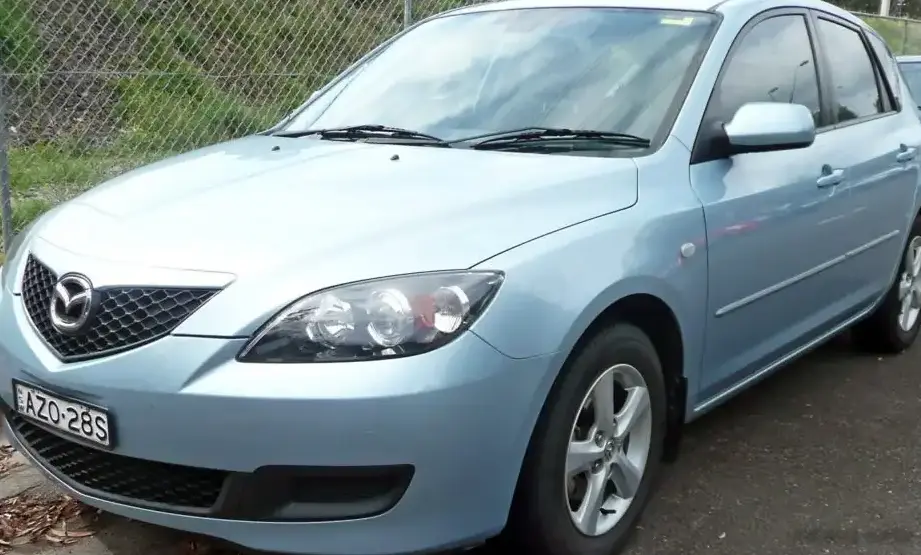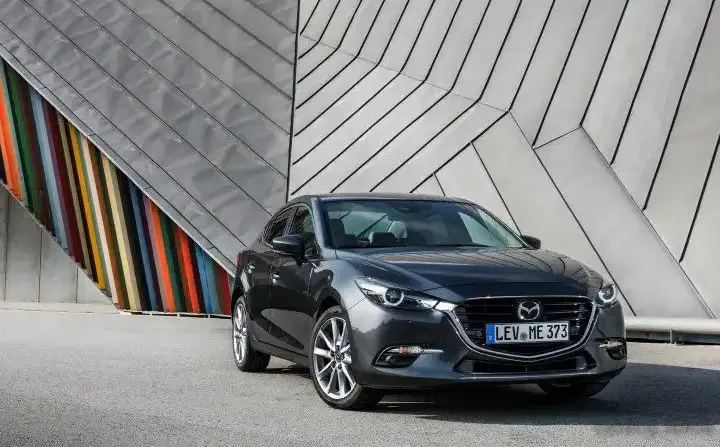
The Mazda 3 III Sedan, specifically the facelifted version produced from 2017 to 2018, represented a significant evolution of Mazda’s compact offering. Within the BM generation, the 2.0 SkyActiv-G variant producing 120 horsepower was positioned as a mainstream, fuel-efficient option, appealing to buyers prioritizing practicality and reasonable performance over outright speed. This model year saw Mazda refine the already successful third generation, focusing on interior enhancements and subtle exterior styling updates. The 2.0L engine, paired with a six-speed automatic transmission, aimed to deliver a balance of responsiveness and economy for everyday driving.
Technical Specifications
| Brand | Mazda |
| Model | 3 |
| Generation | 3 III Sedan (BM, facelift 2017) |
| Type (Engine) | 2.0 SkyActiv-G (120 Hp) |
| Start of production | 2017 |
| End of production | 2018 |
| Powertrain Architecture | Internal Combustion engine |
| Body type | Sedan |
| Seats | 5 |
| Doors | 4 |
| Fuel consumption (urban) | 6.5 l/100 km (36.2 US mpg, 43.5 UK mpg, 15.4 km/l) |
| Fuel consumption (extra urban) | 4.3 l/100 km (54.7 US mpg, 65.7 UK mpg, 23.3 km/l) |
| Fuel consumption (combined) | 5.1 l/100 km (46.1 US mpg, 55.4 UK mpg, 19.6 km/l) |
| CO2 emissions | 119 g/km |
| Fuel Type | Petrol (Gasoline) |
| Acceleration 0 – 100 km/h | 8.8 sec |
| Acceleration 0 – 62 mph | 8.8 sec |
| Acceleration 0 – 60 mph | 8.4 sec |
| Maximum speed | 198 km/h (123.03 mph) |
| Emission standard | Euro 6 |
| Weight-to-power ratio | 10 kg/Hp, 99.6 Hp/tonne |
| Weight-to-torque ratio | 5.7 kg/Nm, 174.3 Nm/tonne |
| Power | 120 Hp @ 6000 rpm |
| Power per litre | 60.1 Hp/l |
| Torque | 210 Nm @ 4000 rpm (154.89 lb.-ft. @ 4000 rpm) |
| Engine layout | Front, Transverse |
| Engine displacement | 1998 cm3 (121.93 cu. in.) |
| Number of cylinders | 4 |
| Engine configuration | Inline |
| Cylinder Bore | 83.5 mm (3.29 in.) |
| Piston Stroke | 91.2 mm (3.59 in.) |
| Compression ratio | 14:1 |
| Number of valves per cylinder | 4 |
| Fuel injection system | Direct injection |
| Engine aspiration | Naturally aspirated engine |
| Engine oil capacity | 4.2 l (4.44 US qt | 3.7 UK qt) |
| Coolant | 6.2 l (6.55 US qt | 5.46 UK qt) |
| Kerb Weight | 1205-1289 kg (2656.57 – 2841.76 lbs.) |
| Max. weight | 1815 kg (4001.39 lbs.) |
| Max load | 526-610 kg (1159.63 – 1344.82 lbs.) |
| Trunk (boot) space – minimum | 419 l (14.8 cu. ft.) |
| Fuel tank capacity | 51 l (13.47 US gal | 11.22 UK gal) |
| Max. roof load | 75 kg (165.35 lbs.) |
| Permitted trailer load with brakes (8%) | 1600 kg (3527.4 lbs.) |
| Permitted trailer load with brakes (12%) | 1300 kg (2866.01 lbs.) |
| Permitted trailer load without brakes | 600 kg (1322.77 lbs.) |
| Permitted towbar download | 75 kg (165.35 lbs.) |
| Length | 4580 mm (180.31 in.) |
| Width | 1795 mm (70.67 in.) |
| Width including mirrors | 2053 mm (80.83 in.) |
| Height | 1450 mm (57.09 in.) |
| Wheelbase | 2700 mm (106.3 in.) |
| Ride height (ground clearance) | 155 mm (6.1 in.) |
| Minimum turning circle | 10.6 m (34.78 ft.) |
| Drivetrain Architecture | The Internal combustion engine (ICE) drives the front wheels of the vehicle. |
| Drive wheel | Front wheel drive |
| Number of gears and type of gearbox | 6 gears, automatic transmission |
| Front suspension | Independent, type McPherson with coil spring and anti-roll bar |
| Rear suspension | Independent multi-link suspension |
| Front brakes | Ventilated discs |
| Rear brakes | Disc |
| Assisting systems | ABS (Anti-lock braking system) |
| Steering type | Steering rack and pinion |
| Power steering | Electric Steering |
| Tires size | 205/60 R16; 215/45 R18 |
| Wheel rims size | 16; 18 |
Powertrain & Engine Architecture
At the heart of this Mazda 3 variant lies the 1.998-liter (2.0L) SkyActiv-G four-cylinder engine. This engine is a key component of Mazda’s SkyActiv technology suite, designed to maximize efficiency without sacrificing driving enjoyment. The SkyActiv-G engine features a high compression ratio of 14:1, achieved through advanced combustion control and precise fuel injection. This engine utilizes direct injection, injecting fuel directly into the combustion chamber for improved fuel atomization and more complete combustion. The engine’s valvetrain employs dual overhead camshafts (DOHC) and four valves per cylinder, optimizing airflow for increased power output. The engine is transversely mounted in the front of the vehicle. Paired with this engine is a six-speed automatic transmission, offering smooth and responsive gear changes. This transmission was specifically tuned to complement the engine’s characteristics, providing a balance between fuel economy and performance.
Driving Characteristics
The 120 horsepower and 210 Nm (154.89 lb-ft) of torque delivered by the 2.0L SkyActiv-G engine, when coupled with the six-speed automatic, resulted in a comfortable and predictable driving experience. Acceleration from 0 to 60 mph took approximately 8.4 seconds, and 0-100 km/h in 8.8 seconds, making it suitable for daily commuting and highway cruising. While not a performance-oriented setup, the engine provided adequate power for overtaking maneuvers. The automatic transmission’s gear ratios were optimized for fuel efficiency, with taller gearing in higher gears to reduce engine speed at cruising speeds. Compared to the more powerful 2.5L engine option, this variant offered a more relaxed driving experience, prioritizing fuel economy over outright acceleration. The automatic transmission, while convenient, did result in a slight reduction in responsiveness compared to the available manual transmission.
Equipment & Trim Levels
The 2.0L SkyActiv-G automatic trim typically included standard features such as air conditioning, power windows and locks, a basic audio system with USB connectivity, and stability control. Interior upholstery was generally cloth, with options for upgraded materials available. Higher trim levels within the 2.0L range could add features like alloy wheels, a touchscreen infotainment system, and a rearview camera. Optional extras included a sunroof, leather upholstery, and advanced safety features like blind-spot monitoring and lane departure warning. The dashboard layout was functional and driver-focused, with a clear instrument cluster and intuitive controls.
Chassis & Braking
The Mazda 3 III Sedan featured an independent suspension system, with a McPherson strut setup at the front and a multi-link suspension at the rear. This configuration provided a good balance between ride comfort and handling precision. The chassis was designed to be lightweight yet rigid, contributing to the car’s overall agility. Braking duties were handled by ventilated discs at the front and solid discs at the rear, providing adequate stopping power for everyday driving. Anti-lock braking system (ABS) was standard, enhancing safety and control during emergency braking situations.
Market Reception & Comparison
The 2.0L SkyActiv-G automatic variant of the Mazda 3 III Sedan was generally well-received by critics for its fuel efficiency and comfortable ride. It was often praised for its refined engine and smooth-shifting transmission. However, some reviewers noted that the engine lacked the punch of the more powerful options. Compared to competitors like the Honda Civic and Toyota Corolla, the Mazda 3 offered a more engaging driving experience and a more stylish interior. Fuel economy figures of around 46.1 US mpg combined were competitive within its class. Reliability was generally good, with the SkyActiv engine proving to be durable and long-lasting.
Legacy
The 2.0L SkyActiv-G engine, in both manual and automatic configurations, has proven to be a reliable and fuel-efficient powertrain. In the used car market, these models are often sought after for their practicality and affordability. While not the most exciting variant of the Mazda 3, the 120 hp automatic offers a compelling combination of value, efficiency, and driving comfort. Regular maintenance, including timely oil changes and fluid checks, is crucial for ensuring the long-term reliability of this powertrain. The SkyActiv technology introduced with this generation of Mazda 3 helped establish the brand as a leader in fuel efficiency and driving dynamics.