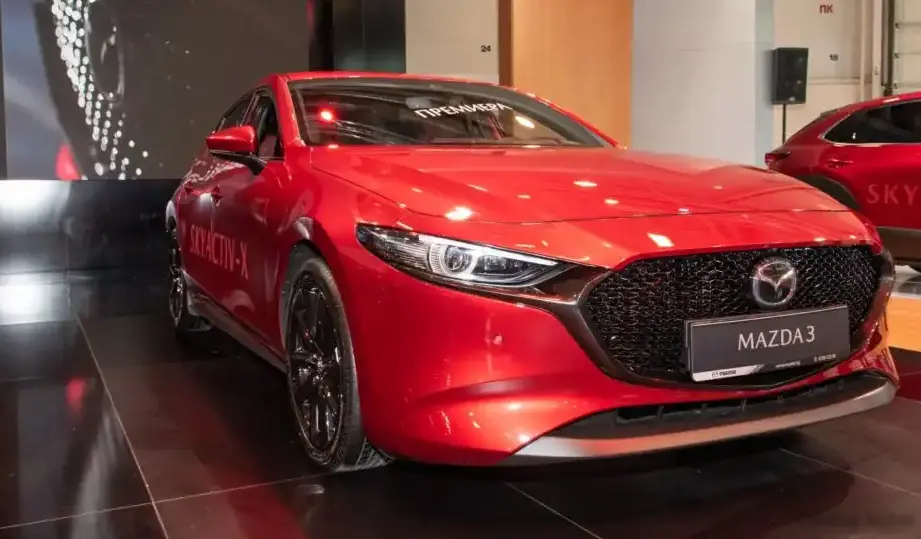
The Mazda 3 IV Hatchback 2.0 e-SkyActiv-G (122 Hp) represents a significant iteration in Mazda’s long-running compact car lineage. Introduced in 2021 as part of the fourth generation (BP) Mazda 3, this variant was produced through June 2024. It occupies a central position within the lineup, offering a balance between fuel efficiency, performance, and affordability. Built on the 1HX0 platform, the 2.0 e-SkyActiv-G model aimed to deliver Mazda’s signature driving dynamics with a focus on modern powertrain technology, specifically incorporating mild-hybrid electrification. This model was primarily marketed in Europe and other global markets, with a focus on appealing to drivers seeking a refined and economical daily driver.
Technical Specifications
| Brand | Mazda |
| Model | 3 |
| Generation | IV Hatchback |
| Type (Engine) | 2.0 e-SkyActiv-G (122 Hp) |
| Start of production | 2021 |
| End of production | June, 2024 |
| Powertrain Architecture | MHEV (Mild Hybrid Electric Vehicle) |
| Body type | Hatchback |
| Seats | 5 |
| Doors | 5 |
| Fuel consumption at Low speed (WLTP) | 7.2-7.3 l/100 km (32.7 – 32.2 US mpg) |
| Fuel consumption at Medium speed (WLTP) | 5.4-5.5 l/100 km (43.6 – 42.8 US mpg) |
| Fuel consumption at high speed (WLTP) | 4.7-4.8 l/100 km (50 – 49 US mpg) |
| Fuel consumption at very high speed (WLTP) | 5.6-5.8 l/100 km (42 – 40.6 US mpg) |
| Combined fuel consumption (WLTP) | 5.5-5.6 l/100 km (42.8 – 42 US mpg) |
| CO2 emissions (WLTP) | 124-127 g/km |
| Fuel consumption (economy) – urban | 6.1-6.2 l/100 km (38.6 – 37.9 US mpg) |
| Fuel consumption (economy) – extra urban | 4.3-4.5 l/100 km (54.7 – 52.3 US mpg) |
| Fuel consumption (economy) – combined | 5-5.1 l/100 km (47 – 46.1 US mpg) |
| CO2 emissions | 111-115 g/km |
| Fuel Type | Petrol (Gasoline) |
| Acceleration 0 – 100 km/h | 10.4 sec |
| Acceleration 0 – 62 mph | 10.4 sec |
| Acceleration 0 – 60 mph | 9.9 sec |
| Maximum speed | 197 km/h (122.41 mph) |
| Emission standard | Euro 6d-ISC-FCM |
| Weight-to-power ratio | 10.4 kg/Hp |
| Weight-to-torque ratio | 6 kg/Nm |
| Power | 122 Hp @ 6000 rpm |
| Torque | 213 Nm @ 4000 rpm (157.1 lb.-ft. @ 4000 rpm) |
| Engine layout | Front, Transverse |
| Engine displacement | 1998 cm3 (121.93 cu. in.) |
| Number of cylinders | 4 |
| Engine configuration | Inline |
| Cylinder Bore | 83.5 mm (3.29 in.) |
| Piston Stroke | 91.2 mm (3.59 in.) |
| Compression ratio | 13:1 |
| Number of valves per cylinder | 4 |
| Fuel injection system | Direct injection |
| Engine aspiration | Naturally aspirated engine |
| Kerb Weight | 1274-1364 kg (2808.69 – 3007.11 lbs.) |
| Max. weight | 1875 kg (4133.67 lbs.) |
| Max load | 511-601 kg (1126.56 – 1324.98 lbs.) |
| Trunk (boot) space – minimum | 351 l (12.4 cu. ft.) |
| Trunk (boot) space – maximum | 1026 l (36.23 cu. ft.) |
| Fuel tank capacity | 51 l (13.47 US gal | 11.22 UK gal) |
| Max. roof load | 75 kg (165.35 lbs.) |
| Permitted trailer load with brakes (8%) | 1300 kg (2866.01 lbs.) |
| Permitted trailer load with brakes (12%) | 1300 kg (2866.01 lbs.) |
| Permitted trailer load without brakes | 600 kg (1322.77 lbs.) |
| Permitted towbar download | 75 kg (165.35 lbs.) |
| Length | 4460 mm (175.59 in.) |
| Width | 1795 mm (70.67 in.) |
| Width including mirrors | 2028 mm (79.84 in.) |
| Height | 1435 mm (56.5 in.) |
| Wheelbase | 2725 mm (107.28 in.) |
| Ride height (ground clearance) | 135 mm (5.31 in.) |
| Minimum turning circle | 10.6 m (34.78 ft.) |
| Drivetrain Architecture | ICE to Front Wheels |
| Drive wheel | Front wheel drive |
| Number of gears and type of gearbox | 6 gears, manual transmission |
| Front suspension | Independent type McPherson |
| Rear suspension | Torsion |
| Front brakes | Disc |
| Rear brakes | Disc |
| Assisting systems | ABS (Anti-lock braking system) |
| Steering type | Steering rack and pinion |
| Power steering | Electric Steering |
| Tires size | 205/60 R16; 215/45 R18 |
| Wheel rims size | 16; 18 |
Powertrain & Engine Architecture
At the heart of the Mazda 3 2.0 e-SkyActiv-G lies the PE-VPH engine, a 1998cc inline-four cylinder gasoline engine. This engine is a key component of Mazda’s SkyActiv technology, designed for high compression (13:1) and improved thermal efficiency. The engine utilizes direct injection, optimizing fuel delivery and combustion. The ‘e-SkyActiv-G’ designation indicates the inclusion of a 24V mild-hybrid system. This system employs a small electric motor and battery to provide a power assist during acceleration and enable smoother start-stop functionality, contributing to improved fuel economy. The engine’s valvetrain features dual overhead camshafts (DOHC) and four valves per cylinder, enhancing breathing and overall performance. The engine is transversely mounted, driving the front wheels. The transmission is a six-speed manual gearbox, chosen for its driver engagement and efficiency.
Driving Characteristics
The 122 hp output, coupled with 213 Nm (157 lb-ft) of torque, provides adequate performance for everyday driving. Acceleration from 0-60 mph takes approximately 9.9 seconds, and the car reaches a top speed of 197 km/h (122.41 mph). While not a performance-oriented variant, the 2.0 e-SkyActiv-G offers a responsive driving experience, particularly in the mid-range. The six-speed manual transmission allows for precise gear selection, and the engine’s torque curve provides sufficient pull for overtaking maneuvers. Compared to higher-output versions of the Mazda 3, such as those with more powerful engines, this variant prioritizes fuel efficiency and a more relaxed driving style. The mild-hybrid system provides a subtle boost during acceleration, enhancing responsiveness without significantly altering the driving character.
Equipment & Trim Levels
The 2.0 e-SkyActiv-G typically came equipped with a solid base level of features. Standard equipment often included air conditioning, a touchscreen infotainment system with Apple CarPlay and Android Auto integration, Bluetooth connectivity, and a suite of safety features such as lane departure warning, lane-keep assist, and automatic emergency braking. Interior upholstery was typically cloth, with options for upgraded materials available. Higher trim levels offered additional features such as a sunroof, leather seats, a premium sound system, and adaptive cruise control. The dashboard configuration was consistent across the range, featuring a modern and minimalist design.
Chassis & Braking
The Mazda 3 IV Hatchback utilizes an independent McPherson strut suspension setup at the front and a torsion beam suspension at the rear. This configuration provides a good balance between ride comfort and handling precision. The chassis is relatively lightweight, contributing to the car’s agility. Braking duties are handled by disc brakes on all four wheels, providing ample stopping power. Anti-lock Braking System (ABS) and Electronic Brakeforce Distribution (EBD) are standard features, enhancing safety and control. Stabilizer bars are fitted to both the front and rear axles, reducing body roll during cornering.
Market Reception & Comparison
The Mazda 3 2.0 e-SkyActiv-G was generally well-received by automotive critics. It was praised for its fuel efficiency, comfortable ride, and engaging driving dynamics. However, some reviewers noted that the 122 hp output could feel somewhat underpowered, particularly when fully loaded or driving on steep inclines. Compared to the diesel variants, the 2.0 e-SkyActiv-G offered lower running costs in terms of fuel, but potentially higher maintenance costs due to the complexity of the gasoline direct injection system. Against competitors like the Volkswagen Golf and Ford Focus, the Mazda 3 distinguished itself with its stylish design, refined interior, and focus on driver engagement.
Legacy
The Mazda 3 2.0 e-SkyActiv-G has proven to be a reliable and durable powertrain. The SkyActiv engine technology has a good reputation for longevity, and the mild-hybrid system has not been associated with widespread issues. In the used car market, this variant represents a good value proposition, offering a well-equipped and fuel-efficient compact hatchback. Maintenance costs are generally reasonable, although regular servicing is essential to ensure optimal performance and reliability. The combination of Mazda’s engineering expertise and the benefits of mild-hybrid technology have cemented the 2.0 e-SkyActiv-G’s position as a popular and dependable choice for drivers seeking a practical and enjoyable daily commuter.