Technical Specifications
| Brand | Mazda |
| Model | 3 |
| Generation | IV Hatchback |
| Type (Engine) | 2.0 e-SkyActiv-G (122 Hp) Skyactiv-Drive |
| Start of production | 2021 |
| End of production | June, 2024 |
| Powertrain Architecture | MHEV (Mild Hybrid Electric Vehicle) |
| Body type | Hatchback |
| Seats | 5 |
| Doors | 5 |
| Fuel consumption at Low speed (WLTP) | 8.2-8.3 l/100 km (28.7 – 28.3 US mpg) |
| Fuel consumption at Medium speed (WLTP) | 5.8-5.9 l/100 km (40.6 – 39.9 US mpg) |
| Fuel consumption at high speed (WLTP) | 5.2-5.3 l/100 km (45.2 – 44.4 US mpg) |
| Fuel consumption at very high speed (WLTP) | 6.2-6.3 l/100 km (37.9 – 37.3 US mpg) |
| Combined fuel consumption (WLTP) | 6.1-6.2 l/100 km (38.6 – 37.9 US mpg) |
| CO2 emissions (WLTP) | 138-141 g/km |
| Fuel consumption (economy) – urban | 6.8-6.9 l/100 km (34.6 – 34.1 US mpg) |
| Fuel consumption (economy) – extra urban | 4.7-4.9 l/100 km (50 – 48 US mpg) |
| Fuel consumption (economy) – combined | 5.4-5.6 l/100 km (43.6 – 42 US mpg) |
| CO2 emissions | 122-127 g/km |
| Fuel Type | Petrol (Gasoline) |
| Acceleration 0 – 100 km/h | 10.8 sec |
| Acceleration 0 – 62 mph | 10.8 sec |
| Acceleration 0 – 60 mph | 10.3 sec |
| Maximum speed | 197 km/h (122.41 mph) |
| Emission standard | Euro 6d-ISC-FCM |
| Weight-to-power ratio | 10.6 kg/Hp |
| Weight-to-torque ratio | 6.1 kg/Nm |
| Power | 122 Hp @ 6000 rpm |
| Torque | 213 Nm @ 4000 rpm (157.1 lb.-ft. @ 4000 rpm) |
| Engine layout | Front, Transverse |
| Engine displacement | 1998 cm3 (121.93 cu. in.) |
| Number of cylinders | 4 |
| Engine configuration | Inline |
| Cylinder Bore | 83.5 mm (3.29 in.) |
| Piston Stroke | 91.2 mm (3.59 in.) |
| Compression ratio | 13:1 |
| Number of valves per cylinder | 4 |
| Fuel injection system | Direct injection |
| Engine aspiration | Naturally aspirated |
| Kerb Weight | 1299-1389 kg (2863.8 – 3062.22 lbs.) |
| Max. weight | 1907 kg (4204.22 lbs.) |
| Max load | 518-608 kg (1141.99 – 1340.41 lbs.) |
| Trunk (boot) space – minimum | 351 l (12.4 cu. ft.) |
| Trunk (boot) space – maximum | 1026 l (36.23 cu. ft.) |
| Fuel tank capacity | 51 l (13.47 US gal | 11.22 UK gal) |
| Max. roof load | 75 kg (165.35 lbs.) |
| Permitted trailer load with brakes (8%) | 1300 kg (2866.01 lbs.) |
| Permitted trailer load with brakes (12%) | 1300 kg (2866.01 lbs.) |
| Permitted trailer load without brakes | 600 kg (1322.77 lbs.) |
| Permitted towbar download | 75 kg (165.35 lbs.) |
| Length | 4460 mm (175.59 in.) |
| Width | 1795 mm (70.67 in.) |
| Width including mirrors | 2028 mm (79.84 in.) |
| Height | 1435 mm (56.5 in.) |
| Wheelbase | 2725 mm (107.28 in.) |
| Ride height (ground clearance) | 135 mm (5.31 in.) |
| Minimum turning circle | 10.6 m (34.78 ft.) |
| Drivetrain Architecture | ICE to Front Wheels |
| Drive wheel | Front wheel drive |
| Number of gears and type of gearbox | 6 gears, automatic transmission |
| Front suspension | Independent type McPherson |
| Rear suspension | Torsion |
| Front brakes | Disc |
| Rear brakes | Disc |
| Assisting systems | ABS (Anti-lock braking system) |
| Steering type | Steering rack and pinion |
| Power steering | Electric Steering |
| Tires size | 205/60 R16; 215/45 R18 |
| Wheel rims size | 16; 18 |
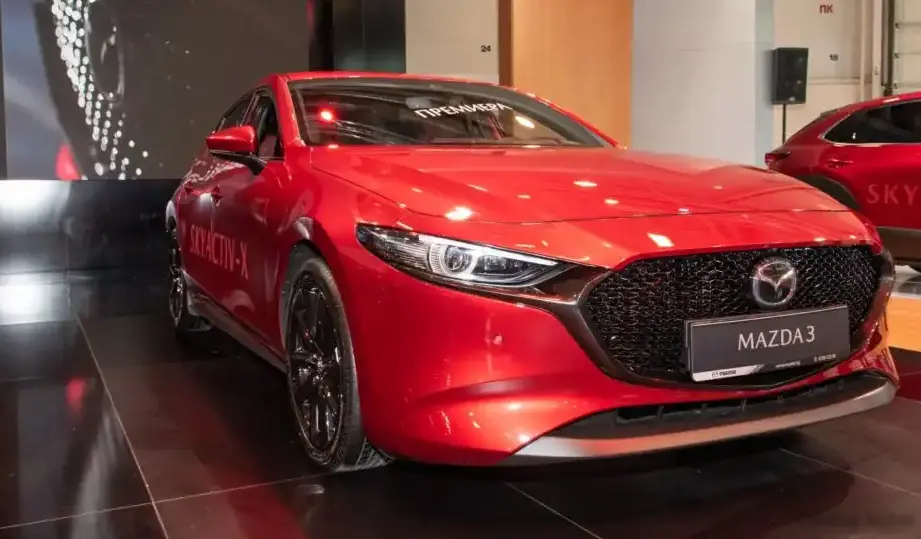
The Mazda 3 IV, launched in 2019, represented a significant departure from its predecessors, adopting a more sophisticated and premium design language. The 2.0 e-SkyActiv-G (122 Hp) Skyactiv-Drive variant, introduced in 2021, was a crucial part of this generation’s strategy. It utilized Mazda’s SkyActiv technology, focusing on efficiency and responsiveness. The “Skyactiv-Drive” designation specifically refers to the six-speed automatic transmission engineered for smooth and quick shifts. This model was positioned as a practical and well-equipped option for buyers seeking a comfortable and economical daily driver, particularly in markets where manual transmissions were less popular.
Powertrain & Engine Architecture
At the heart of this Mazda 3 variant lies the PE-VPH 2.0-liter inline-four cylinder engine. This engine is part of Mazda’s SkyActiv-G family, known for its high compression ratio (13:1) and direct injection system. The high compression ratio, achieved through careful engine design and precise fuel control, contributes to improved thermal efficiency and power output. The direct injection system ensures precise fuel delivery, optimizing combustion and reducing emissions. The engine also incorporates Mazda’s i-Stop start/stop system, further enhancing fuel economy in urban driving conditions. The mild-hybrid system, utilizing a small electric motor and battery, provides assistance during acceleration and regenerative braking, contributing to a slight improvement in fuel efficiency. The Skyactiv-Drive automatic transmission is a conventional torque-converter automatic, but with a focus on quick and seamless gear changes. It features six forward gears and is programmed to adapt to driving conditions and driver input.
Driving Characteristics
The 122 horsepower and 157 lb-ft of torque produced by this engine and transmission combination deliver adequate, but not exhilarating, performance. Acceleration from 0-60 mph takes around 10.3 seconds, and the top speed is 122.41 mph. The Skyactiv-Drive transmission is tuned for comfort and efficiency, prioritizing smooth shifts over aggressive downshifts. While it offers a manual shift mode, it’s not particularly sporty. Compared to the higher-output 2.5-liter engine option, this 2.0-liter variant feels noticeably less powerful, especially when fully loaded or tackling steep inclines. However, the engine is responsive enough for everyday driving, and the transmission effectively manages power delivery. The mild-hybrid system provides a subtle boost during acceleration, making the car feel more eager than its horsepower figure might suggest.
Equipment & Trim Levels
The 2.0 e-SkyActiv-G Skyactiv-Drive typically came standard with a respectable level of equipment. This included features like Mazda’s infotainment system with an 8.8-inch display, Apple CarPlay and Android Auto integration, a rearview camera, and a suite of safety features such as lane departure warning, lane-keep assist, and automatic emergency braking. Interior upholstery was typically cloth, with options for leatherette or full leather available as upgrades. Higher trim levels added features like a premium sound system, heated front seats, a sunroof, and adaptive cruise control. The dashboard layout was clean and modern, with a focus on driver ergonomics.
Chassis & Braking
The Mazda 3 IV utilizes a front-wheel-drive platform with an independent McPherson strut suspension in the front and a torsion beam suspension in the rear. This suspension setup provides a good balance between ride comfort and handling. The steering is precise and well-weighted, offering a connected feel to the road. Braking duties are handled by disc brakes on all four wheels, providing adequate stopping power. The ABS (Anti-lock Braking System) and electronic brake-force distribution are standard features, enhancing safety and stability. The chassis is relatively lightweight, contributing to the car’s nimble handling characteristics.
Market Reception & Comparison
The Mazda 3 IV, in general, received positive reviews from automotive critics, praised for its stylish design, refined interior, and engaging driving dynamics. The 2.0 e-SkyActiv-G Skyactiv-Drive variant was often seen as a sensible choice for buyers prioritizing fuel economy and comfort. Compared to the more powerful 2.5-liter engine option, it offered better fuel efficiency but at the expense of performance. Against competitors like the Volkswagen Golf, Ford Focus, and Hyundai i30, the Mazda 3 stood out with its premium feel and focus on driver engagement. Fuel economy figures were competitive, averaging around 38-39 mpg in combined driving conditions. Reliability reports have generally been positive, with the SkyActiv engine proving to be durable and dependable.
Legacy
The Mazda 3 IV 2.0 e-SkyActiv-G Skyactiv-Drive has established itself as a reliable and fuel-efficient compact hatchback in the used car market. The SkyActiv engine and transmission combination has proven to be durable, with relatively few reported issues. Its blend of practicality, comfort, and style continues to appeal to buyers seeking a well-rounded and dependable vehicle. While not the sportiest option in the Mazda 3 lineup, it remains a popular choice for those prioritizing everyday usability and long-term ownership costs. The mild-hybrid technology, while not a full hybrid system, demonstrates Mazda’s commitment to improving fuel efficiency and reducing emissions.