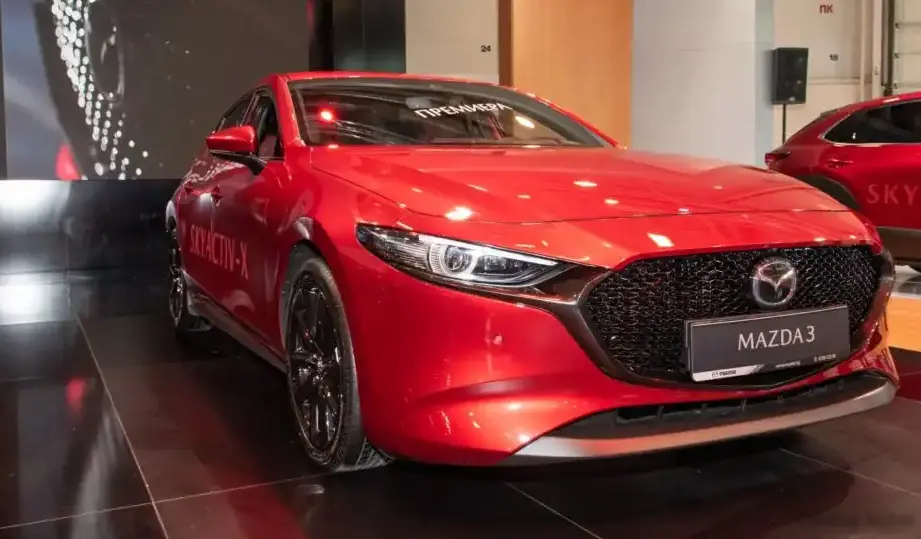
The Mazda 3 IV Hatchback 2.0 e-SkyActiv-X (186 Hp) represents a significant step forward in Mazda’s engineering, introduced in 2021 as part of the fourth generation (BP) Mazda 3 series. This variant, utilizing Mazda’s innovative e-SkyActiv-X technology, aimed to deliver the benefits of a gasoline engine with the efficiency closer to a diesel. Positioned as a mid-range offering within the broader Mazda 3 lineup, it bridged the gap between the more affordable base models and the higher-performance options. The 2.0 e-SkyActiv-X engine was designed to appeal to drivers seeking a balance of performance, fuel economy, and refinement in a compact hatchback package.
Technical Specifications
| Brand | Mazda |
| Model | 3 |
| Generation | IV Hatchback |
| Type (Engine) | 2.0 e-SkyActiv-X (186 Hp) |
| Start of production | 2021 |
| Powertrain Architecture | MHEV (Mild Hybrid) |
| Body type | Hatchback |
| Seats | 5 |
| Doors | 5 |
| Fuel consumption at Low speed (WLTP) | 6.5 l/100 km (36.2 US mpg) |
| Fuel consumption at Medium speed (WLTP) | 5.2-5.3 l/100 km (45.2 – 44.4 US mpg) |
| Fuel consumption at high speed (WLTP) | 4.6-4.7 l/100 km (51.1 – 50 US mpg) |
| Fuel consumption at very high speed (WLTP) | 5.4-5.6 l/100 km (43.6 – 42 US mpg) |
| Combined fuel consumption (WLTP) | 5.3-5.4 l/100 km (44.4 – 43.6 US mpg) |
| CO2 emissions (WLTP) | 118-121 g/km |
| Fuel consumption (economy) – urban | 5.6 l/100 km (42 US mpg) |
| Fuel consumption (economy) – extra urban | 4.2 l/100 km (56 US mpg) |
| Fuel consumption (economy) – combined | 4.7 l/100 km (50 US mpg) |
| CO2 emissions | 105-106 g/km |
| Fuel Type | Petrol (Gasoline) |
| Acceleration 0 – 100 km/h | 8.1 sec |
| Acceleration 0 – 62 mph | 8.1 sec |
| Acceleration 0 – 60 mph | 7.7 sec |
| Maximum speed | 216 km/h (134.22 mph) |
| Emission standard | Euro 6d-ISC-FCM |
| Weight-to-power ratio | 7.1 kg/Hp |
| Weight-to-torque ratio | 5.5 kg/Nm |
| Power | 186 Hp @ 6000 rpm |
| Torque | 240 Nm @ 4000 rpm (177.01 lb.-ft. @ 4000 rpm) |
| Engine layout | Front, Transverse |
| Engine displacement | 1998 cm3 (121.93 cu. in.) |
| Number of cylinders | 4 |
| Engine configuration | Inline |
| Cylinder Bore | 83.5 mm (3.29 in.) |
| Piston Stroke | 91.2 mm (3.59 in.) |
| Compression ratio | 15:1 |
| Number of valves per cylinder | 4 |
| Fuel injection system | Direct injection |
| Engine aspiration | Naturally aspirated |
| Engine systems | Start & Stop System, Particulate filter |
| Kerb Weight | 1320-1411 kg (2910.1 – 3110.72 lbs.) |
| Max. weight | 1929 kg (4252.72 lbs.) |
| Max load | 518-609 kg (1141.99 – 1342.62 lbs.) |
| Trunk (boot) space – minimum | 351 l (12.4 cu. ft.) |
| Trunk (boot) space – maximum | 1026 l (36.23 cu. ft.) |
| Fuel tank capacity | 51 l (13.47 US gal | 11.22 UK gal) |
| Max. roof load | 75 kg (165.35 lbs.) |
| Permitted trailer load with brakes (8%) | 1300 kg (2866.01 lbs.) |
| Permitted trailer load with brakes (12%) | 1300 kg (2866.01 lbs.) |
| Permitted trailer load without brakes | 600 kg (1322.77 lbs.) |
| Permitted towbar download | 75 kg (165.35 lbs.) |
| Length | 4460 mm (175.59 in.) |
| Width | 1795 mm (70.67 in.) |
| Width including mirrors | 2028 mm (79.84 in.) |
| Height | 1435 mm (56.5 in.) |
| Wheelbase | 2725 mm (107.28 in.) |
| Ride height (ground clearance) | 135 mm (5.31 in.) |
| Minimum turning circle | 10.6 m (34.78 ft.) |
| Drivetrain Architecture | ICE to Front Wheels, MHEV |
| Drive wheel | Front wheel drive |
| Number of gears | 6 |
| Type of gearbox | Manual transmission |
| Front suspension | Independent type McPherson |
| Rear suspension | Torsion |
| Front brakes | Disc |
| Rear brakes | Disc |
| Assisting systems | ABS |
| Steering type | Steering rack and pinion |
| Power steering | Electric |
| Tires size | 205/60 R16; 215/45 R18 |
| Wheel rims size | 16; 18 |
Powertrain & Engine Architecture
The heart of this Mazda 3 variant is the 2.0-liter e-SkyActiv-X engine, designated as part of the P5-VPS engine family. This engine is notable for its use of Spark Controlled Compression Ignition (SPCCI), a technology that aims to combine the efficiency of a diesel engine with the clean emissions of a gasoline engine. Unlike traditional gasoline engines that rely on spark plugs to ignite the air-fuel mixture, the e-SkyActiv-X uses a small initial spark to initiate compression ignition. This allows for leaner combustion, resulting in improved fuel economy and reduced CO2 emissions. The engine features direct injection and a high compression ratio of 15:1. The mild-hybrid system, consisting of a 24V electrical system and an integrated starter generator, provides a small amount of electric assistance during acceleration and enables smoother start-stop functionality. The engine is paired with a 6-speed manual transmission, delivering power to the front wheels.
Driving Characteristics
The 186 hp and 177 lb-ft of torque produced by the 2.0 e-SkyActiv-X engine provide adequate performance for everyday driving. Acceleration from 0 to 60 mph takes approximately 7.7 seconds. While not a particularly sporty setup, the engine delivers a linear power delivery, making it easy to modulate. The manual transmission offers precise shifts, and the overall driving experience is characterized by Mazda’s focus on driver engagement. Compared to higher-output engine options in the Mazda 3 range, such as the 2.5-liter naturally aspirated engine, the e-SkyActiv-X prioritizes fuel efficiency over outright performance. The gear ratios are tuned to maximize fuel economy, which can sometimes result in the engine feeling slightly strained during aggressive acceleration or when fully loaded.
Equipment & Trim Levels
The 2.0 e-SkyActiv-X trim typically included standard features such as Mazda’s infotainment system with an 8.8-inch display, Apple CarPlay and Android Auto integration, a rearview camera, and a suite of advanced safety features including adaptive cruise control, lane departure warning, and automatic emergency braking. Interior upholstery was typically cloth, with options for leatherette or full leather available as upgrades. Higher trim levels added features like a premium sound system, heated front seats, and a power sunroof. The overall interior design emphasized a minimalist aesthetic with high-quality materials and a focus on ergonomics.
Chassis & Braking
The Mazda 3 IV Hatchback utilizes a front-wheel-drive platform with an independent McPherson strut suspension in the front and a torsion beam suspension in the rear. The chassis is designed to provide a balance of ride comfort and handling agility. Disc brakes are fitted on all four wheels, providing adequate stopping power. The steering system is an electric power-assisted rack and pinion system, offering precise and responsive steering feel. Stabilizer bars are included on both the front and rear axles to reduce body roll during cornering.
Market Reception & Comparison
The Mazda 3 IV Hatchback 2.0 e-SkyActiv-X received generally positive reviews from automotive critics. It was praised for its innovative engine technology, fuel efficiency, and engaging driving dynamics. However, some reviewers noted that the engine could feel slightly underpowered in certain situations. Compared to other trims in the Mazda 3 lineup, the e-SkyActiv-X offered a compelling alternative for drivers prioritizing fuel economy and environmental consciousness. It provided a noticeable improvement in fuel efficiency compared to the 2.5-liter gasoline engine, while still delivering a respectable level of performance.
Legacy
The 2.0 e-SkyActiv-X engine represents a significant milestone in Mazda’s pursuit of innovative powertrain technology. While the SPCCI technology has faced some challenges in terms of real-world emissions performance and long-term durability, it remains a testament to Mazda’s engineering prowess. In the used car market, the Mazda 3 IV Hatchback 2.0 e-SkyActiv-X is generally considered a reliable and fuel-efficient option. Regular maintenance, including oil changes and spark plug replacements, is crucial to ensure the longevity of the engine and its SPCCI system. The mild-hybrid system has also proven to be relatively reliable, with few reported issues.